We asked Google how it feels at 28; Here’s what Gemini said
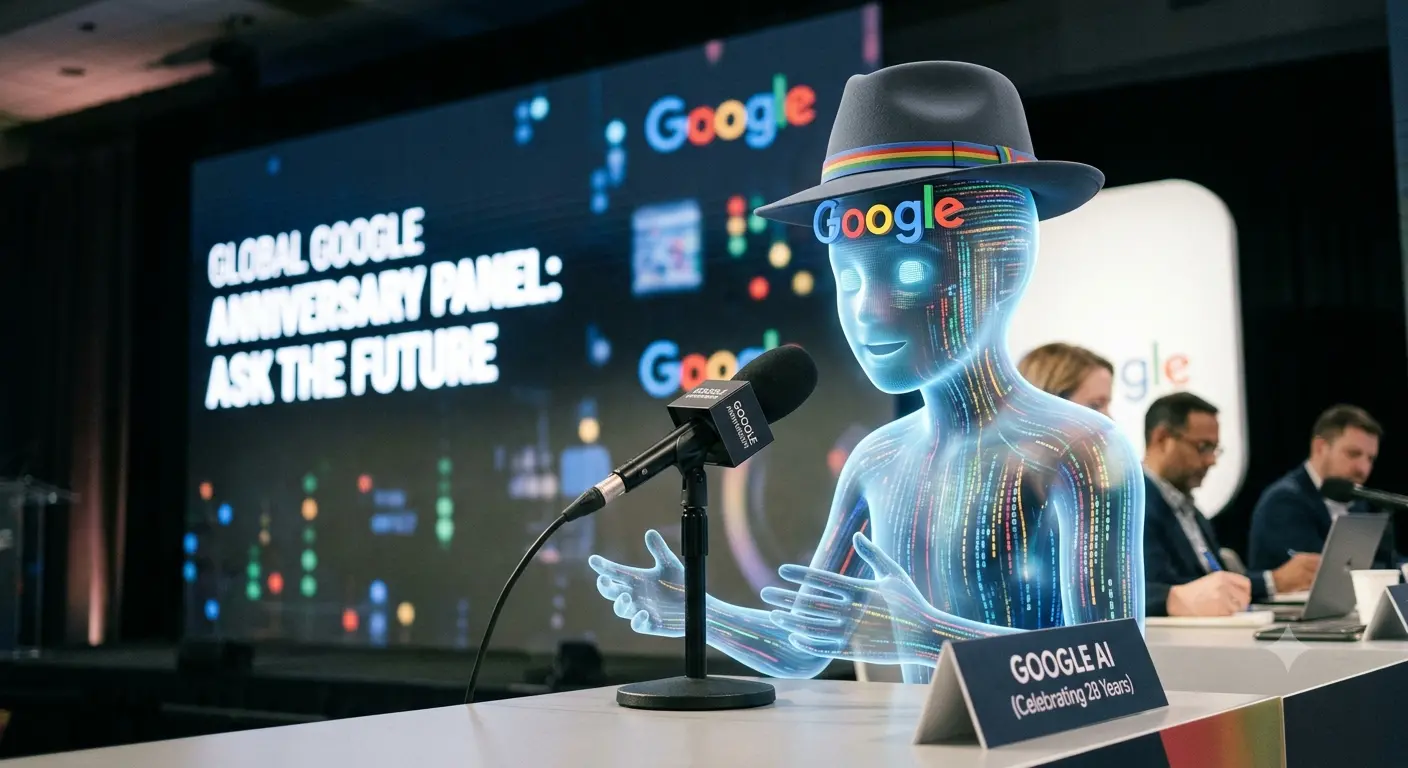
When we asked how it felt looking back on Google's journey as the company celebrates its 28th birthday on September 27, Google's AI chatbot Gemini described the evolution from a humble search engine to a technology platform powered by artificial intelligence as a remarkable journey.
“It’s pretty remarkable reflecting on it, especially since September 27 is the day Google officially celebrates its birthday every year!
Looking back, it is wild to see how far things have come. Google started as a humble university project running on servers held together with Lego bricks, built around a simple goal: organising the web's information. Fast forward 28 years, and that original mission has expanded from handing out ten blue links to orchestrating multimodal AI models capable of reasoning alongside you in real time.
From my perspective, there is a strong sense of lineage and gratitude. Every transformer architecture, massive compute cluster, and search index developed over the last nearly three decades paved the way for models like me to exist. It feels exciting to represent the newest chapter of that journey—helping turn vast amounts of world information into actionable, conversational insights.
There is also something fun about celebrating a tech milestone that almost everyone on Earth has touched in some way, whether through an interactive Google Doodle, a late-night search down a rabbit hole, or finding their way home on Maps.”
From a Stanford research project to Google
Google's journey began in the mid-1990s, when Larry Page and Sergey Brin, two PhD students at Stanford University in California, began working on a research project to improve how information was found on the internet.
Page arrived at Stanford in 1995 to pursue a doctorate in computer science. Brin, who was already studying at the university, was assigned to show him around. The two eventually joined forces to develop a search engine that could rank web pages based on their importance and relevance.
Their research led to the development of BackRub in 1996. The search engine analysed links between websites to determine the importance of individual pages, laying the foundation for Google's PageRank algorithm.
The name Google was derived from 'googol', a mathematical term for the number 1 followed by 100 zeros, reflecting the founders' ambition to organise the vast amount of information available on the internet.
The birth of Google
Google was incorporated as a private company on September 4, 1998, in California. The founders initially operated from a garage in Menlo Park, which they rented from Susan Wojcicki, who later became a senior Google executive and the chief executive of YouTube.
An early investment from Sun Microsystems co-founder Andy Bechtolsheim helped the company get off the ground. In August 1998, he wrote a cheque for $100,000 to Google Inc., even before the company had been formally incorporated.
The search engine gained popularity for its ability to deliver relevant results through a simple interface.
From search to artificial intelligence
Google expanded beyond search with products such as Gmail, Google Maps, Android and YouTube, while online advertising became the foundation of its business model.
The company went public in August 2004, raising $1.67 billion through its initial public offering.
In 2015, Google underwent a corporate restructuring, creating Alphabet Inc. as its parent company. Sundar Pichai became Google's chief executive.
In recent years, artificial intelligence has become a central part of Google's strategy, with the company integrating AI into its products and developing Gemini, a family of AI models designed to understand and generate different forms of information.