Meteor hit Cleveland Ohio: 7-ton fireball at 45,000 mph lights up sky; boom shakes homes | VIDEO
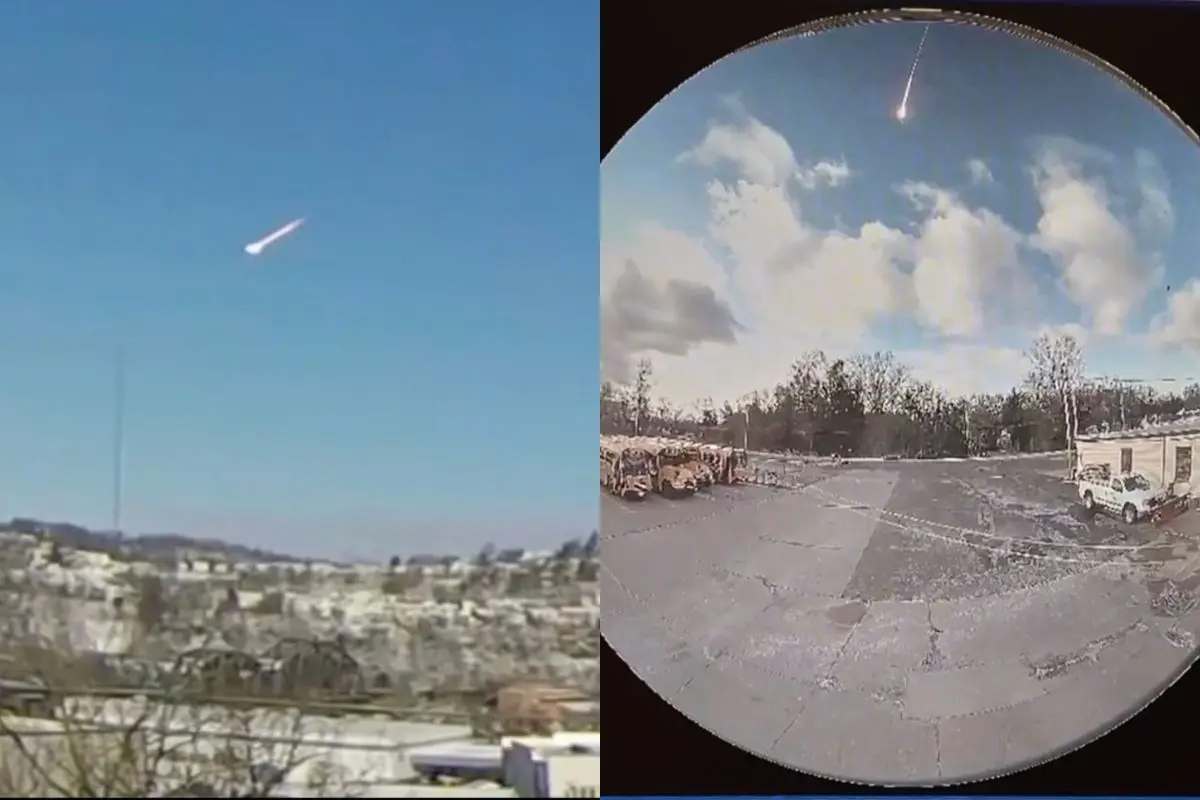
A bright fireball streaked across skies over northeast Ohio on Tuesday morning, startling residents with a loud boom and shaking homes, in what scientists say was a meteor tearing through Earth’s atmosphere at extraordinary speed.
The event, witnessed across multiple US states and parts of Canada, was captured on video and detected by satellites, with officials linking the blast-like sound to the meteor’s rapid entry and fragmentation high above the region.
The US National Weather Service said the phenomenon was likely a meteor, after a “fireball” was widely reported over eastern Ohio and western Pennsylvania.
"Satellite imagery suggested this could have been a meteor entering Earth's atmosphere, as it appears the fireball was detected around the Cleveland area," the weather service said in a Facebook post.
Fireball tracked across multiple states
According to NASA, the meteor was first detected at about 8:57 a.m. local time near Lake Erie, off the coast of Lorain, Ohio. Travelling at speeds of around 40,000 miles per hour, it cut a path of more than 34 miles through the upper atmosphere before breaking apart.
Eyewitnesses reported seeing the blazing object across a wide area, including Ohio, Pennsylvania, New York, Michigan and as far as Ontario in Canada. Additional sightings came from Delaware, Illinois, Indiana, Kentucky, Maryland, Virginia and Washington, D.C.
The American Meteor Society received numerous reports, while both ground cameras and a geostationary weather satellite recorded the event.
Sonic boom rattles homes
As the object fragmented roughly 30 miles above Medina County, it released a powerful pressure wave equivalent to about 250 tonnes of TNT, according to NASA. The resulting shockwave produced a loud boom that was heard across the region and caused noticeable vibrations.
Residents compared the sound to an explosion, while National Weather Service staff in Cleveland also reported hearing the blast and feeling the tremors. No injuries or damage have been confirmed.
Scientists said such booms occur when meteors enter the atmosphere at extreme speeds and rapidly decelerate.
"Because this meteor traveled so high in the atmosphere, people for a hundred miles around were able to see it. As it hit the atmosphere at about 50 times the speed of sound, it was like hitting a brick wall, it just exploded. The resulting sonic boom is part of what you hear as the pieces slow down."
Size and nature of the object
NASA estimated the object to be about 6 feet (roughly 1.8 metres) in diameter and weighing around seven tonnes, roughly comparable to the size of a small car.
Experts believe fragments may have survived the descent and fallen as meteorites, although no debris had been immediately recovered.
"There could be some small fragments, but a lot of it would have burned up in the atmosphere,” NWS meteorologist Brian Mitchell said.
Astronomers noted that while objects enter Earth’s atmosphere frequently, events of this scale over populated areas are uncommon.
"This one really does look like it’s a fireball, which means it’s a meteorite, a small asteroid," said astronomer Carl Hergenrother, adding that such bright events are rarely caused by re-entering satellites.
What causes a meteor?
Meteors occur when fragments of asteroids or space rock enter Earth’s atmosphere at high speed and burn due to friction, producing a bright streak of light often referred to as a fireball.
The Ohio object travelled tens of miles through the atmosphere before disintegrating, with surviving pieces continuing southward as smaller fragments.
“That’s a rocky or metal piece, a fragment that’s floating through space, that comes in contact with our atmosphere; it’s that friction that creates that streak of light that we see,” said JonDarr Bradshaw of the Great Lakes Science Center.
Rare but not unusual
Scientists say meteors strike Earth’s atmosphere daily, but most go unnoticed as they occur over oceans or sparsely populated areas.
Ralph Harvey, a geology professor, told USA today that such events happen several times a day globally, but are rarely witnessed on this scale.
The relatively small size of the asteroid also explains why it was not detected in advance. NASA has only tracked a handful of such objects before they entered the atmosphere.
What to do if you find a meteorite
Authorities say meteorites pose no danger to people, but should be handled carefully to preserve their scientific value.
Experts advise against touching them with bare hands, as oils and moisture can damage their surface. Instead, they should be picked up using gloves or wrapped in clean aluminium foil and stored in a dry, sealed container.
Astronomers described the incident as an unusual and memorable experience for those who witnessed it.
“A shared experience, the sound of meteors, something from space coming in,” told astronomer Jay Reynolds to 19 News. “It’s a big deal. How often does this happen, very rarely.”