PSLV-C62 mission encounters anomaly during end of the PS3 stage: ISRO
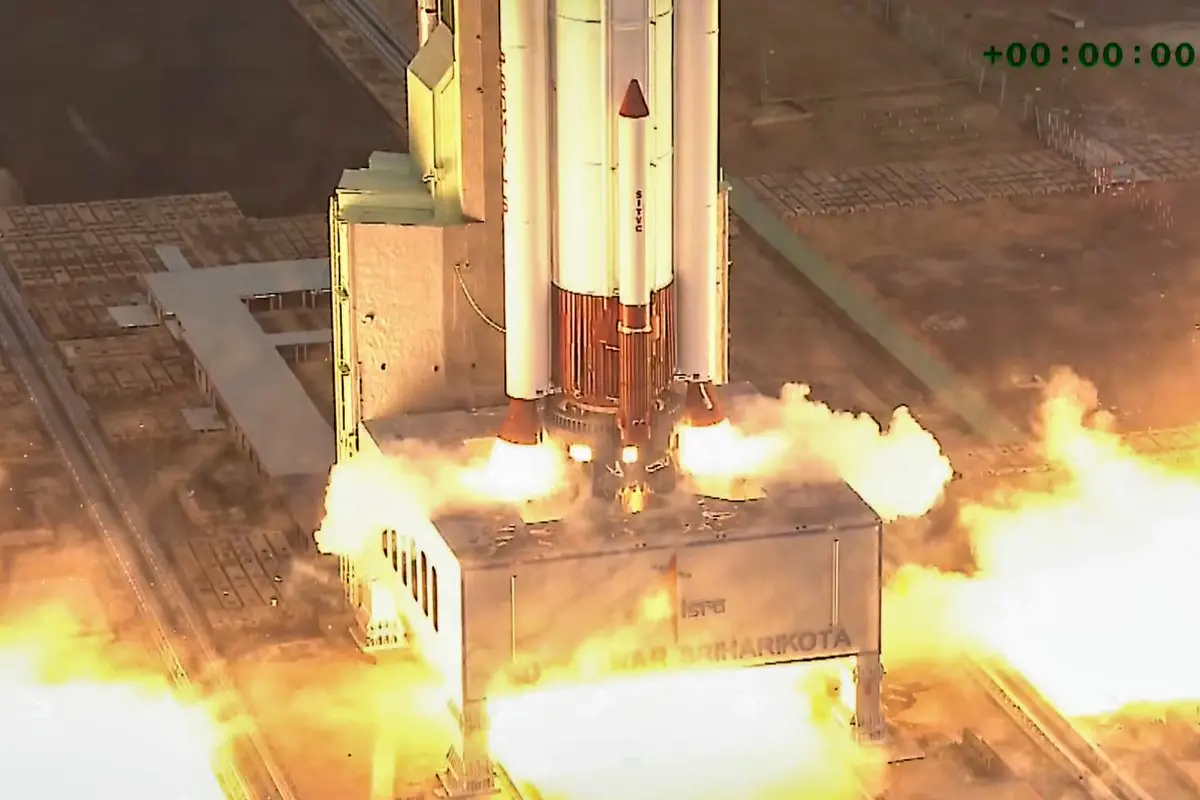
Sriharikota: The Indian Space Research Organisation (ISRO) on Monday said that the PSLV-C62 rocket carrying the EOS-N1 earth observation satellite and 14 co-passenger satellites reportedly experienced a deviation in its flight path. The ISRO chief said the agency is closely analysing the situation.
The 44.4 metre tall four-stage rocket lifted off as scheduled at 10.18 am from the spaceport here. The mission was intended to place a primary Earth Observation satellite and multiple co-passenger satellites into a 512 km Sun-Synchronous Orbit.
According to ISRO, the first two stages performed within expected parameters, and at the end of the third stage (PS3), the vehicle experienced "disturbances". Addressing the team at the Mission Control Centre here, ISRO chief Narayanan said, "The PSLV is a four-stage vehicle with two solid stages and two liquid stages. The performance of the vehicle up to the end of the third stage was expected. Close to the end of the third stage we are seeing more disturbance in the vehicle and subsequently, there was a deviation observed in the flight path."
"We are analysing the data and we shall come back at the earliest," he said.
Taking to X (formerly Twitter), ISRO said, “The PSLV-C62 mission encountered an anomaly during end of the PS3 stage. A detailed analysis has been initiated.”
This mission marked the space agency’s first launch of the year and was carried out by NewSpace India Ltd (NSIL), ISRO’s commercial arm. The 14 secondary payloads came from a wide range of domestic and international customers.
The EOS-N1 and 14 co-passengers are planned for injection into Sun Synchronous Orbit; the KID capsule is planned for a re-entry trajectory.
The PSLV’s high-performance solid third stage (HPS3) has now detached successfully, the very unit that led to disappointment in 2025.
At a height of 116 km, the rocket has released its protective nose cone, allowing Anvesha and its 15 international payloads to face space for the first time as extra mass is discarded.
The lift-off of the PSLV-C62 rocket, with a lift off mass of 260 tonne, was rescheduled to 10:18:30 hrs on January 12 from the earlier 10:17 hrs on Monday, ISRO said.
Satellite deployment plan
The PSLV-C62/EOS-N1 mission would initially deploy the Earth Observation Satellite built by Thailand and the United Kingdom, followed by 13 other co-passenger satellites into the sun-synchronous orbit around 17 minutes after lift-off.
KID capsule and PS4 demonstration
Subsequently, the separation of the fourth stage of the rocket (PS4) and demonstration of Kestrel Initial Technology Demonstrator (KID) capsule, weighing about 25 kg and belonging to a Spanish startup, are expected to take place over 2 hours after the launch.
According to ISRO, scientists would restart the fourth stage of the rocket to demonstrate the KID capsule to make its re-entry into the earth atmosphere.
For this to occur, the scientists would re-start the fourth stage to de-boost and enter a re-entry trajectory, and this will be followed by the KID capsule separation.
Both the PS4 stage and the KID capsule (which will be the last co-passenger) will re-enter the Earth's atmosphere and make a splashdown in the South Pacific Ocean, ISRO said.
PSLV track record
PSLV has completed 63 flights so far, including the ambitious Chandrayaan-1, Mars Orbiter Mission (MOM), and Aditya-L1 mission.
The previous launch of a PSLV rocket, was the PSLV C-61 Earth Observation Satellite 09 mission launched on May 18, 2025. It could not be accomplished due to an 'observation' in the third stage of the rocket.
(with inputs from PTI)