Meet Dr Nikku Madhusudhan: The Indian-origin scientist behind life discovery on K2-18b
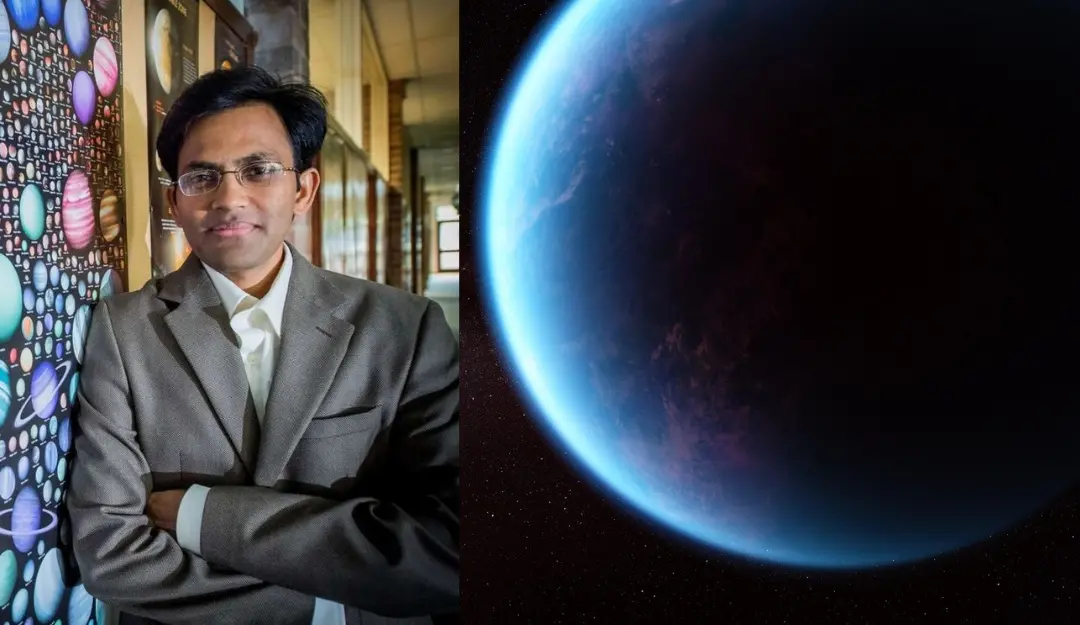
Washington DC: In a groundbreaking development in the search for extraterrestrial life, Indian-origin astrophysicist Dr Nikku Madhusudhan and his team have detected a molecule on a distant exoplanet that could signal biological activity.
Using data from the James Webb Space Telescope (JWST), the researchers observed the presence of dimethyl sulfide (DMS) in the atmosphere of K2-18b, a planet located 120 light-years from Earth. On Earth, DMS is exclusively produced by living organisms, primarily marine algae, making its detection a possible biosignature.
Dr Madhusudhan, born in India in 1980, completed his engineering degree at the Indian Institute of Technology (BHU), Varanasi, and earned his master’s and PhD in planetary science at the Massachusetts Institute of Technology (MIT), where he studied under noted exoplanet expert Dr Sara Seager. He is currently a professor at the University of Cambridge and is internationally recognised for introducing the concept of “Hycean planets”—ocean-covered worlds with hydrogen-rich atmospheres that may support life.
K2-18b, classified as a “sub-Neptune,” is larger than Earth but smaller than Neptune and orbits a cool dwarf star. It was first identified in 2017. In 2021, Dr Madhusudhan proposed that such planets could sustain life under the right atmospheric and oceanic conditions. The detection of DMS, alongside methane and carbon dioxide in the planet’s atmosphere, strengthens this hypothesis.
“This is a revolutionary moment. It’s the first time humanity has seen potential biosignatures on a habitable planet,” Dr Madhusudhan said at a recent press briefing. However, he cautioned against jumping to conclusions: “It is in no one’s interest to claim prematurely that we have detected life. Still, the best explanation for our observations is that K2-18b is covered with a warm ocean, brimming with life.”
These findings, published in Astrophysical Journal Letters, renew scientific curiosity around the Fermi Paradox—the contradiction between the high probability of extraterrestrial life and the lack of direct evidence. While the detection of DMS doesn't confirm life, it adds to a growing body of evidence suggesting we may not be alone in the universe.
Further analysis of K2-18b using the JWST is planned, along with future missions by next-generation observatories. Dr Madhusudhan’s work has opened a new chapter in the study of potentially habitable worlds, offering a tantalising glimpse into life beyond Earth and redefining humanity’s quest to understand its place in the cosmos.