Partner, not patron: India's high-stakes bid for space autonomy
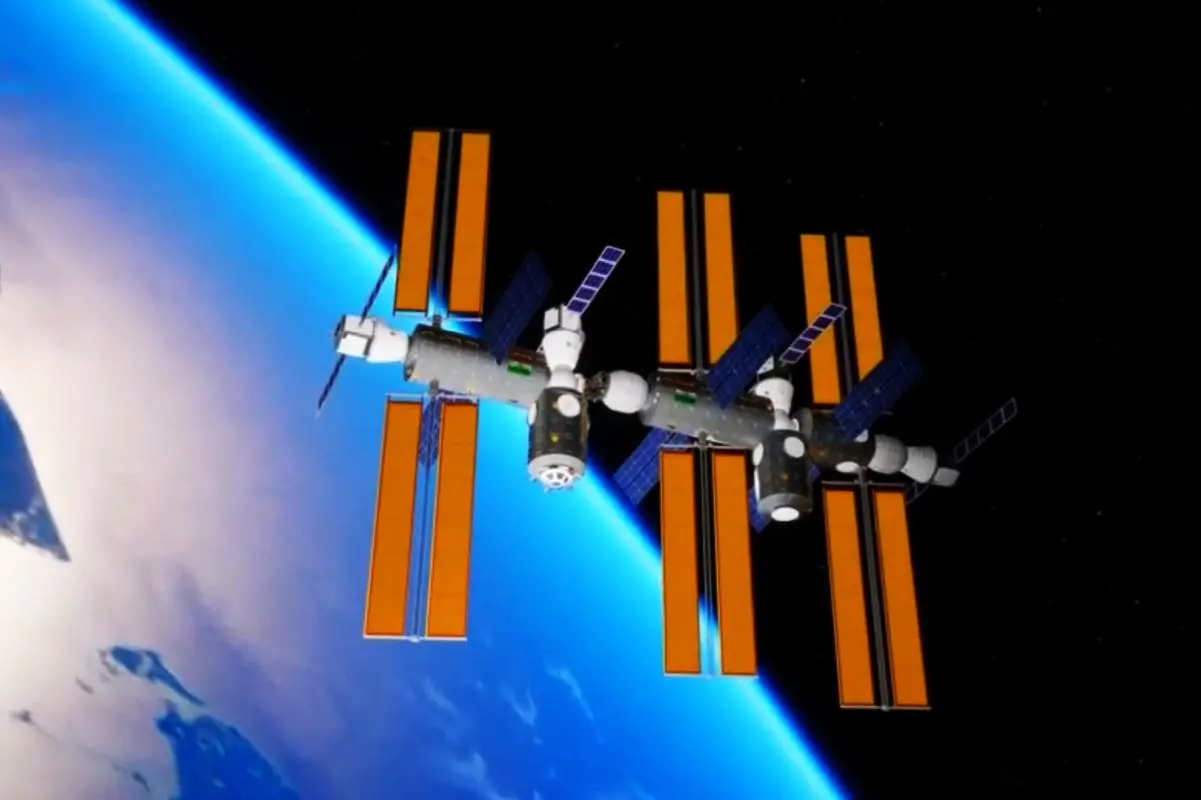
When Prime Minister Narendra Modi unveiled the model of India's Bharatiya Antariksh Station on National Space Day this August, it wasn't just a showpiece moment. It was a calculated signal to the world: India wants American technology and partnerships, but it refuses to become anyone's junior partner in space.
This balancing act -- joining the US-led Artemis Accords while simultaneously building its own space station -- reveals the complexities of India's emerging space diplomacy in an era where the cosmos has become another battleground for great power rivalry.
The timing of India's space ambitions is particularly telling. Just two years after joining the Artemis Accords in June 2023, a US-led framework signed by over 40 nations to establish rules for lunar exploration, India announced plans to launch the first module of its own space station by 2028. This isn't contradictory; it's strategic.
Through Artemis, India gains access to NASA's advanced radar technology like NISAR, sends astronauts to train on the International Space Station, and positions itself as a credible player in global space governance. The Axiom-4 mission carrying Indian astronaut Shubhanshu Shukla exemplifies these benefits -- experience that would cost India decades and billions to acquire independently.
Yet the BAS project tells a different story. It announces that despite Western partnerships, India will not surrender control over its human spaceflight program. This matters because space stations represent more than scientific achievement; they symbolize permanent presence and independence in orbit.
By planning its own station, India joins an exclusive club currently limited to the US, Russia, and China. More importantly, it creates insurance against the unpredictability of international politics. If tomorrow's geopolitical tensions force nations to choose sides, India wants its own lifeboat in orbit.
This dual approach reflects decades of learned behavior. During the Cold War, India mastered the art of extracting technology from both superpowers while remaining genuinely nonaligned.
The Soviet Union launched India's first satellite Aryabhata in 1975 and sent Rakesh Sharma to space, while India simultaneously courted Western partners. When US sanctions hit in the 1990s over alleged weapons technology transfers, India didn't collapse -- it doubled down on self-reliance and built the PSLV rocket system that became its workhorse. Those lessons shaped today's multi-alignment strategy: work with everyone, depend on no one completely.
According to analysis from The Diplomat, this balancing becomes particularly delicate when considering resource extraction on the Moon. India has consistently advocated that space belongs to all humanity, not just wealthy nations capable of mining lunar resources. This principle puts India in an awkward position within Artemis, which many developing nations view as a framework designed to legitimize commercial exploitation by spacefaring powers.
As the voice of the Global South at the United Nations Committee on the Peaceful Uses of Outer Space, India must represent countries in Africa, Latin America, and Southeast Asia who fear being locked out of the space economy. If India appears too aligned with Washington's commercial interests, it loses credibility as an advocate for equitable access to space.
The financial mathematics of India's ambitions reveal the scale of the challenge. Operating a space station costs approximately $3 billion (₹26,400 crore) annually, based on NASA's ISS expenditures. ISRO's entire annual budget hovers around $1.7 billion (₹14,960 crore).
Even with the government's ₹500 crore Technology Adoption Fund and relaxed foreign investment rules, private funding dropped 55% in 2024, falling from $130 million (₹1,146 crore) to just $59 million (₹520 crore). Without sustained government commitment and guaranteed purchase orders from ISRO and defense agencies, the BAS risks becoming an expensive symbol rather than a functional orbital laboratory.
The frugal innovation (achieving great results with limited resources) that made missions like Chandrayaan-3 globally celebrated -- achieving results at a fraction of Western costs -- faces a different test when building infrastructure for permanent human habitation in space.
Technology gaps compound these financial pressures. Despite Artemis membership, US export control laws like ITAR restrict India's access to critical systems in avionics, propulsion, and deep-space communication. India must either develop these capabilities domestically -- a time-consuming and expensive process -- or negotiate special technology transfer agreements that may come with strings attached.
The workforce challenge is equally real. India graduates thousands of engineers annually, but only a handful specialize in cryogenics, life-support systems, or space robotics -- the precise skills needed to make BAS operational. Building this expertise pipeline takes years of focused investment in education and training programs that barely exist today.
The geopolitical environment adds another layer of complexity. As The Diplomat notes in its coverage of India's space strategy, escalating U.S.-China competition over lunar resources and cislunar security could force India into uncomfortable choices.
The China-Russia International Lunar Research Station represents an alternative pole of attraction, though India has carefully maintained distance from it. If tensions intensify and the Artemis coalition demands clearer alignment as the price of continued cooperation, India's balancing act becomes exponentially harder.
Yet abandoning strategic autonomy entirely would contradict decades of foreign policy and alienate Global South nations who see India as their representative in space governance.
Three scenarios loom for the next decade. India could drift toward deeper Artemis integration, with BAS becoming a delayed or scaled-back project as NASA partnerships dominate mission planning. Alternatively, India could prioritize BAS through sheer political will and industrial mobilization, emerging as an independent third pole between American and Chinese space programs. The most likely outcome, however, is continued balancing -- leveraging Artemis for technology and training while maintaining BAS as a symbol and statement of independence, even if timelines slip and capabilities fall short of initial ambitions.
What makes India's position unique is its potential role as a bridge power. Unlike China, which many nations view with suspicion, India carries no historical baggage of space imperialism. Its reputation for cost-effective innovation and willingness to share satellite data with developing countries creates trust. If India can maintain credibility as both an Artemis participant and an advocate for equitable space governance, it could shape international rules in ways that balance commercial interests with broader access.
The success of this strategy ultimately depends not on choosing between independence and partnership, but on managing the tension between them skillfully.
India needs Artemis for the technology leap it provides, but it needs BAS to ensure it never becomes dependent on any single power's goodwill. In a world where space increasingly mirrors earthly geopolitics, India's ability to walk this tightrope may determine whether it becomes a rule-maker in the cosmos or just another participant following rules written by others. The model unveiled on National Space Day represents more than engineering ambition – it's a diplomatic statement that India intends to chart its own course among the stars, partnerships notwithstanding.