The final supermoon of 2025 is here — and it’s brighter than anything you’ve seen!
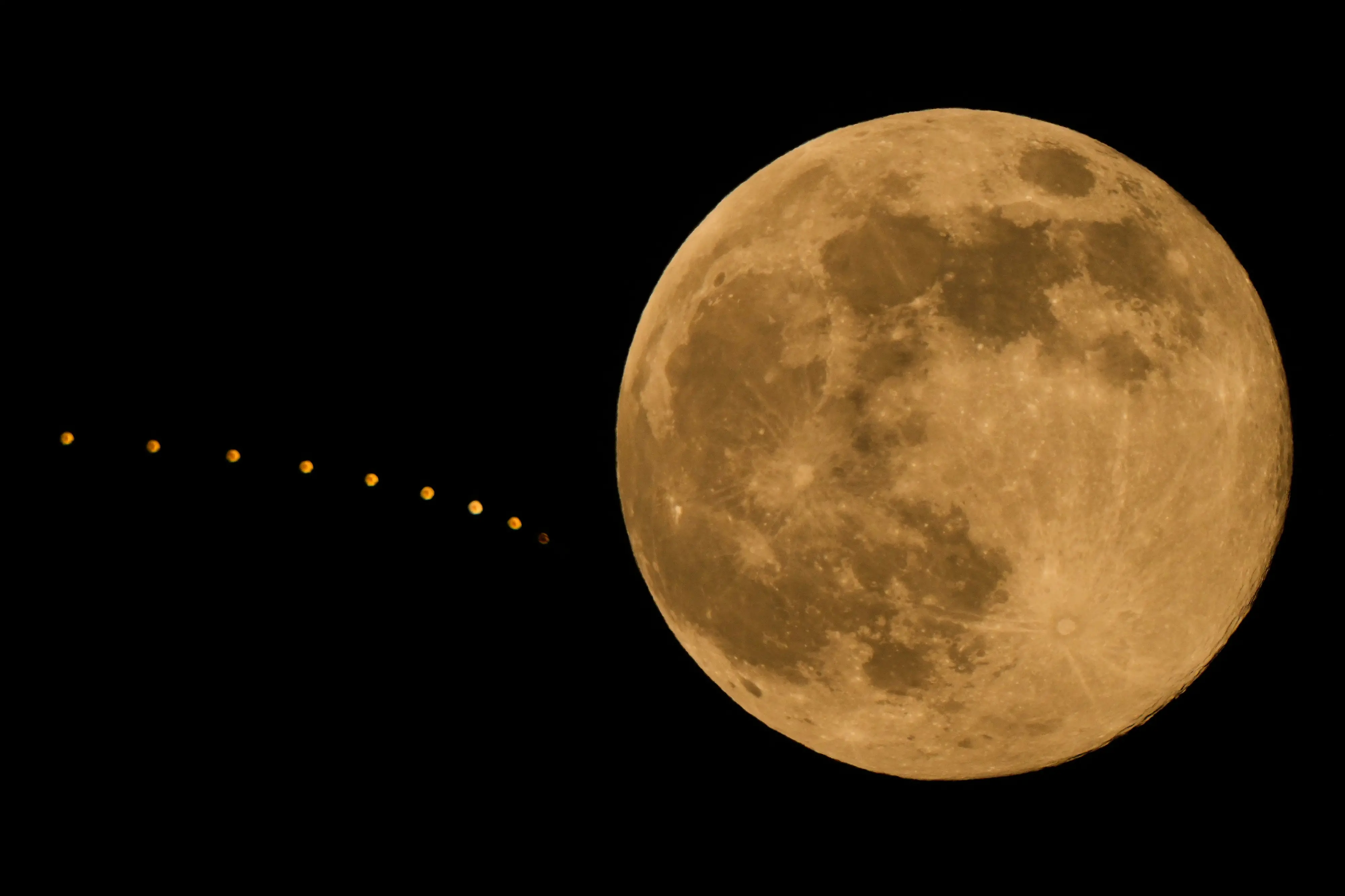
The final full supermoon of 2025, called the Cold Moon, lit up the skies across the United States on December 4 local time (early December 5 IST), marking a brilliant conclusion to this year’s lunar display. Peak illumination occurred around 6:14–6:15 pm EST (4:44–4:45 am IST, December 5), according to the U.S. Naval Observatory.
The Cold Moon, the third and last supermoon of the year, reached a perigee distance of roughly 221,965 miles from Earth, making it appear slightly larger and up to 30% brighter than a typical full moon. Clear late-autumn weather across many regions of the US enhanced the viewing experience. An optical effect known as the “moon illusion” made the rising moon appear even bigger, particularly striking on the horizon.
Major US cities witnessed prominent moonrises as follows: New York at 4:56 pm EST, Los Angeles at 5:27 pm PST. The moon remained bright into early December 5 (IST) for international observers, including India, where the event occurred before dawn.
A supermoon occurs when a full moon coincides with the Moon’s closest approach to Earth in its elliptical orbit, known as perigee. NASA notes that supermoons can appear up to 14% larger and 30% brighter than usual full moons. The Cold Moon also earned its name due to its timing near the winter solstice, the shortest day of the year in the Northern Hemisphere.
This year’s Cold Moon was visible not only in the US but also in several countries worldwide, including Pakistan, Chile, Mexico, and Panama, where the moon illuminated iconic skylines and natural landscapes. Skywatchers captured stunning images of the supermoon behind cityscapes, mountains, and waterways.
For those who missed this year’s final supermoon, astronomers have noted that three more supermoons are expected in 2026, offering future opportunities to witness similar celestial spectacles.
The Cold Moon, the last supermoon of 2025, served as the finale to a year of remarkable lunar events. Unlike ordinary full moons, supermoons occur when the moon is at its closest point to Earth in its elliptical orbit, or perigee, making them appear brighter and larger in the sky.
Observers in the United States experienced a clear view of the phenomenon on the evening of December 4, local time. The moon reached its peak brightness at approximately 6:14–6:15 pm EST, corresponding to early morning hours in India on December 5. Late-autumn clear skies enhanced visibility, allowing enthusiasts to enjoy an unobstructed celestial display.
The Cold Moon has cultural significance as well, deriving its name from the Mohawk and Mohican traditions. Historically, it symbolised the arrival of harsh winter nights, also referred to as the Long Night Moon.
Astronomers and space agencies, including NASA, explained that supermoons can appear up to 14% larger and 30% brighter than typical full moons. The 2025 Cold Moon’s slightly closer perigee, approximately 221,965 miles from Earth, made it particularly prominent. Photographers captured the moon rising behind mountains, city skylines, and waterfronts in countries across the globe, including Los Angeles, Mexico City, Panama City, Punta Arenas in Chile, and Karachi.
For enthusiasts who missed the Cold Moon, three additional supermoons are predicted in 2026, offering further opportunities to observe this striking astronomical phenomenon. The Cold Moon marked a fitting end to the 2025 lunar calendar, blending scientific significance with cultural symbolism and stunning visual appeal.