Explainer: How Proba-3 will unlock mysteries of the Sun's corona
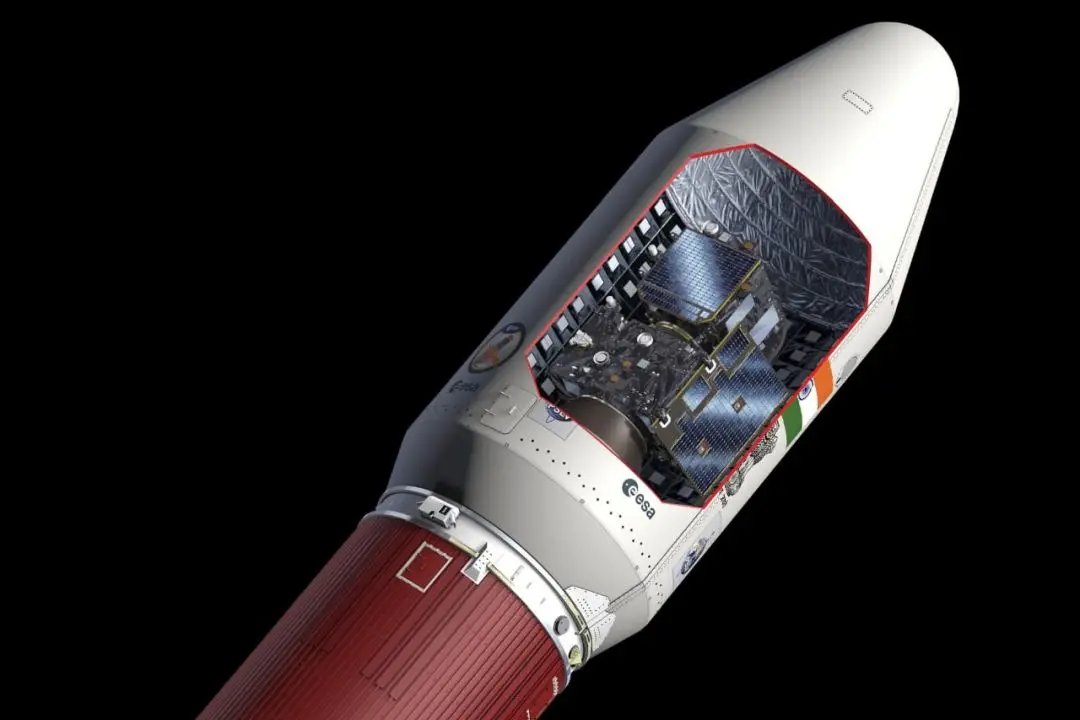
European Space Agency's groundbreaking Proba-3 mission, designed to create artificial eclipses through precise formation flying, is almost ready to launch! It is set to take off on Wednesday, 4 December, at 16:08 IST. The launch will use a PSLV-XL rocket from the Satish Dhawan Space Centre in Sriharikota, India. This mission will demonstrate advanced space technology while helping scientists study the Sun in new ways.
The satellite is expected to separate from the rocket about 18 minutes after launch. Around 15 minutes later, the flight control team at ESA's 'European Space Security and Education Centre' (ESEC) in Redu, Belgium, will receive the first signal from the satellite.
The Proba-3 Mission Objective
Proba-3, the newest mission in ESA's series of in-orbit demonstration projects, involves two satellites being launched together. Once in space, they will separate and start working together using extremely precise formation flying, accurate down to just one millimeter—the thickness of a typical fingernail. This high level of precision will showcase advanced space technology and pave the way for future missions.
Proba-3 has been designed to achieve an impressive scientific goal to test its capabilities. The two satellites will position themselves 150 meters apart in space, aligning perfectly with the Sun.
One satellite will block the Sun’s light, creating a carefully controlled shadow on the other. This setup will allow scientists to study the Sun’s outer atmosphere in detail, demonstrating the mission's precision and advanced technology.
Proba-3's 'Occulter' satellite will block the bright surface of the Sun, just like what happens during a total solar eclipse on Earth. This will allow scientists to see and study the Sun’s faint outer atmosphere, known as the corona, which is a million times dimmer than the Sun's Visible Surface itself.
This unique setup helps reveal details about the corona that are normally hidden by the Sun’s intense light.
The second Proba-3 satellite, called the ‘Coronagraph,’ carries the optical instrument that will study the Sun’s outer atmosphere ,corona.
Proba-3 will augment understanding of the Sun
On Earth, total solar eclipses happen about once every 18 months on average and only last for a few minutes.
Proba-3 will allow scientists to study the Sun's outer atmosphere, or corona, at an incredibly close distance to the Sun's edge—down to just 1.1 solar radii.
To explain, the Sun's radius is the distance from its center to its surface. For example, if the Sun's radius is represented as "X" observing at 1.1 solar radii means Proba-3 will look at the corona starting at a distance of 1.1X from the Sun's centre.
This is just 10% beyond the Sun's surface, allowing scientists to study the faint outer atmosphere, or corona, in greater detail than ever before.
This is much closer than any telescope or instrument on Earth or in space has ever been able to observe before, giving scientists a clearer and more detailed view of this faint outer layer of the Sun.
Proba-3 will create these artificial solar eclipses for six hours during each orbit around Earth, which lasts 19 hours and 36 minutes.
Proba-3 will also carry out various formation flying experiments, such as moving the two satellites closer or farther apart, changing their distance, and adjusting their direction together. It will also test rendezvous techniques (carefully bringing two spacecraft close together in space). These experiments will help develop advanced technologies for future space missions.
Proba-3: Pathway to future missions
The goal is to make the two satellites work together so precisely that they function like one large spacecraft about 150 meters wide. This will show a new way of running space missions, where different parts of the mission, like instruments, can be spread across multiple satellites instead of being packed into one. This approach could make future missions more flexible and efficient.
India's four-stage PSLV-XL rocket was selected for this mission because it offers excellent performance at a cost-effective price, making it a good choice for a mission with a limited budget focused on testing new technology.
Proba-3 will travel in a highly stretched (elliptical) orbit around Earth, reaching a farthest point (apogee) of over 60,530 km and a closest point (perigee) of 600 km, with an inclination of 59°. The main formation-flying activities will happen at the highest point of the orbit. This is because, at this distance, the effects of Earth’s gravity are weaker, making it easier and more fuel-efficient to adjust the satellites' positions. This setup helps save energy and ensures smoother operations for the mission.
This mission marks the first time in over 20 years that ESA is using an ISRO rocket for launch. The last time was in 2001, when ESA’s Proba-1 satellite (short for Project for On-Board Autonomy) was launched using ISRO’s PSLV rocket. Proba-1 was an Earth observation mission designed to test new space technologies. This shows the continued collaboration between ESA and ISRO in advancing space missions.
The Proba missions are a series of experimental space projects. The name "Proba" comes from Latin, meaning "Let’s try." The series began with Proba-1, followed by Proba-2 in 2009, which focused on studying the Sun. In 2013, Proba-V (V stands for Vegetation) was launched to observe Earth and monitor plant growth across wide areas. Each mission is designed to test new technologies while contributing to scientific research.