Axiom-4 mission with Shukla paves the way for a new space station
America’s most expensive government housing project isn’t on Earth—it’s floating about 250 miles (around 400 kilometers) above us.
The International Space Station (ISS) took over $100 billion and 13 years to build and has been continuously occupied since the year 2000. Surprisingly, it usually hosts no more than six astronauts at a time.
Weighing about a million pounds (approximately 450 metric tons), the ISS is as large as a football field, offering as much living space as a six-bedroom house. It orbits Earth every 90 minutes and serves as a high-tech lab in space, with six research modules where astronauts carry out important scientific experiments.
But the ISS is getting old. After 25 years of service, NASA and its 14 international partners have decided to retire it. By 2030, the plan is to safely bring the station down through Earth’s atmosphere and allow it to splash down in a remote part of the ocean.
Before the International Space Station (ISS) is retired, it will play a key role in preparing for its own replacement. This next-generation space station will be developed by the private sector, with Axiom Space, a company based in Houston, building the new modules. SpaceX will handle the rocket launches and provide the Dragon spacecraft to carry astronauts.
Over the last three years, Axiom Space has already sent three teams of four private astronauts each to the ISS. These missions have helped lay the groundwork for building their own space station. The fourth mission, called Axiom Mission 4 (Ax-4), is scheduled for June 10 and will mark another important step forward. If all goes as planned, the first new space station module from Axiom is expected to be launched by 2027.
Peggy Whitson, a former NASA astronaut and now Axiom Space’s director of human spaceflight, believes it’s very important for the United States to keep sending people into space. She says this is why the new Axiom space station matters so much.
Whitson, who led Axiom Mission 2 (Ax-2) and will also lead Ax-4, explains that the new station needs to be ready before the ISS is shut down. According to her, expanding our presence in space is important—not just for advancing technology but also for maintaining the U.S.'s strength and leadership in space exploration.
The Ax-4 mission will last just 14 days, which is quite short compared to the six months to one year that astronauts usually spend on the space station. But even in this short time, the Ax-4 crew will be busy conducting important scientific experiments, just like the earlier Axiom missions—which also stayed in space for less than 18 days.
Despite being a brief trip, the mission aims to achieve meaningful results through focused research work.
According to Allen Flynt, Axiom’s Chief of Mission Services, the Ax-4 mission will include 60 scientific experiments and activities involving 31 countries, such as the U.S., India, Poland, Hungary, Saudi Arabia, Nigeria, the UAE, and several European nations.
He stated during a May 20 press conference that this will be the most research ever carried out during an Axiom mission on the International Space Station.
As per Time Media Singapore, this mission marks a major step in expanding international cooperation in space-based scientific research.
As part of the Ax-4 mission, astronauts will carry out several important experiments. One key area of study is how microgravity affects the human brain, which is vital for preparing future long-term missions to the Moon and Mars.
Researchers will also look at how the heart and muscles adjust to space conditions, and how eye-hand coordination changes while in orbit. Another experiment will explore how to control blood sugar levels in space, which could enable astronauts with insulin-dependent diabetes to participate in future space missions.
One of the most important and ambitious parts of the research involves testing new cancer drugs. Scientists believe that doing this in space could speed up the results and lead to faster breakthroughs.
Peggy Whitson explains why space is a good place to study cancer. ‘People often ask, “Why go to space to study cancer?”’ she says. ‘The reason is that cancer cells grow faster in microgravity. So, in a short time, scientists can give these cells a drug and quickly see if it slows them down. If the drug stops the cells from growing, it shows real promise as a treatment.’
During the earlier Ax-2 mission, the astronauts focused on colorectal cancer. In Ax-4, the crew will study triple-negative breast cancer, which is a very aggressive type. Even though the mission will only last for a short time, the team is confident they can complete the study while in space.
The Ax-4 mission is not only focused on science but also strengthening global partnerships. While the crew will carry out a variety of international experiments, the mission itself shows how space exploration is becoming a truly global effort.
Even though Axiom Space is an American company, only one American—Peggy Whitson—will be on board when the mission launches. This highlights how countries around the world are coming together to take part in space missions.
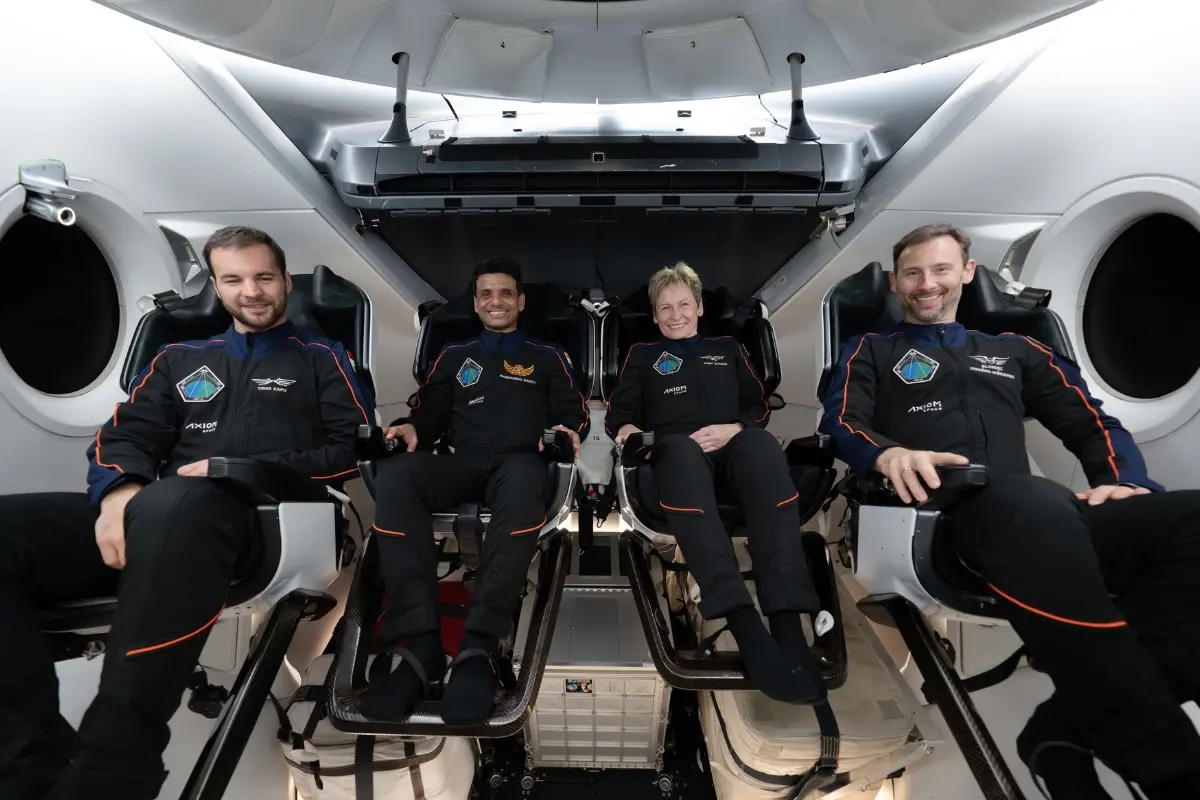
Joining Peggy Whitson on the Ax-4 mission will be three astronauts from different countries: Shubhanshu Shukla from India, Sławosz Uznański-Wiśniewski from Poland, and Tibor Kapu from Hungary.
This mission is very special for all three nations, as they have waited a long time to see one of their own go to space again. According to Time Media Singapore:
- Hungary hasn’t had a person in space since 2009, when Charles Simonyi, a private space tourist, visited the ISS on a Russian Soyuz spacecraft.
- India’s last astronaut was Rakesh Sharma, who went to space in 1984 aboard a Soviet Soyuz and docked with the Salyut 7 space station.
- Poland has waited the longest—its only astronaut, Mirosław Hermaszewski, went to space in 1978 on a Soyuz mission.
This mission marks a proud moment for these countries, as they return to space exploration after decades.
Sergio Palumberi, the mission manager at the European Space Agency (ESA), spoke at the May 20 press conference and said that private space missions like Ax-4 give ESA member countries a great chance to send more astronauts and carry out more scientific research on the International Space Station.
He also shared that ESA will be conducting 17 science and technology experiments during this mission. Countries like Hungary and Poland, which are part of ESA, will benefit from these valuable opportunities.
Orsolya Ferencz, Hungary’s Ministerial Commissioner for Space Research, said that this mission means much more than just going to space for Hungary.
She explained that it is a strategic national effort that shows Hungary’s dedication to developing its own advanced technologies and making sure the country has a strong role in the growing global space industry.
The four astronauts on the Ax-4 mission will join seven others already living on the International Space Station (ISS). This current crew includes three Americans, three Russians, and one Japanese astronaut—Takuya Onishi, who is also the commander of the space station right now.
While traveling to and from space, Peggy Whitson will lead the Ax-4 team. However, once they are on the ISS, she will hand over command responsibilities to Onishi, who will be in charge of the full crew during their time on the station.
Peggy Whitson explained that she is in charge of her Ax-4 team and their planned tasks on the International Space Station (ISS). However, the crew already living on the ISS will continue to manage the overall operations of the station.
She added that it wouldn’t make sense for someone who is only staying for a short time to take full control of the station.
The 14-day Ax-4 mission is not just about the current trip—it’s part of a bigger plan for the future. This mission, along with the three earlier ones, is like a practice run for both the astronauts and Axiom’s mission control team on Earth. These flights help everyone gain valuable experience in handling tasks in space and managing operations from the ground.
All this training is building up to a major event in 2027, when Axiom’s first space station module will be launched and connected to the International Space Station (ISS).
Over the next three years, four more modules will be launched and connected to the first Axiom module already attached to the International Space Station (ISS). Together, these will form a semi-independent space station that operates alongside the ISS.
By the year 2030, just before the ISS is taken out of service, the Axiom station will detach from it and become a fully separate, free-floating space lab in orbit.
The first module of the Axiom space station is called the Payload, Power, and Thermal Module (PPTM). As the name suggests, it will supply electric power, help control the temperature, and offer storage space for the new station.
This module will play a key role in keeping the station running smoothly and supporting future missions.
After the PPTM module, Axiom plans to launch four more modules—which include one airlock, two habitat (living) modules, and a Research and Manufacturing Facility (RMF). The RMF will serve as the main hub for carrying out scientific research and manufacturing products in space.
This module will also have a special viewing area with windows, similar to the cupola on the ISS, but much larger. It will offer a full 360-degree view of the Earth and outer space, giving astronauts a wide and clear look at their surroundings.
Peggy Whitson says the viewing area in the new module is much larger than the ISS cupola. She explains that astronauts will be able to step fully inside it, making it feel like a spacewalk experience—but without wearing a spacesuit. It will give astronauts a more immersive view of space and Earth.
Axiom Space may add more modules in the future, depending on demand. If private companies or governments are willing to pay for scientific experiments or to test equipment in microgravity, the company is open to expanding the station further to meet their needs.
For the past 25 years, people in the space community have grown accustomed to seeing international astronauts regularly living and working in space on the International Space Station (ISS). While the ISS may not have created the same level of global excitement as earlier U.S. space missions like Mercury, Gemini, and Apollo—which were the first programs to send Americans into space and eventually to the Moon—we will still feel a sense of loss when the ISS is gone.
Axiom Space is ready to step in and continue human space missions, keeping the presence of astronauts in orbit alive.