Salil Chowdhury in Malayalam Cinema - From Chemeen to Vastuhara
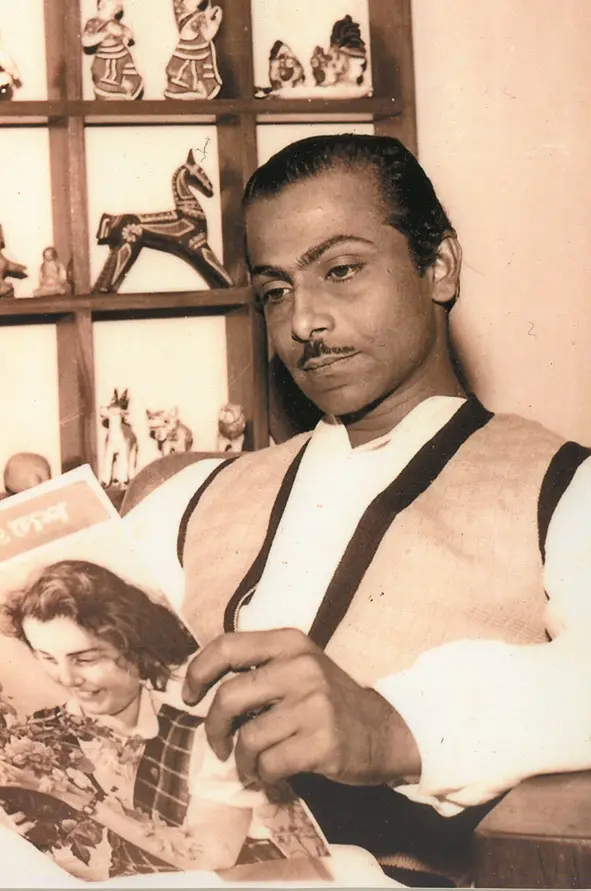
The year of Salil Chowdhury’s birth is open to debate as some insist that he was born in 1925 but there is no one to verify this record. Some say he was born in 1923. I met Salil Choudhury over my growing years when he had just made a name for himself with the music of Do Bigha Zamin directed and produced by Bimal Roy on whose insistence, Choudhury had migrated to Bombay. They lived in a rented flat in Malad, a Bombay suburb. But their door remained open to many strugglers from Kolkata who had come to Bombay to find a footing in the field of music in films. In fact, one did not know whether they were members of the family or were house-guests.
The story goes that when Salil Chowdhury came to Calcutta for his graduate studies in 1944, he was attracted by the political ethos of the day and became a communist. He started writing songs and setting tunes for IPTA, the cultural wing of the communist party. Bicharpati, Runner, Abak Protibhi, Bidroho Aaj were songs of hope and awakening in Bengal during the final years of the oppressive and exploitative British rule. Gaanyer Bodhu, which he composed at the age of 20, created a new wave in Bengali music. His experiments in composition and orchestration were unique. His first Bengali film "Paribortan" was released in 1949. "Mahabharati" in 1994 was the last of his 41 Bengali films. One of his very first assignments as a music director was with Mrinal Sen’s debut film Raat Bhor.
Salil-da was chased by the police for his communist activities and his creation of what came to be known as Gana Sangeet or mass songs of protest against the British rule. He was forced to go underground and hid in the villages in the Sundarbans and living with the peasants, he imbibed their folk songs which later found place in his film compositions with great success. He often had to go underground to avoid arrest.
This writer’s introduction to the music of Salil Choudhury was through his three immortal compositions of three Bengali songs. All three songs were sung by Hemant Kumar, known in Bengal as Hemanta Mukhopadhyay. The lyrics were clearly underscored with a Leftist slant as the writers and Choudhury himself were known Leftists.
Living through the Second World War, the Bengal famine and the desperate political situation in the 1940s, he joined IPTA (Indian Peoples Theater Association) and became a member of the communist party. During this period he wrote numerous songs and with IPTA took his songs to the masses. They travelled through the villages and cities in Bengal and his songs became the voice of the masses. They were powerful and stimulating songs of protest, which made people aware of the rampant social injustice that surrounded them. Salil-da’s music and lyrics, during his post-Independence, commercial phase in Mumbai, was soaked in and reflected his concern for social injustice. Apart from the flute, he played the esraj, violin and piano. He had almost a complete understanding of and knowledge about several other instruments and this is often seen in his musical creations over time.
Salil Chowdhury was, like S.D. Burman, both Bengalies, involved not only in the music he created for a given song but also the mood that sustained at that given point when the music and/or song would occur within the visual space of the film. For most music directors who worked during that time, the story was the hero. They took pains to know the story and the script, the scene where the song would be placed, its build-up and its follow-up. But Salil Chowdhury first created the tune of a given song having understood the mood it had to express and reflect and then asked the lyricist to write the lyrics that would fit into the tune composed by Salil-da.
He was a self-taught musician and the beauty of his compositions lies in the beautiful blend of folk, Indian classical and western classical music. He played the flute beautifully and during his revolutionary phase in the freedom struggle, he always carried his flute with him and would begin to play it spontaneously. His favourite composer was Mozart. His compositions often used folk melodies and melodies based on Indian classical ragas but the orchestration was very much Western in its construction. He developed a unique style one could identify with easily and get to love at the same time.
Salil-da’s music was a blend of Eastern and the Western music traditions. He had once said: “I want to create a style which shall transcend borders — a genre which is emphatic and polished, but never predictable” He dabbled in a lot of things and it was his ambition to achieve greatness in everything he did. But at times, his confusion was evident: “I do not know what to opt for: poetry, story writing, orchestration or composing for films. I just try to be creative with what fits the moment and my temperament”, he once told a journalist.
Salil’s love for Western classical music started when he was a young boy growing up in an Assam tea garden where his father worked as a doctor. His father inherited a large number of western classical records and a gramophone from a departing Irish doctor. While Salil listened to Mozart, Beethoven, Tchaikovsky, Chopin, and others everyday, his daily life was surrounded by the sound of the forest, chirping of the birds, sound of the flute and the local folk-music of Assam. This left a lasting impression in young Salil.
He often told his children that he thought he was Mozart reborn. In fact, his hit number, itna na mujhse tu pyar badha from the film Chhaya (1961), a duet belted out by Talat Mahmud and Lata Mangeshkar was strongly inspired by a Mozart composition. We also learn that Raj Kapoor’s only film Salil-da composed the music for was Jagte Raho. The film used a bhangra song for the first time in a Hindi film. Salil-da added that Jagte Raho had the tune of aaja re pardesi on the soundtrack whenever the character (Raj Kapoor) in Jagte Raho was asking for water, “Shailendra, who wrote the lyrics of all the songs of Madhumati, convinced me to use the same tune for his lyrics for the Aaja Re Pardesi song, a full-fledged song in Madhumati and it turned into magic,” reminisced Salilda. The Mausam Beeta Jaaye number in Do Bigha Zamin had strong traces of the Soviet Red March “with me creating a distinctly Indian alaap for the song so that it sustains the Indian identity of the film’s story, characters and their evolution,” Salil-da said.
Readers may recall that Salil-da took the Malayalam film music world by storm when he first composed the music for Chemeen which won the National Award for the Best Film the following year. The CD was later brought out by Saregama HMV. After Chemeen, he scored music for 23 films in Malayalam. Some films never saw light of day in the theatres and some were big box office flops. He scored the music for films in 13 languages.
“I felt very sad when, after I had scored the music for G. Aravindan’s last film, Vastuhara (1991) my only film for Aravindan, the director had passed away and the film died its own silent death.” He admitted that his music was at times, very strongly influenced by his active participation in Leftist politics and his active membership of the IPTA, a known Communist cultural organization in pre-Independent India. He just could not cut off from his Leftist ideals in his compositions.
“One of the seven notes of music is lost forever.” These are words uttered by the late Naushad when he heard of the sad demise of poet, lyricist, composer, instrumentalist Salil Chowdhury. So shocked was Lata Mangeshkar that she went into seclusion for three days, refusing to speak to the media or anyone else.