What is the Doomsday Clock, and why has it moved closer to 'global catastrophe'?
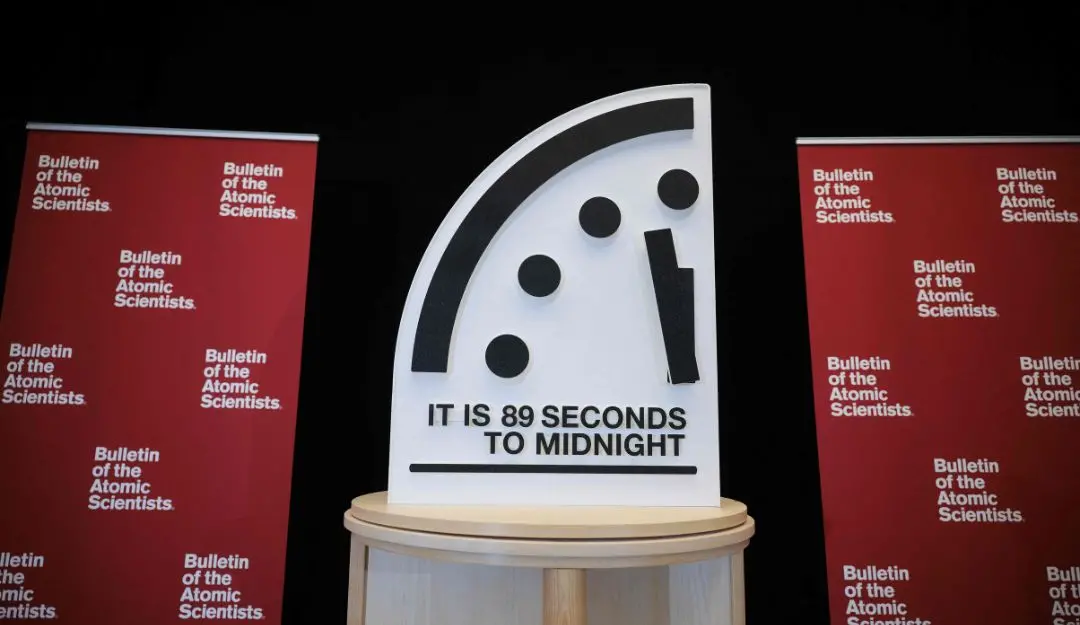
The Doomsday Clock, a symbolic measure of how close humanity is to global catastrophe, has been moved to just 89 seconds before midnight, marking the closest it has ever been to a theoretical point of annihilation. The decision, announced Tuesday by the Bulletin of the Atomic Scientists–founded in 1945 by scientists including Albert Einstein and J Robert Oppenheimer–highlights escalating threats such as Russia’s nuclear rhetoric, geopolitical tensions, the rapid rise of artificial intelligence in military applications, and the worsening climate crisis.
The Doomsday Clock: A symbol of global risk
The Chicago-based nonprofit organisation first introduced the Doomsday Clock in 1947, at the onset of Cold War tensions following World War II. Designed as a warning to humanity, the clock’s time is adjusted annually to reflect global threats, with midnight representing a catastrophic event. Over the decades, nuclear risks, environmental crises, and technological dangers have influenced its movement.
This year, the Bulletin’s Science and Security Board determined that humanity is now one second closer to midnight than in 2023, emphasizing the growing danger posed by nuclear threats, artificial intelligence, and climate change.
How does the Doomsday Clock work?
The Doomsday Clock serves as a symbolic measure of how close humanity is to global catastrophe, with midnight representing annihilation. The Bulletin of the Atomic Scientists first introduced the clock in the 1940s in response to the dangers of nuclear war. After the United States dropped atomic bombs on Hiroshima and Nagasaki at the end of World War II, scientists associated with the Bulletin sought to create a way to communicate the existential risks posed by nuclear weapons to the public.
Each year, the time on the clock is determined by the Bulletin's Science and Security Board, which consists of experts in nuclear policy, climate science, and emerging technologies. Since 1973, this board has been responsible for setting the clock, taking over from Eugene Rabinowitch, a disarmament campaigner and former Bulletin editor.
The decision to move the clock forward or backward is based on an assessment of global threats, including nuclear tensions, climate change, and technological risks. The board consults with academic peers and the Bulletin’s sponsors, which include 13 Nobel laureates, before finalizing the time. If global stability improves, the clock moves further from midnight; if threats escalate, it moves closer, signaling a greater risk to humanity.
Nuclear risks: Russia’s aggression and global tensions
At the forefront of the Bulletin’s decision is the ongoing war in Ukraine. The war, which began in 2022, has heightened concerns over nuclear escalation, particularly after Russian President Vladimir Putin lowered the threshold for nuclear strikes in November. The Kremlin framed the move as a deterrent to the West, particularly as Ukraine continues to receive U.S. and NATO-backed military aid.
Daniel Holz, chair of the Bulletin’s Science and Security Board, told Reuters, "The war in Ukraine continues to loom as a large source of nuclear risk. That conflict could escalate to include nuclear weapons at any moment due to a rash decision or through accident and miscalculation."
In another alarming development, Russia announced in October that it would not negotiate a replacement for the New Strategic Arms Reduction Treaty (New START) with the U.S. The treaty, set to expire in 2026, currently limits the number of nuclear weapons both countries can deploy. Moscow has argued that any future agreement must expand to include other nuclear-armed nations, further complicating disarmament efforts.
Meanwhile, tensions in the Middle East have also fueled global instability. The Israel-Gaza war, combined with regional hostilities involving Iran, has created an unpredictable security situation. In Asia, China has increased military pressure on Taiwan, while North Korea continues to test ballistic missiles, further exacerbating geopolitical risks.
Artificial Intelligence
Another major factor influencing the Doomsday Clock’s adjustment is the rapid advancement of artificial intelligence (AI), particularly its potential military applications.
Holz noted that "Advances in AI are beginning to show up on the battlefield in tentative but worrisome ways, and of particular concern is the future possibility of AI applications to nuclear weapons. In addition, AI is increasingly disrupting the world's information ecosystem. AI-fueled disinformation and misinformation will only add to this dysfunction."
In the U.S., the Biden administration sought to regulate AI risks with an executive order in October 2024, but his successor, Donald Trump, repealed it just last week. The lack of global AI governance has raised fears that autonomous systems could exacerbate military conflicts or even influence nuclear strategies.
Climate change
The worsening climate crisis remains a significant reason for the Doomsday Clock’s grim outlook.
The U.N. World Meteorological Organization reported that 2024 was the hottest year ever recorded, marking a continued trend of rising global temperatures. Scientists warn that intensifying storms, wildfires, and extreme weather events are pushing ecosystems to their limits.
"While there has been impressive growth in wind and solar energy, the world is still falling short of what is necessary to prevent the worse aspects of climate change," Holz emphasized.
A final warning to world leaders
Holz described the 89-second mark as a "warning to all world leaders", urging major powers—including the United States, China, and Russia—to prioritize global stability and security.
Former Colombian President and Nobel Peace Prize laureate Juan Manuel Santos echoed these sentiments at the Bulletin’s press conference, stating: "This is a bleak picture but it is not yet irreversible."
The organization also asserted that the United States, China and Russia have the main responsibility to pull the world back from the brink.