Did the US use a downed F-15 pilot rescue as a cover to extract Uranium from Iran?
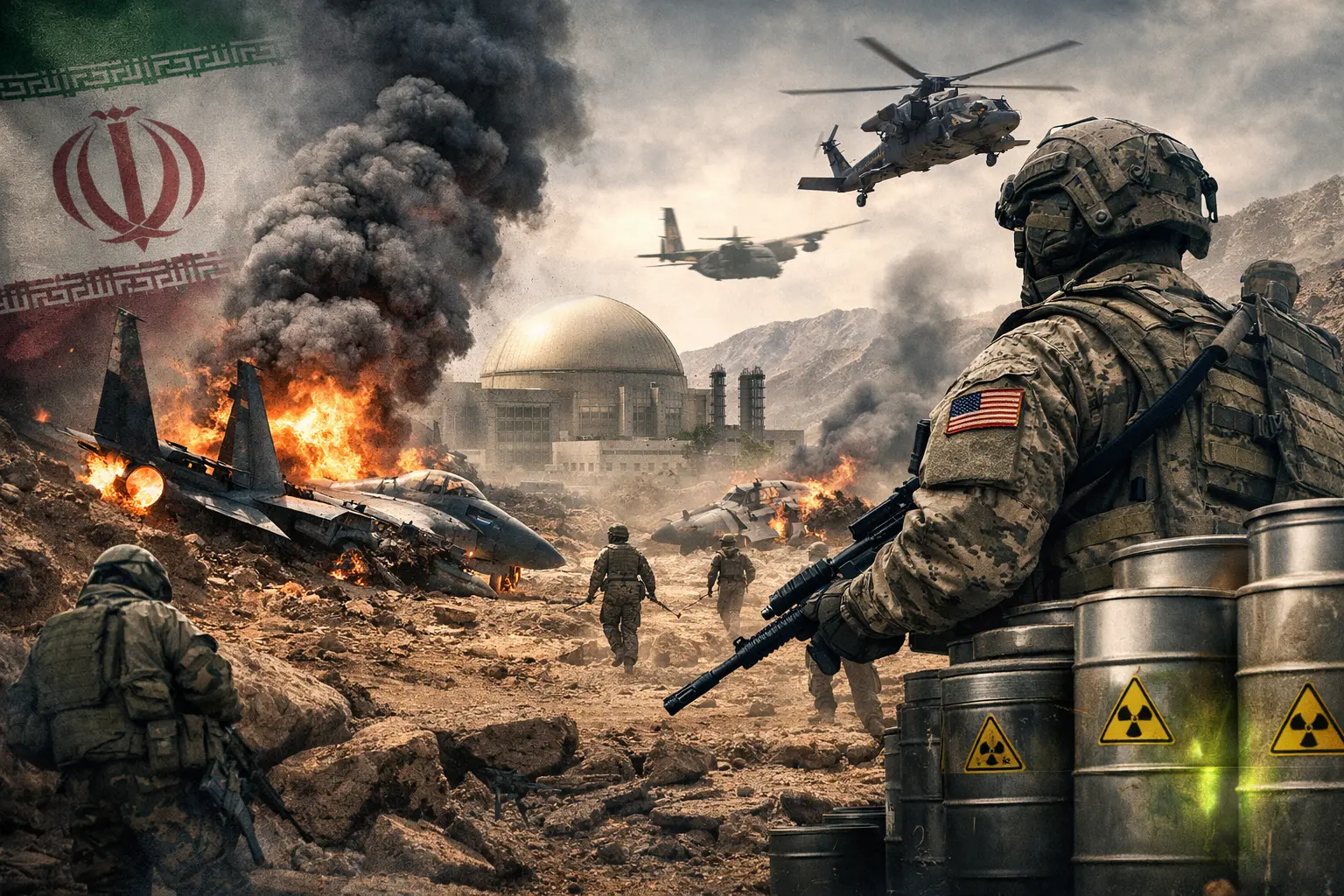
As the US-Israel war with Iran drags on, an information vacuum has opened the way for speculation, with conspiracy theories spreading rapidly online. One of the most prominent claims now circulating suggests that the dramatic US mission to retrieve a downed airman inside Iran was not a rescue at all, but a covert bid to seize enriched uranium from facilities near Isfahan.
No verified evidence has been produced to support these allegations, and Washington has repeatedly framed the operation as a standard combat search-and-rescue response. But the scale of the mission, and the lack of detailed official comment in the crucial early hours, has fuelled doubts and alternative explanations.
What sparked the speculation?
The latest round of theories emerged after an American F-15E was shot down by Iran’s Revolutionary Guard last Friday. Two crew members ejected over rugged terrain in the province of Kohkilouyeh and Boyer-Ahmad. The pilot was recovered the same day; the weapons systems officer was found around 48 hours later.
Online, however, users began stitching together a theory that the crash narrative was fabricated altogether, portraying the rescue as a smokescreen concealing a failed extraction of nuclear material. Some claim the US deliberately destroyed its own aircraft to hide traces of a covert mission.
A US-based defence commentator posting as FinanceLancelot wrote: "The 'downed pilot' was a fake cover story for a failed US military operation to capture Iran's primary stockpile of highly enriched 60% uranium, roughly 440–970 pounds." He added: "The primary stockpile is located at Isfahan, exactly where the pilot was lost. This explains why the US heavily bombed the area while 'searching' and why the C-130s were destroyed without loss of life."
Why Isfahan became central to the theory
Isfahan hosts several core elements of Iran’s nuclear programme, including conversion, fuel fabrication and research centres, and has historically stored enriched uranium. The area was also targeted by US strikes in March and during Operation Rising Lion in June 2025, adding to perceptions that it remains a strategic focus.
Another commentator, Tyler Weaver (Armchair Warlord), claimed: "the crew's disappearance and the search operation were both fake", arguing the US mobilisation was inconsistent with a typical rescue. "Using multiple heavy transports, assault helicopters for 100+ operators is logistically absurd for rescuing one or two isolated airmen in a remote area," he wrote, adding that a genuine search would have used "1–2 silent helicopters at night and not of this scale."
Theories link rescue mission to firing of US Army Chief
Some posts broadened the speculation, tying the incident to the sudden dismissal of US Army Chief of Staff Gen Randy George. Weaver claimed the general had opposed a Trump-era plan to deploy ground forces inside Iran to seize enriched uranium: "I'd like to note that Hegseth fired General George - US Army Chief of Staff - on April 2, apparently because he just wasn't a good fit for the job and definitely not because he'd told him that this whole scheme was insane."
The Pentagon has not publicly explained the firing. CBS News reported that the defence secretary wanted “someone who will implement President Donald Trump's vision for the Army”.
Plans for uranium seizure had previously been discussed
Suggestions that the US contemplated physically removing Iran’s uranium stockpile are not new. Officials and military strategists had debated scenarios in which special forces might secure nuclear materials to prevent them being converted into weapons. As the New York Times noted, "The United States and Israel have the capability to secure Iran's nuclear materials; this is one scenario in which there could be boots on the ground."
Analysts, however, have long warned that such an operation would be extraordinarily risky and may offer little strategic gain. Figures such as Colonel Douglas McGregor (Retd) and retired Admiral James Stavridis have publicly dismissed the feasibility of seizing uranium as a meaningful war objective, describing it as high-risk for minimal reward.
Iran’s military accuses US of a covert nuclear snatch operation
Iran’s own military leadership has added fuel to the debate, issuing detailed accusations that the US attempted, and failed, to infiltrate nuclear sites under cover of a rescue operation.
In statements from April 5–6, officials from the Khatam al-Anbiya Central Headquarters and the Revolutionary Guards described the US effort as a “deception and escape mission” staged around an abandoned airfield in southern Isfahan. A spokesman, Ebrahim Zolfaghari, said the American plot was “completely foiled.”
Iran alleges the true purpose was not the retrieval of the downed crew, but an attempt to raid nuclear facilities and remove enriched uranium. They claim Iranian forces destroyed several American aircraft, including two C-130 transport planes and two Black Hawk helicopters, during the incident.
Washington rejects allegations
The US has denied any ulterior motive, insisting both airmen were recovered during a demanding rescue mission that spanned roughly 36 hours. American officials maintain the mobilisation of special forces, helicopters and transport aircraft reflected wartime conditions and the need to operate in hostile, mountainous terrain.
There has been no independently verified evidence substantiating Iran’s claim that US forces attempted to seize uranium, nor any proof that nuclear material was moved or went missing.