'Such a brilliant man': Trump praises Jensen Huang, calls Alice Huang a 'pretty woman’
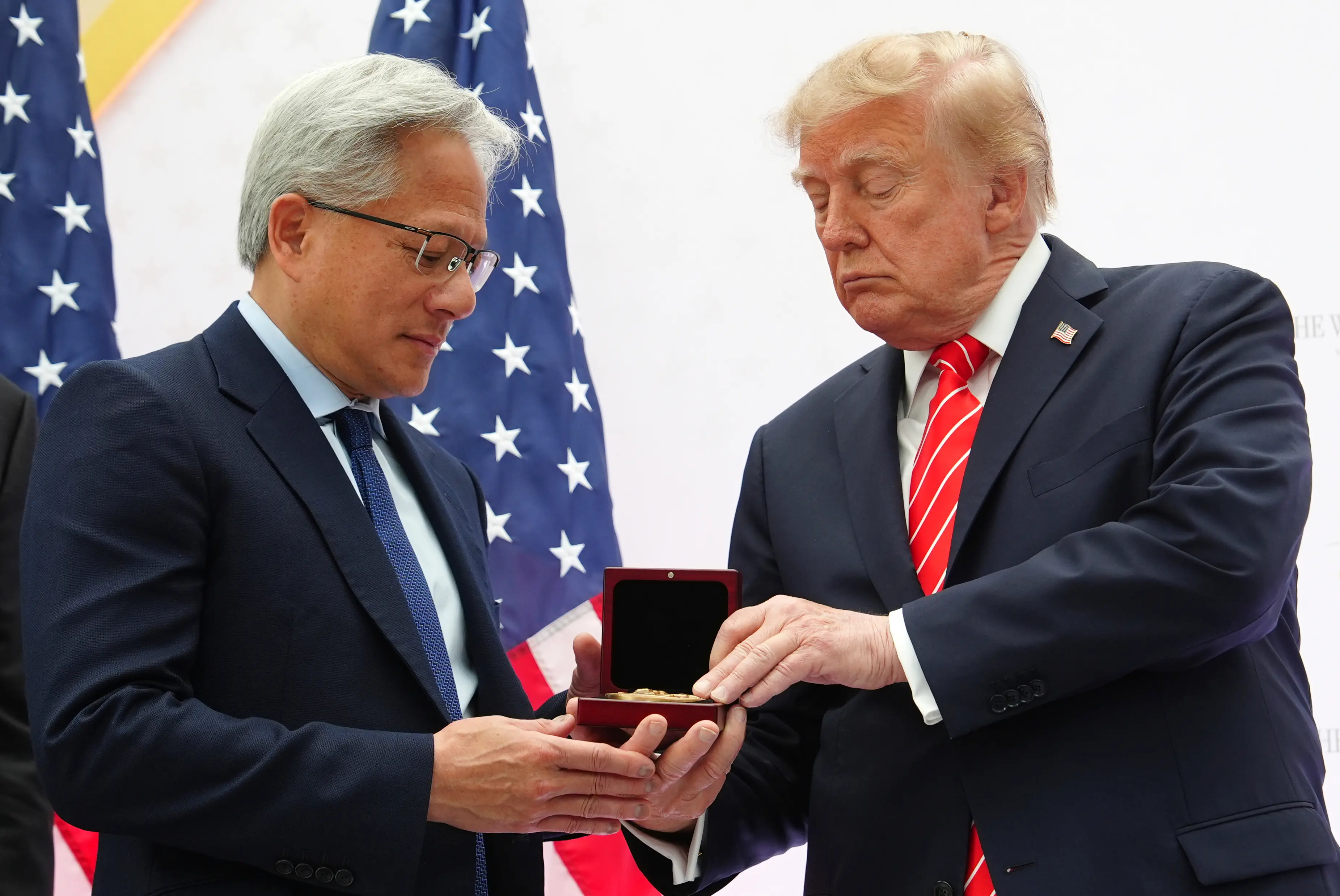
Beijing: US President Donald Trump has defended former Nvidia chief executive Jensen Huang amid an ongoing controversy involving his admitted extramarital affair with Chinese businesswoman Alice Huang, who has been accused in media reports of having links to Chinese intelligence.
In an interview with Fox News broadcast on Wednesday, Trump described Jensen Huang as an exceptionally talented technology leader and said the situation surrounding his departure from Nvidia was a tragedy.
"It's a tragedy. He's such a brilliant man," Trump said, adding that some people were difficult to replace and that Huang was "10 years ahead" of others in his field.
"We need to take care of our geniuses. There are not many of them," Trump said.
Trump says he briefly mentioned Huang to Xi
Trump said he had referred to Jensen Huang's situation during his interactions with Chinese President Xi Jinping in Shenzhen, but insisted that the controversy was not discussed in detail.
"We did not discuss it. I might have referred to it just briefly because it's such a tragedy," Trump said.
The US president also rejected suggestions that he had received information confirming Alice Huang was a spy.
"I haven't heard that she was a spy," he said.
Describing Alice Huang as a businesswoman who purchased Nvidia chips, Trump questioned whether the transactions had been conducted legally, saying: "Who knows if they were bought right or wrong. But I can tell you we allow them to buy. We want to make money."
He also referred to Alice as a "pretty woman" and made a broader remark about Chinese women being viewed with suspicion in connection with espionage allegations. His comments came amid questions about whether the relationship could have exposed sensitive information or created risks for US national security.
What are the allegations involving Alice Huang?
Alice Huang is a Chinese businesswoman who previously served as a director of Megaspeed, a Singapore-based technology company involved in high-performance computing and data-centre operations.
Reports have alleged that Megaspeed purchased large quantities of Nvidia's advanced chips and that some of those chips may have been diverted to China despite US export restrictions. US intelligence agencies are reportedly examining Alice Huang's connections and whether information was passed to Chinese authorities.
The allegations have not been publicly established as proven facts. China has rejected claims of espionage, while the US investigation is examining the possible national security implications.
Jensen Huang acknowledged having an extramarital affair in a message to Nvidia employees, apologising to his family and colleagues. He did not publicly identify Alice Huang in that message. He subsequently resigned as Nvidia's chief executive on November 11, with chief financial officer Colette Kress appointed interim CEO.
Nvidia creates committee to oversee national security and export controls
Amid the controversy, Nvidia announced on November 17 that its board had established a new National Security and Export Control Oversight Committee.
The committee will supervise the company's national security policies, compliance with export controls and management of global trade risks. It will be chaired by board director Suzanne Nora Johnson, with Stephen C. Neal and John O. Dabiri as members.
Nvidia said the committee would work with independent external experts in law, national security and trade compliance. The company's existing national security and global trade compliance teams will report to the committee, while continuing to handle day-to-day operations with interim CEO Colette Kress.
The move comes as US authorities and lawmakers examine the sale and possible diversion of advanced AI chips to China. The controversy has also intensified scrutiny of Nvidia's internal controls and its approach to export restrictions.
Trump-Xi-Putin talks take place amid wider security concerns
Trump's comments on Huang came during his visit to China for the Asia-Pacific Economic Cooperation summit in Shenzhen, where he was also scheduled to meet Xi and Russian President Vladimir Putin.
The three leaders' discussions included nuclear arms control and the wars in Ukraine and Iran. Trump has promoted the meetings as an opportunity to discuss international security and explore ways to address the conflicts, although analysts have cautioned against expecting immediate breakthroughs.
The talks are also taking place against a backdrop of tensions over trade, advanced technology and access to AI chips. The United States has sought tighter controls to limit China's access to sensitive computing technology, while Nvidia has a commercial interest in selling its products to international customers, including in China.
Why the Jensen Huang controversy has become a national security issue
The controversy extends beyond Jensen Huang's private life because of Nvidia's position in the global artificial intelligence industry and the strategic importance of its advanced chips.
Three issues are central to the dispute:
1. Access to advanced AI chips
Nvidia's processors are widely used to develop and operate advanced AI systems. The US government has imposed export restrictions on certain high-performance chips to limit China's access to technology that could have military and strategic applications. Allegations that restricted chips may have reached China through intermediaries have therefore attracted regulatory attention.
2. The relationship between business leadership and national security
The allegations involving Alice Huang have raised questions about whether Jensen Huang's personal relationship could have exposed confidential business or technology information. However, the existence of an affair does not by itself establish espionage or prove that Nvidia's technology was compromised.
3. Nvidia's corporate governance and export compliance
The creation of a dedicated board committee indicates that Nvidia is strengthening oversight of national security and international trade compliance. The committee's work, along with investigations by US authorities, could help establish whether the company had adequate safeguards governing chip sales and sensitive information.
Trump's defence of Jensen Huang also highlights the tension between the commercial importance of US technology companies and Washington's efforts to restrict China's access to advanced AI technology. While the president has praised Huang's contribution to the industry, the questions surrounding chip exports and possible intelligence links remain matters for investigators and regulators.
The outcome could have implications beyond Nvidia, particularly for how major technology companies manage export controls, customer relationships and national security risks.