Trump cuts G7 summit short as Israel-Iran conflict escalates
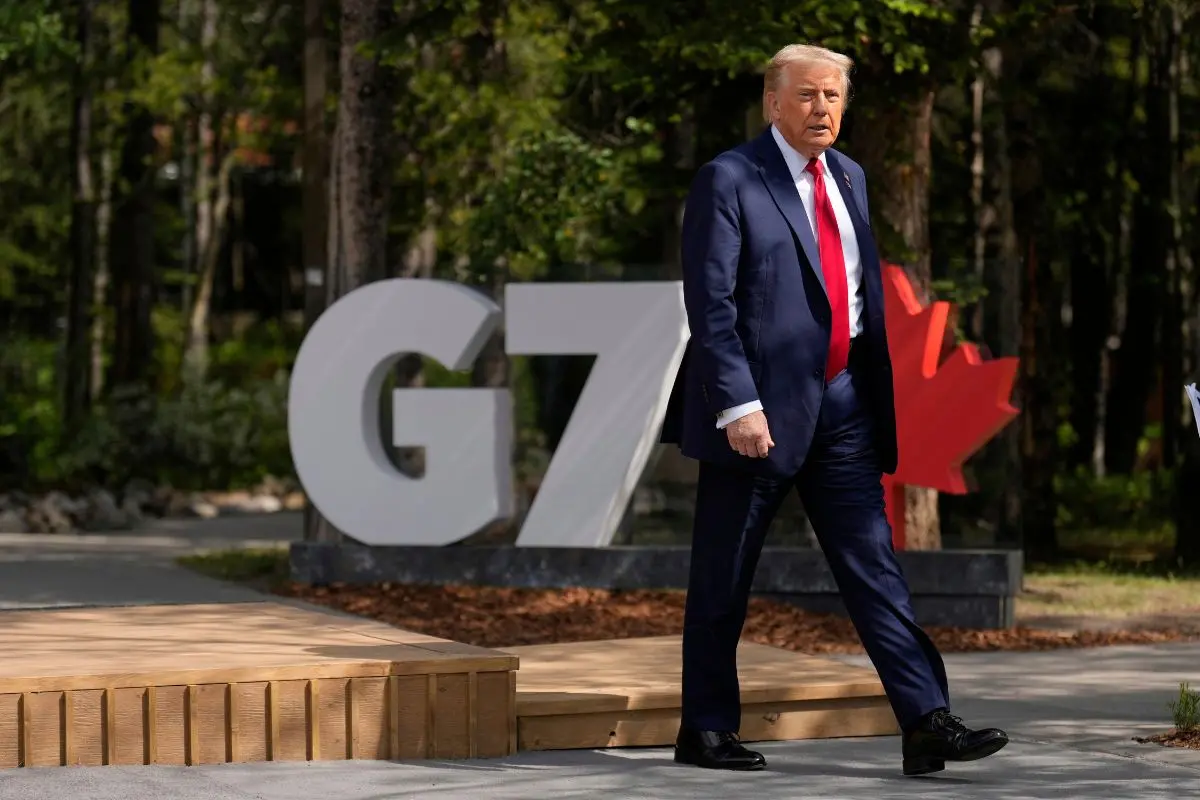
Alberta: US President Donald Trump is abruptly leaving the Group of Seven summit on Monday, cutting his visit short amid intensifying conflict between Israel and Iran. His early departure came just hours after issuing a stark warning for civilians in Tehran to evacuate “immediately” as Israeli airstrikes on the Iranian capital reportedly escalated.
World leaders had gathered in Canada with the aim of addressing several pressing global issues. However, the summit was quickly overshadowed by the deepening Middle East crisis, with Israel's aerial bombardment campaign against Iran entering its fourth consecutive day.
At the summit, President Trump warned Iran that it must rein in its nuclear programme before it is “too late.” He claimed Iranian leaders were now willing to talk but had missed their chance to reach an agreement during a 60-day window prior to the Israeli strikes. “They have to make a deal,” he told reporters.
When asked whether the United States would become directly involved in the conflict, Trump replied cryptically: “I don’t want to talk about that.”
Later in the day, in a dramatic post on his social media platform Truth Social, the President declared: “Everyone should immediately evacuate Tehran!” The warning, issued around 2am Tehran time, was followed by news of explosions and heavy anti-aircraft fire reported by Iranian media.
Shortly afterwards, the White House confirmed Trump would leave the summit early, cancelling Tuesday meetings that were set to focus on the wars in Ukraine and Gaza, and on global trade.
“Much was accomplished, but because of what’s going on in the Middle East, President Trump will be leaving tonight after dinner with Heads of State,” White House press secretary Karoline Leavitt announced online.
The President’s early exit has added further volatility to an already tense summit. Trump has recently imposed sweeping tariffs on dozens of countries, contributing to fears of a global economic slowdown, while talks on the wars in Ukraine and Gaza have yielded little progress.
Despite participating in some bilateral meetings, Trump appeared less interested in consensus-building with other G7 leaders--including those from the UK, France, Germany, Italy, Japan, and Canada--preferring a unilateral approach to foreign policy.
British Prime Minister Keir Starmer, French President Emmanuel Macron, German Chancellor Friedrich Merz, and Italian Premier Giorgia Meloni reportedly held an informal meeting late Sunday to discuss how to de-escalate the Israel-Iran conflict. Germany has signalled it will push for a final G7 statement reinforcing that Iran must never acquire nuclear weapons-capable material.
European leaders have expressed a desire to cool tensions in the region rather than inflame them. But President Trump, in a further post, reiterated his hard-line stance:
“AMERICA FIRST means many GREAT things, including the fact that, IRAN CAN NOT HAVE A NUCLEAR WEAPON. MAKE AMERICA GREAT AGAIN!!!”
Trump's assertive posture contrasts sharply with the more diplomatic tone taken by several other G7 leaders. Chancellor Merz told reporters Germany would pursue “small steps” toward a peaceful resolution, while Prime Minister Starmer’s office emphasised the importance of unity among democratic nations.
The summit was also punctuated by tension over trade. Trump used the occasion to finalise a UK-US trade framework first announced in May. Standing alongside Starmer, he praised the deal, stating: “British trade is very well protected... because I like them, that’s why. That’s their ultimate protection.”
However, Trump has also introduced a 10% baseline tariff on most imports, with the potential for rate increases in July once a 90-day negotiating period expires. Steel and aluminium imports face 50% duties, and autos 25%. Tariffs on Canadian and Mexican goods remain in place under measures intended to curb fentanyl smuggling.
Talks with other leaders, including Japanese Prime Minister Shigeru Ishiba, European Commission President Ursula von der Leyen, and Canadian Premier Mark Carney, focused on both trade and security. Macron’s office confirmed that he and Trump discussed tariffs, the situation in the Middle East, and the war in Ukraine.
Trump had been scheduled to meet Tuesday with Mexican President Claudia Sheinbaum and Ukrainian President Volodymyr Zelenskyy, who was expected to present a proposal for purchasing additional US defence equipment. The status of that package is now uncertain.