‘Ready to do everything’: Putin vows to help end Middle East war in meeting with Iran's Pezeshkian
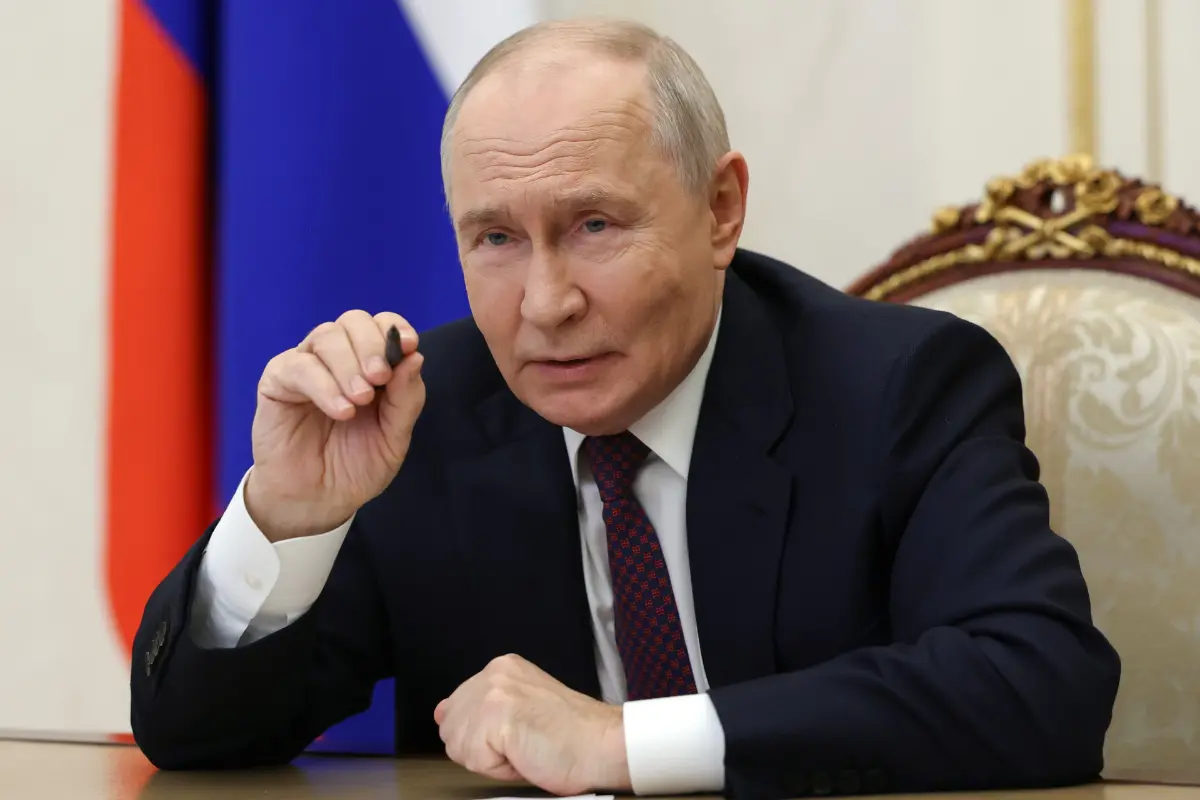
Ashgabat: Russian President Vladimir Putin pledged on Thursday to "do everything" within his power to assist in bringing an end to the Middle East conflict during a meeting with Iranian counterpart Masoud Pezeshkian ahead of a regional summit, according to Russian news reports.
The heads of state of two of the world’s most sanctioned nations held discussions after landing in Turkmenistan for a meeting of the Commonwealth of Independent States (CIS), scheduled to open on Friday in the Caspian Sea resort town of Avaza.
"We are ready to do everything that is in our power to contribute to the settlement of this situation," Putin stated.
He added that Iran had demonstrated "real efforts to end the war" since the onset of US-Israeli military strikes on February 28, Russian press agencies reported.
Putin also pointed to a "positive evolution" in bilateral ties between Moscow and Tehran.
The two countries have deepened diplomatic and defence cooperation since Russia initiated its military offensive in Ukraine in February 2022, becoming progressively interdependent.
ALSO READ: Trump rules out US attack on Iran before November 3 midterm elections
Conflict impasse
Kyiv and Western nations have repeatedly accused Iran of furnishing Russia with Shahed attack drones and short-range ballistic missiles for use against Ukrainian targets.
Concurrently, Moscow stands accused of providing intelligence data to Iran to facilitate strikes against US assets across the Middle East.
Putin and Pezeshkian previously met on the margins of the Shanghai Cooperation Organisation summit in Kyrgyzstan last month. In a phone call on Wednesday, Putin informed Pezeshkian of his readiness to assist in mediating the Middle East crisis, according to Iranian state news outlet IRNA.
The diplomatic engagements coincide with an apparent deadlock in talks between Tehran and Washington. Pezeshkian remarked this week that direct negotiations with the United States were "meaningless".
Diplomatic avenues aimed at resolving Russia’s offensive in Ukraine likewise remain stalled, even as both warring sides step up military operations.
"We are engaged in dialogue, but every time we negotiate with the United States, they attack again," Iranian state media quoted Pezeshkian as saying during his discussions with Putin.
US President Donald Trump ruled out launching further military strikes against Iran prior to the US mid-term elections on November 3, asserting on Thursday that Washington was conducting "productive discussions" with Tehran.
Pezeshkian stated that Tehran sought a "final framework" to bring a permanent halt to hostilities.
However, he criticised Washington for "trying to impose its policies and views on all countries".
"If the United States insists on pursuing a unilateral approach, a resolution will not be possible," Pezeshkian noted, according to Iranian state reports.
ALSO READ: Riyadh airport attacks: India issues Saudi advisory as flights cancelled
Sphere of influence
Putin and Pezeshkian are set to participate in the CIS summit—a regional bloc originally formed by ex-Soviet republics—alongside leaders from Armenia, Azerbaijan, Belarus, Turkmenistan, and other Central Asian nations.
The bilateral talk between Putin and Pezeshkian formed part of several side meetings planned during the summit, according to Kremlin foreign policy adviser Yuri Ushakov.
The CIS was founded in 1991 to manage the dissolution of the Soviet Union and preserve operational ties among former member republics.
Several member nations have since departed the organisation—Georgia withdrew after its 2008 conflict with Russia, Ukraine ended its involvement following Moscow's 2014 annexation of Crimea, and Moldova exited in 2023 to pursue closer integration with the European Union.
For Russia, which has faced international isolation since expanding its military action in Ukraine in 2022, the CIS serves as proof that Moscow "actually has the orbit and that it has its own sphere of influence that is fortified and institutionalised", according to Temur Umarov, a scholar at the Carnegie Russia Eurasia Centre in Berlin.
However, Friday’s gathering unfolds as several CIS member states seek to broaden their economic and diplomatic alliances, particularly through enhanced relations with China and Western capitals.
"Even if Russia decides to use this platform to propagate anti-Western or anti-Ukrainian rhetoric, that does not mean the other members will automatically subscribe to its position," observed Zhanibek Arynov, a Kazakhstan-based analyst specialising in Central Asian geopolitics.
AFP