Pentagon vows escalation against Iran in first briefing since strikes began; says ‘we fight to win’
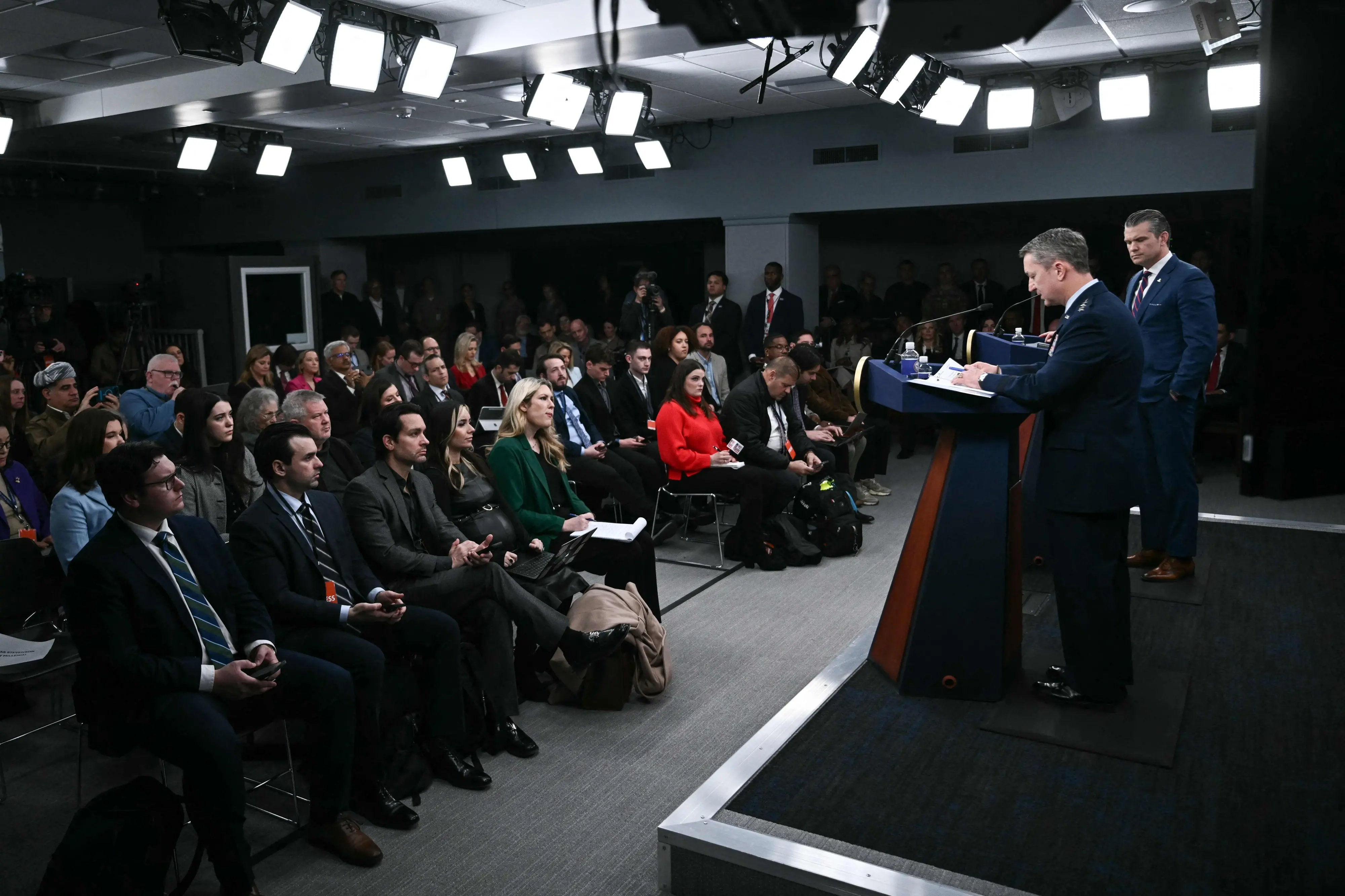
Washington: Defence Secretary Pete Hegseth and Air Force Gen Dan Caine on Monday delivered the Trump administration’s most detailed account yet of the widening US–Israeli assault on Iran, vowing to pursue those responsible for killing Americans as the conflict deepens across the Middle East.
The two senior officials, appearing in the administration’s first on-camera news conference since strikes began on Saturday, said the goal of the joint operation is to dismantle Iran’s military capabilities, protect regional partners and prevent Tehran from expanding its power beyond its borders.
Hegseth reiterated Washington’s determination to stop Iran from ever acquiring a nuclear weapon, accusing the government in Tehran of fortifying its conventional arsenal as a protective shield for what he described as nuclear ambitions. He again criticised the 2015 nuclear deal negotiated under former President Barack Obama, dismissing it as a failure.
Campaign aims to cripple Iranian missile and naval power
Hegseth said the current US operation, “Operation Epic Fury,” is focused on destroying missile production sites, launch systems, naval assets and “wider security infrastructure”. He said Washington hopes the Iranian people recognise what he called an “incredible opportunity,” echoing President Donald Trump’s earlier message that “now is your time.”
He addressed Iran’s internal security forces directly, warning they should “carefully consider” their next steps. Hegseth stressed that US strikes were being carried out in a manner he described as surgical yet overwhelming, insisting the campaign would not become what he termed an “endless war.”
“This is not Iraq. This is not endless,” he said, adding that the mission had a “clear, devastating, decisive mission” to “destroy the missile threat”, dismantle Iran’s navy and ensure “no nukes.”
He rejected suggestions that the administration should outline its limits publicly. “No, but we’re not going to go into the exercise of what we will or will not do,” he said when asked whether there were US boots on the ground in Iran. To detail future steps, he added, would be “foolishness”.
Caine: Mission is not quick, losses expected
Gen Caine provided a broader framework for the operation, saying it is intended to guarantee the security of US forces and allies while constraining Iran’s ability to project power outside its borders. He made clear the campaign would be prolonged.
“Our mission is to protect ourselves and our regional partners, prevent Iran from the ability to project power from outside of its borders and be ready for follow on actions as appropriate,” Caine said, emphasising that the mission is “not a single overnight mission.”
He warned that further American casualties should be expected. “We expect to take additional losses, as always we will work to minimise US losses but as the secretary general said this is major combat operations,” he said. Addressing families of those killed, he added: “We grieve with you, and we will never forget you.”
US confirms projectile struck tactical operations centre
Hegseth acknowledged that while most incoming fire had been intercepted by US air-defence systems, at least one strike had broken through. He said a projectile hit what he called a fortified “tactical operations centre” and noted that the weapons involved were “powerful”.
Caine said the operation relied heavily on cyber capabilities, which he said had “effectively disrupted communications and sensor networks,” leaving Iranian forces unable to coordinate or respond. He also revealed that B-2 stealth bombers had been used, making a 37-hour round-trip flight as part of the coordinated strikes.
The chairman said US forces had delivered “synchronised and layered effects” meant to disrupt, degrade and ultimately destroy Iran’s ability to sustain combat operations.
Hegseth rejects regime-change narrative
The defence secretary pushed back on the accusation that Washington was pursuing regime change, saying, “This is not a so-called regime change war, but the regime sure did change and the world is better off for it,” referring to the killing of Supreme Leader Ayatollah Ali Khamenei.
Hegseth argued that Iran had “started the conflict from its inception,” saying the Islamic Republic had “waged a savage, one-sided war against America” for 47 years. He added: “Their war on Americans has become our retribution against their Ayatollah and his death cult.”
He made no claim of an imminent nuclear threat from Iran but said US and Israeli strikes last summer had already “obliterated their nuclear program to rubble.” The current focus, he said, is Iran’s missiles and drones, which he described as tools for “nuclear blackmail ambitions.”
US says Iran was stalling before strikes
Hegseth also accused Tehran of dragging out diplomatic talks before the operation. “The former regime had every chance to make a peaceful and sensible deal. But Tehran was not negotiating,” he said.
He added that American forces were moving with clarity and without constraints, “No stupid rules of engagement, no nation building quagmire, no democracy building exercise, no politically correct wars. We fight to win, and we don’t waste time or lives.”
Monday’s briefing came hours before Secretary of State Marco Rubio was scheduled to update congressional leaders on the situation, underscoring the gravity of a conflict that US officials say is likely to intensify in the days ahead.
First major briefing since US-Israeli strikes began
Monday’s appearance by Hegseth and Caine marked the first formal news conference since US and Israeli strikes inside Iran began on Saturday. While Trump has given a handful of phone interviews, he has not taken questions on camera and has released only two video statements since the operation started.
The conflict has widened dramatically, with Iran and allied armed groups firing missiles at Israel, Arab nations and U.S. military positions across the region. Four American service members have been killed in action, and Trump warned on Sunday there would likely be further casualties.
Kuwait downs three US jets amid chaos
Regional turmoil deepened after US ally Kuwait “mistakenly shot down” three American F-15E Strike Eagles during heavy combat activity involving Iranian aircraft, drones and ballistic missiles.
United States Central Command said all six pilots ejected safely and were reported to be in stable condition.
No end in sight as death toll rises
US leaders have not presented an exit strategy, and the killing of Iran’s Supreme Leader Ali Khamenei has intensified uncertainty about the future of the Islamic Republic, sending the region into deeper instability.
Trump told The New York Times that the campaign might continue for “four to five weeks” and said U.S. and Israeli forces have already struck “hundreds” of targets. Those strikes include missile bases inside Iran and operations against its naval forces, with Washington and Israel claiming they have destroyed headquarters buildings and several warships.
The Iranian Red Crescent Society reported at least 555 people killed in Iran since the US-Israeli operation began. Authorities in Israel and Lebanon say 11 and 31 people have died in their respective territories amid the cross-border fire.
(With AP inputs)