Is Pakistan planning to land spacecraft on Moon? Details emerge about secret project with China
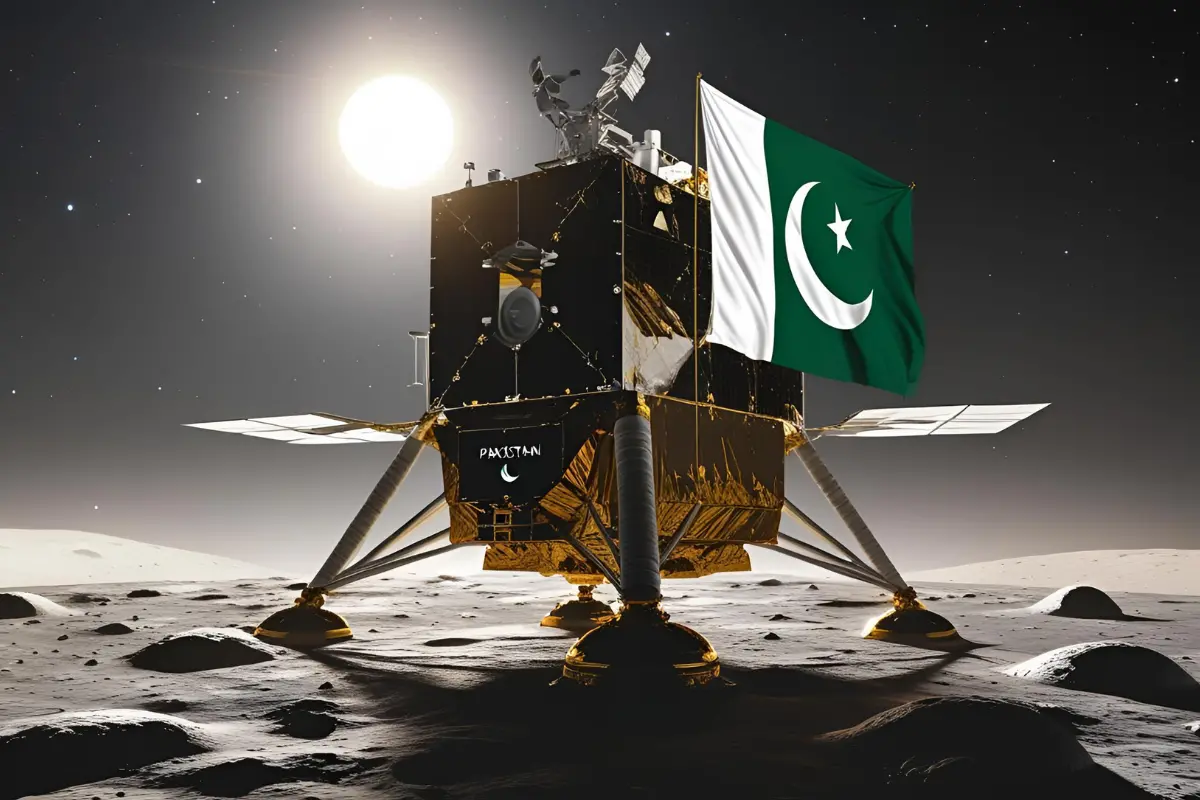
Beijing: In a bid to bridge the widening technological gap with India’s ISRO, Pakistan plans to land a spacecraft on the Moon by 2035 with help from China, according to Minister for Planning, Development and Special Initiatives, Ahsan Iqbal.
The announcement came during Iqbal’s recent visit to Beijing, where he met senior Chinese officials, including Shan Zhongde of China’s Atomic Energy Authority and Space Agency. Iqbal urged deeper strategic cooperation to fill longstanding gaps in Pakistan’s space and nuclear capabilities, Geo News reported.
Pakistan’s Space and Upper Atmosphere Research Commission (SUPARCO), which has yet to launch a satellite independently, has been tasked with the mission.
As a first step, Pakistan will contribute a 35-kg lunar rover to China’s Chang’e-8 mission in 2028. The rover will carry out scientific experiments, terrain analysis, and resource evaluation at the Moon’s south pole.
According to Geo News, the discussion between the two sides, framed as strategic cooperation, largely highlighted Pakistan's growing dependence on Chinese technology and expertise.
Iqbal promoted the "Uraan Pakistan" initiative, claiming that the country's Prime Minister Shehbaz Sharif has reinvigorated the country's stagnant space science sector, Geo News reported.
He noted that three Pakistani-made satellites were launched recently, though all with significant Chinese assistance, and Pakistan now hopes to again piggyback on China's space station to send its first astronaut by 2026, with no clear independent capability.
Iqbal called for increased Chinese support in nuclear energy and emerging technologies, including quantum computing—a field where Pakistan has limited native expertise.
SUPARCO was founded in 1961 by Nobel laureate Dr. Abdus Salam, who served as scientific adviser to then-President Ayub Khan.
Progress at SUPARCO has been hindered by limited government funding. The agency operates on an annual budget of roughly $36 million, far less than India’s space agency, ISRO, which receives substantially more.
SUPARCO has also been headed by retired military officers for the past 11 years. The appointments have sparked concerns about the agency’s scientific direction and long-term vision.
Moreover, Pakistan relies heavily on China for satellite launches and development, limiting its indigenous capabilities. Few universities in Pakistan offer space-related courses, restricting the growth of skilled professionals. (ANI)