Nepal-Tibet flash floods kill 162, leave over 1,300 missing; nearly 300 Indians among those untraced
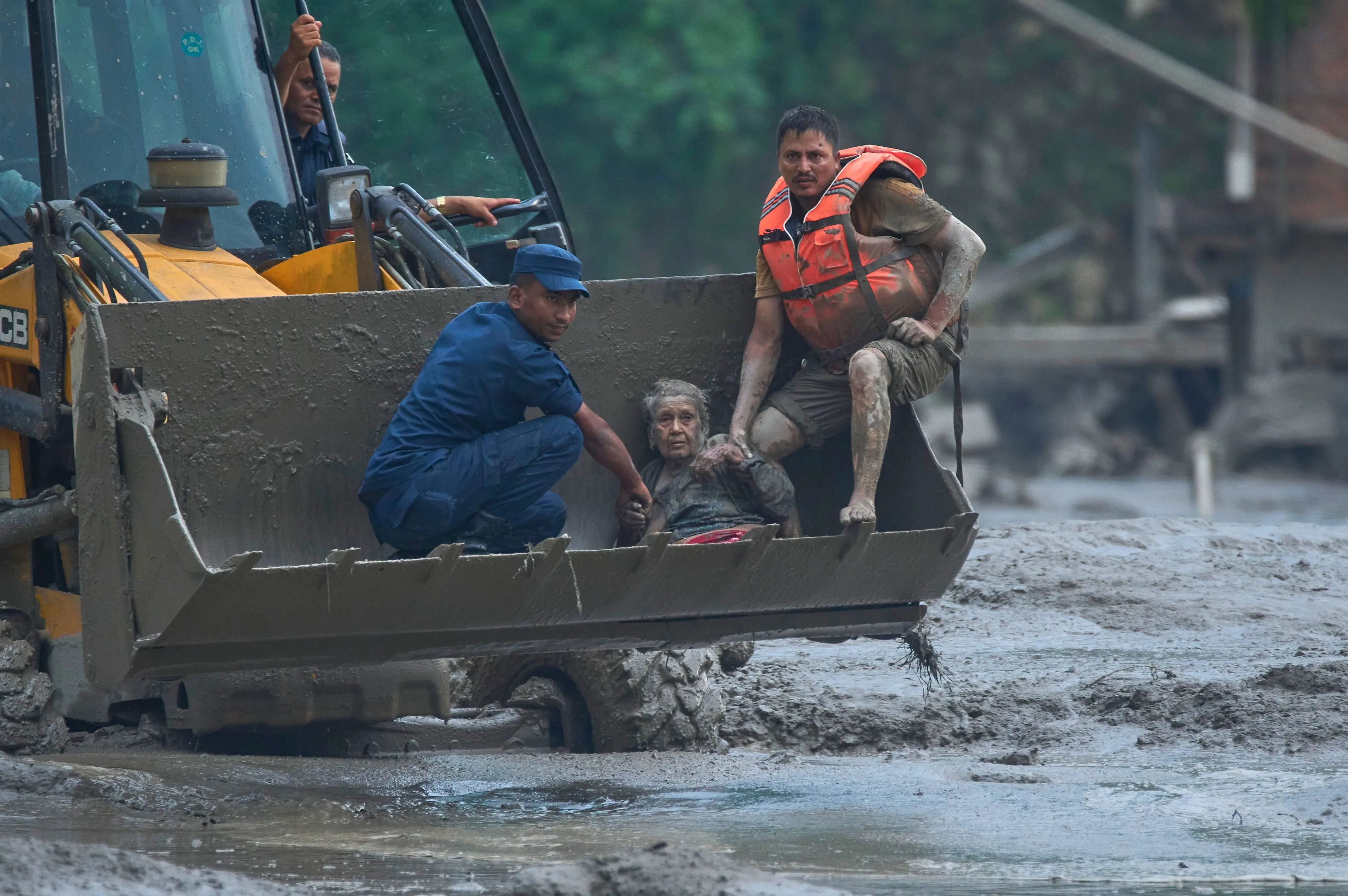
At least 162 people have died and more than 1,300 remain missing after devastating flash floods and landslides struck the Nepal-Tibet border, sweeping away homes, vehicles and entire stretches of villages. Nearly 300 Indians are among those reported missing, Nepal's Foreign Minister Shisir Khanal said on Thursday.
The disaster struck on Wednesday after an avalanche blocked the flow of the Lhende tributary of the Bhotekoshi River, with floodwaters first hitting Timure near the Nepal-China border at Rasuwagadhi. The flooding then tore through communities along the Bhotekoshi and Trishuli rivers.
Nepal Police said the death toll had risen to 162 on Thursday. Nepal's disaster agency said 823 people, including 579 Nepali and foreign tourists, remained out of contact in the country.
Across the border in Tibet, Chinese state media reported 558 people missing, including 260 foreigners, after a mudslide hit the Gyirong Port area. Three people were reported dead there.
Taken together, the figures put the number of people unaccounted for in Nepal and Tibet at more than 1,380, although authorities are still working to establish the full scale of the disaster.
Nearly 300 Indians among those missing
The tragedy has raised particular concern in India, with nearly 300 Indian nationals reportedly among those untraced in Nepal.
Earlier reports had said at least 133 Indians and 37 NRIs were among nearly 500 people missing. At least 50 of the Indians were pilgrims travelling for the Kailash Manasarovar Yatra.
The Indian Embassy in Kathmandu said it was coordinating with the Nepal government and relevant authorities for the rescue and relief of Indian nationals affected by the floods.
The embassy has issued emergency contact numbers for assistance: +977 985 131 6807 and +977 970 910 7500.
The Embassy of India in Beijing has also provided a WhatsApp helpline at 0086 185 1428 4905.
READ MORE: Nepal flood viral video: Elephant ‘rescuing’ stranded man is not from Nepal, here's the truth
The Nepal Tourism Board has issued additional assistance numbers, including the toll-free emergency number 1234, hotline 1144 and Tourist Police number 9851289445.
'Like an inland tsunami'
The scale and speed of the flooding left residents with little time to escape.
Surveillance footage from the Chinese side of the border showed a huge wall of mud and debris crashing into a multi-storey building on Wednesday morning. People could be seen running as the surge engulfed the structure, while buses and cars were swept away by the floodwaters.
Environmental historian Ruth Gamble of Australia's La Trobe University described the flow as "like an inland tsunami", saying it travelled nearly 170 kilometres down the Bhote Koshi valley into central Nepal.
The route is used by international tourists travelling between Kathmandu and Lhasa, with popular areas including Syabrubesi among those affected.
Raju Bhadel, a businessman in Nepal's Nuwakot district, said his brother-in-law called in distress after the family's house was swept away.
"They were crying and said their entire house had been swept away. Three family members were rescued, but his brother is still missing," he said.
Teacher Manok Mishra, also in Nuwakot, said he witnessed nine trucks being swept away, with people inside them.
Tourists among the missing
Nepal's tourism authorities said foreigners from India, Australia, Britain, Malaysia, the Netherlands, Portugal, South Africa, South Korea and the United States were among those who could not be contacted.
Hiking company Himalayan Glacier told AFP that 47 members of a group, including two children, were missing in Nepal. The company said its teams were checking hospitals receiving victims.
Many trekking companies do not operate tours during the monsoon season, but tourists and pilgrims still travel through the region. The flood also hit Syabrubesi, a gateway to popular trekking routes, as well as areas used by pilgrims travelling towards the base of Mount Kailash, a site considered holy by Buddhists and Hindus.
Rescue operations intensify
Rescue teams were searching through thick mud and sludge as floodwaters buried the lower floors of multi-storey buildings.
The Nepali Army was conducting flights and had rescued scores of people, while residents living close to rivers in danger zones were instructed to move to safer locations.
Subash Khatani was among those searching for a missing family member.
"He is among the missing from Rasuwa. That's why we are out to search for him," he said.
Nepal's Foreign Minister Khanal said authorities were still trying to determine the full extent of the destruction.
"Thousands of families have lost homes and are missing as of now. We are still trying to ascertain the full extent of the disaster," he said.
China has also stepped up rescue operations. Chinese leader Xi Jinping said the immediate priority was to search for and rescue missing people.
Tibet government officials mobilised nearly 800 emergency workers, 150 vehicles, sniffer dogs and speed boats, according to China's state-run Xinhua news agency.
The International Federation of Red Cross and Red Crescent Societies said it was sending emergency supplies including blankets, first-aid kits, stretchers and body bags.
Glacial collapse blamed for disaster
The United States Geological Survey initially treated the event as a magnitude 4.4 earthquake. Further analysis of seismic data and satellite imagery, however, led it to conclude that the disaster was caused by a glacial collapse and debris flow, rather than an earthquake.
The collapse triggered a massive flow of water, mud and debris downstream, producing catastrophic impacts in both Nepal and Tibet.
Climate change is contributing to glacier melt worldwide, increasing the risks associated with glacial lake floods and glacial collapses.
Qianggong Zhang, head of climate and environmental risks at the Kathmandu-based International Centre for Integrated Mountain Development, also warned of the possibility of another flood.
With a blockage still lodged upstream on the Nepal-China border river, authorities were preparing for the possibility of a second surge.
Traffic authorities in Tibet's Shigatse also warned that roads in the area were at risk of mudslides and unsafe for passage.
The floods have already affected seven districts in Nepal, with the disaster extending from Rasuwa in the north to Chitwan in the south, near the Indian border.
With AFP, PTI inputs