‘Modi San’ rides Japan’s bullet train; cherry blossom-inspired E10 model headed for Ahmedabad line | WATCH
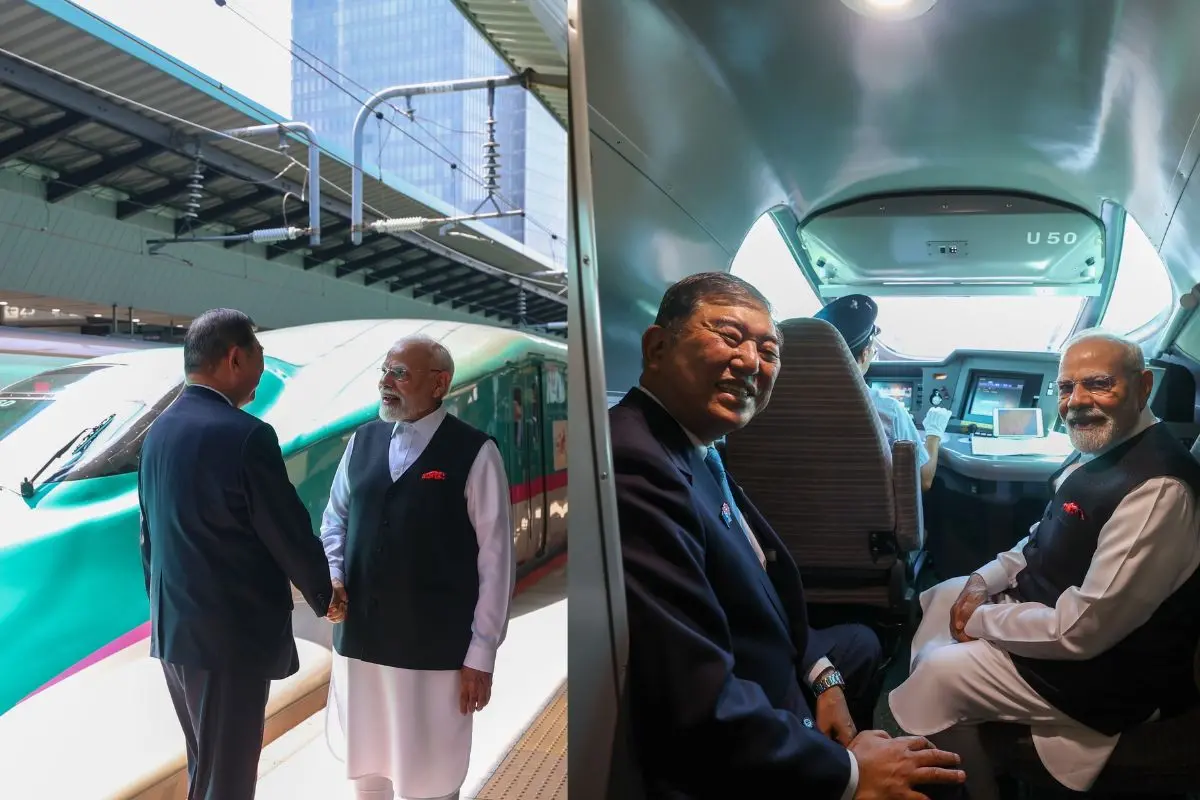
Tokyo/Sendai: On the second day of his official visit to Japan, Prime Minister Narendra Modi travelled aboard a Shinkansen (bullet train) alongside Japanese Prime Minister Shigeru Ishiba from Tokyo to Sendai.
People from all walks of life erupted into joyous chants to welcome PM Modi, shouting "Welcome to Japan, Modi San!" The Prime Minister expressed his happiness and greeted the crowd warmly. Among the enthusiastic gathering were many children, with whom PM Modi took time to interact.
PM Modi’s journey to Sendai, located in the Miyagi Prefecture, was part of his itinerary for the 15th India-Japan Annual Summit. The visit included inspections of key industrial sites, notably a semiconductor manufacturing facility and a bullet train coach production plant.
Japanese PM Shigeru Ishiba personally accompanied PM Modi on the Shinkansen. In a post on social media platform X, Ishiba shared, “With Prime Minister Modi to Sendai. Continuing from last night, I will be with you in the car.”
This symbolic gesture showcased the strong personal rapport and growing strategic partnership between the two nations.
What is the significance of the semiconductor facility Modi visited?
PM Modi toured a cutting-edge semiconductor plant near Sendai. The facility is being developed under the Japan Semiconductor Manufacturing Company (JSMC), a joint venture between Taiwan's Powerchip Semiconductor Manufacturing Corporation (PSMC), SBI Holdings and other Japanese partners.
Located in Ohira Village’s Second Northern Sendai Central Industrial Park, the plant aims to revive Japan’s domestic semiconductor industry. The production will begin with 40nm technology, later expanding to 28nm and 55nm nodes. It will focus on automotive electronics, aligning with rising global demand from EV and mobility sectors. Once fully operational, it is expected to produce 40,000 12-inch wafers per month.
PM Modi also met Indian train drivers currently undergoing training at Japan Railways (JR East). Ishiba posted on X, “Greetings with the Indian train drivers currently training at JR East.”
This highlights the India-Japan cooperation in high-speed rail, particularly in the context of the Mumbai-Ahmedabad bullet train project, which uses Japanese Shinkansen technology.
The Mumbai-Ahmedabad High-Speed Rail (MAHSR) project, was officially launched in September 2017. The foundation stone was laid by Prime Minister Narendra Modi and then Japanese Prime Minister Shinzo Abe in Sabarmati, Gujarat. This initiative followed a Memorandum of Understanding signed in December 2015, which aimed to develop India’s first high-speed rail corridor.
Initially, it was planned that the E5 series bullet trains, currently operating in Japan, would be deployed on the Mumbai-Ahmedabad route. However, with Japan’s announcement of the introduction of the advanced E10 series trains by 2030, Tokyo offered New Delhi the latest model instead.
The new E10 series trains, inspired by Japan’s iconic cherry blossom or sakura, are set to operate on the 508-kilometre high-speed corridor, which spans 352 kilometres in Gujarat and 156 kilometres in Maharashtra. These trains will be equipped with cutting-edge safety features, including earthquake-proof technology. The E10 uses ‘L-shaped vehicle guides’ to prevent derailment during seismic activity and lateral dampers to reduce vibrations, thereby enhancing passenger safety.
The Mumbai-Ahmedabad corridor, designed with Japanese Shinkansen technology, will allow bullet trains to travel at speeds exceeding 250 kilometres per hour on dedicated tracks. Commercial services are expected to commence by 2027, with prototype trials likely starting in 2026.
Beyond the bullet train: Key areas of India-Japan cooperation
PM Modi’s Japan visit marks a major step in advancing India-Japan ties across technology, infrastructure, defence, and trade. The visit reflects both nations’ shared vision for a free, open, and resilient Indo-Pacific and their commitment to future-ready industrial collaboration.
This is PM Modi’s 15th India-Japan Annual Summit with Japanese leadership and comes at a time when both countries are focusing on next-gen supply chains and critical technology partnerships, particularly in light of shifting global dynamics.