Meteor explodes over US with blast equivalent to 300 tonnes of TNT | VIDEO
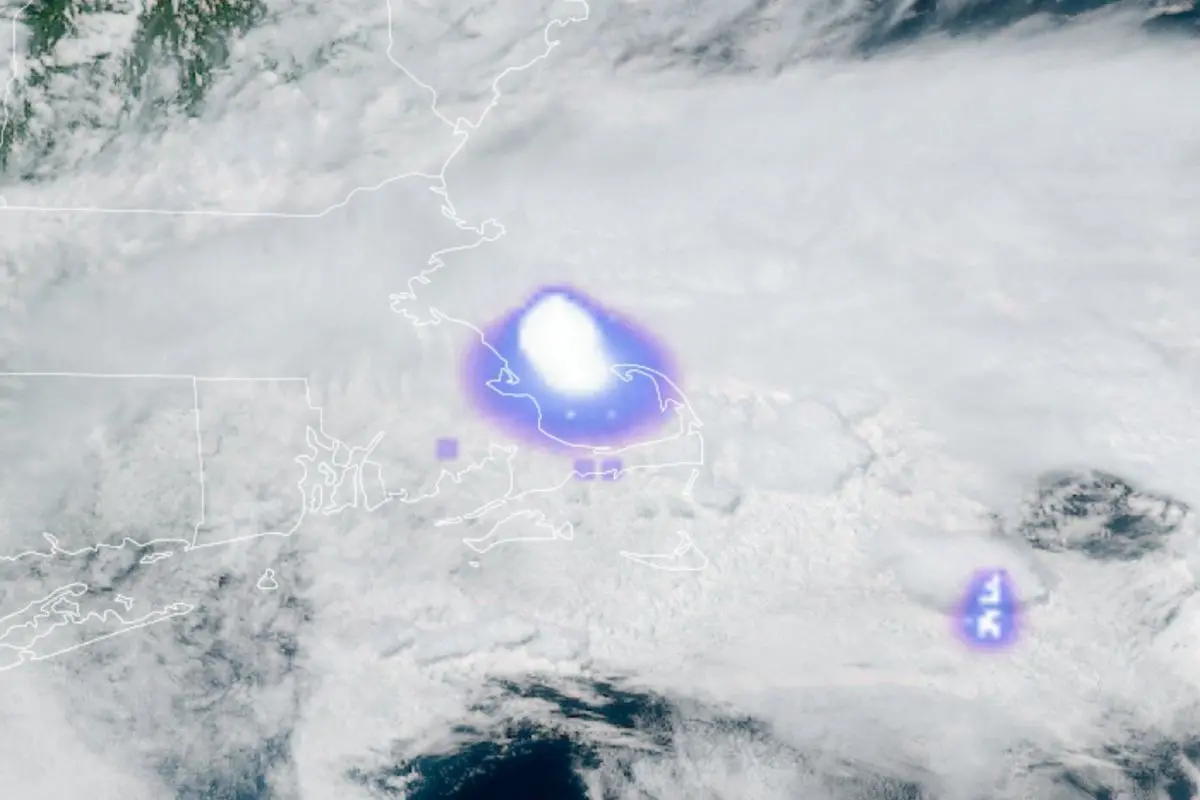
A meteor travelling at tens of thousands of miles per hour exploded high above the northeastern United States on Saturday, producing a brilliant fireball and a powerful sonic boom that startled residents across parts of Massachusetts and New Hampshire.
The space rock disintegrated in the atmosphere at around 2:06 pm EDT, releasing energy equivalent to approximately 300 tonnes of TNT, according to NASA. The explosion generated a bright flash visible across the region and loud booms that prompted a flood of reports on social media, with some residents saying the shockwave was strong enough to rattle homes.
Scientists said the meteor burned up before reaching the ground, leaving no reports of impact damage.
Fireball spotted over New England
According to NASA, the meteor fragmented at an altitude of about 40 miles (64 kilometres) above northeastern Massachusetts and southeastern New Hampshire.
Jennifer Dooren, NASA's deputy news chief, said the object was a naturally occurring meteor and was not linked to any active meteor shower.
"This fireball was not associated with any currently active meteor shower, but it was a natural object and not a re-entry of space debris or a satellite," Jennifer Dooren, who is the US space agency's deputy news chief, said in a statement. "The energy released at breakup is estimated to be equivalent to about 300 tons of TNT, which accounts for the loud booms."
Dooren said the meteor was travelling at roughly 75,000 mph (more than 120,000 kph) when it broke apart.
Residents across the Boston area and elsewhere in New England reported hearing a sudden explosion-like sound shortly after the fireball appeared in the sky. Many turned to social media to share videos, photographs and eyewitness accounts. Some users said the boom was so intense that it shook buildings and windows.
Satellite detects unusual flash
Meteorologists monitoring weather satellites also identified an unusual atmospheric flash that was not linked to storm activity.
Nick Stewart, a spaceflight meteorologist, wrote on X, "Reports of an explosion hears around Boston I believe are going to be a rather significant bolide/meteor entering the atmosphere. Very large 'flash' detected by GOES-19 GLM that does not correlate with active thunderstorms."
In a follow-up post, he added, "The flash density product really shows this anomalous 'flash' which is pretty distinctive of a bolide/meteor reentry. east of Boston. This is the likely source of the loud boom/explosion."
The observations were later supported by data collected by the National Oceanic and Atmospheric Administration's GOES-19 satellite.
NASA and NOAA confirm meteor breakup
NASA Space Alerts also addressed the incident on social media, citing both eyewitness reports and satellite observations.
"Eyewitnesses in New England and @NOAA's GOES-19 satellite reported a bright fireball on Saturday, May 30, at 2:06 p.m EDT accompanied by a loud noise."
"The meteor appears to have fragmented at an altitude of 40 miles over northeast MA and southeast NH. The energy released at breakup is estimated to be equivalent to about 300 tons of TNT, which accounts for the loud noise," it added.
USGS identifies sonic boom
The United States Geological Survey said the disturbance was consistent with a meteor-generated sonic boom rather than seismic activity.
According to the agency, it was a "widely felt sonic boom from a suspected bolide".
"Unlike earthquakes which occur at discrete location in the earth, sonic boom events occur along a linear path in the atmosphere," the agency added.
Scientists routinely track such events using specialised monitoring systems designed to detect explosions in the atmosphere. While meteors enter Earth's atmosphere frequently, most are much smaller and burn up unnoticed. Larger objects can create dramatic fireballs and loud shockwaves when they fragment.
Comparison with Russia's Chelyabinsk event
Although the New England meteor generated considerable attention, experts noted that it was far less powerful than the meteor that exploded above the Russian city of Chelyabinsk in 2013.
That house-sized space rock detonated about 14 miles (23 kilometres) above the ground, releasing energy equivalent to roughly 440,000 tonnes of TNT, according to NASA. The blast shattered windows across a vast area and injured more than 1,600 people, most of them from flying glass.
(With AFP inputs)