Hamas chief Ismail Haniyeh killed in Tehran; Iran blames Israel
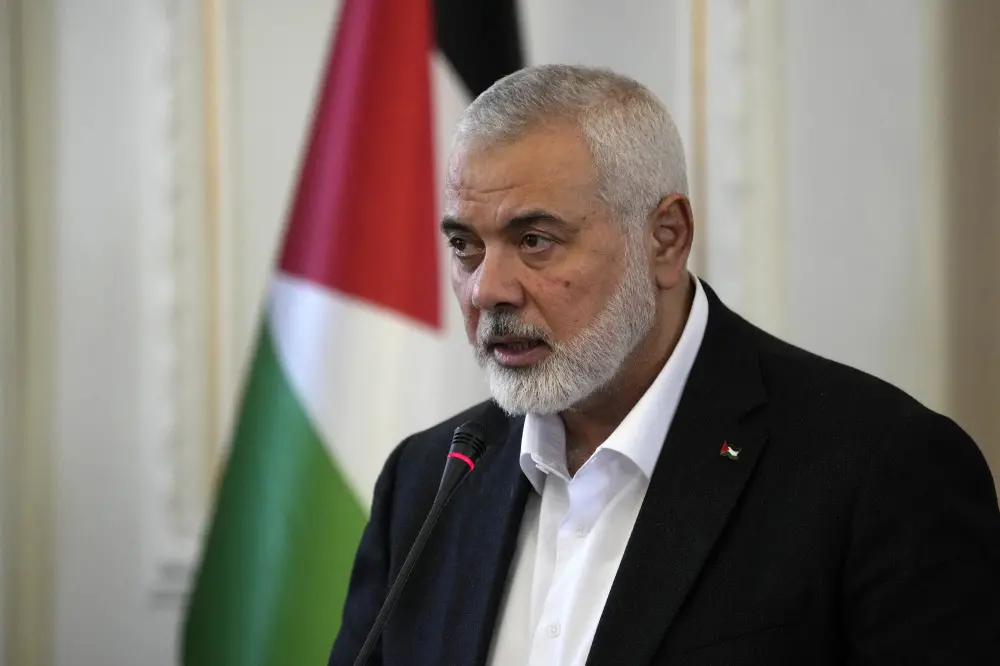
Iran's Islamic Revolutionary Guard Corps (IRGC) has confirmed the assassination of Hamas Chief Political Leader, Ismail Haniyeh, who was killed alongside one of his bodyguards at his residence in Tehran, while he was in town from Qatar for the inauguration of President Masoud Pezeshkian.
Hamas released a statement shortly after the announcement, claiming that Haniyeh was martyred in a "Zionist aggression" on his home in Tehran, following his attendance at the inauguration ceremony of Iran's new president. The IRGC statement gave no details on how Haniyeh was killed. State TV reported on his death early Wednesday. Just a day ago, Haniyeh had met with Iranian Supreme-Leader, Ali Khamenei and President Masoud Pezeshkian.
Palestinian outfit Hamas confirmed that an Israeli strike in Tehran claimed the life of its chief, Ismail Haniyeh.
"Brother, leader, mujahid Ismail Haniyeh, the head of the movement, died in a Zionist strike on his headquarters in Tehran after he participated in the inauguration of the new (Iranian) president," the movement said in a statement.
Analysts on Iranian state television promptly pointed fingers at Israel, accusing the country of responsibility. Israel typically refrains from commenting on such incidents, particularly those allegedly carried out by its intelligence agency, Mossad.
Israel has been suspected of conducting a prolonged campaign of targeted assassinations against Iranian nuclear scientists and individuals linked to the country's nuclear program. Notably, in 2020, prominent Iranian nuclear scientist Mohsen Fakhrizadeh was fatally shot by a remote-controlled machine gun while traveling in a vehicle near Tehran.
US Secretary of Defense Lloyd Austin expressed hope that Israel can achieve a diplomatic solution and de-escalate the situation, despite recent developments. Speaking to reporters in Manila, Philippines, Austin stated, "I do not believe war is inevitable. There is always room for diplomacy, and I encourage parties to pursue those opportunities."
However, Austin noted that the US has been monitoring events on Israel's border with Lebanon with concern. "We will take all necessary steps to prevent a broader conflict in the region," he emphasized.
When asked about the US response if the conflict were to escalate into a wider war, Austin reaffirmed his previous statement: "If Israel is attacked, we will certainly assist in its defense." He referenced the US's actions in April as an example, adding, "We will take similar measures again if necessary."
Austin stressed that the US prioritizes diplomatic solutions, saying, "We will work diligently to reduce tensions and address issues through diplomatic means, rather than resorting to conflict."
CIA Director Bill Burns had met senior officials from Israel, Qatar, and Egypt in Rome on Sunday, as part of ongoing efforts to facilitate a resolution.
Meanwhile, Brett McGurk, the White House Coordinator for the Middle East and North Africa, is currently in the region engaging in talks with key US partners. These diplomatic efforts aim to address the escalating tensions and promote a peaceful resolution.
The killing marks a significant moment in the nine-month-old war in Gaza. The timing of the incident is particularly sensitive, as the Biden administration has been actively seeking to broker a temporary cease-fire and hostage-release agreement between Hamas and Israel.
Hamas' October 7 attack sparked the war when terrorists stormed into southern Israel, killing some 1,200 people -- mostly civilians -- and abducting about 250. Since then, Israeli ground offensives and bombardments have killed nearly 40,000 people in Gaza and more than 90,900 wounded, according to the territory's Health Ministry. However, the ministry's tally does not distinguish between civilian and combatant casualties.
In April, the Israel Defense Forces (IDF) confirmed that three sons of Hamas political leader Ismail Haniyeh were killed in an Israeli Air Force airstrike. The deceased were identified as Amir Haniyeh, a Hamas military cell commander, and his brothers Mohammad and Hazem Haniyeh, who were also Hamas military operatives. The IDF announced on April 10 that the airstrike targeted the three individuals in central Gaza, confirming their identities and affiliation with Hamas.
Additionally, the IDF reported the elimination of Fuad Shukr, also known as "Sayyid Muhsan," who was Hezbollah's senior military commander and right-hand man to leader Hassan Nasrallah. According to the IDF, Shukr was responsible for numerous attacks on Israel, resulting in the deaths of 12 children in Majdal Shams, as well as several Israelis and foreign nationals. He was also allegedly responsible for managing Hezbollah's advanced weaponry, including precision-guided missiles, cruise missiles, anti-ship missiles, long-range rockets, and UAVs.
AP with Additional Inputs from Agencies