SPECIALSChina's fourth aircraft carrier puts India and Indo-Pacific on notice
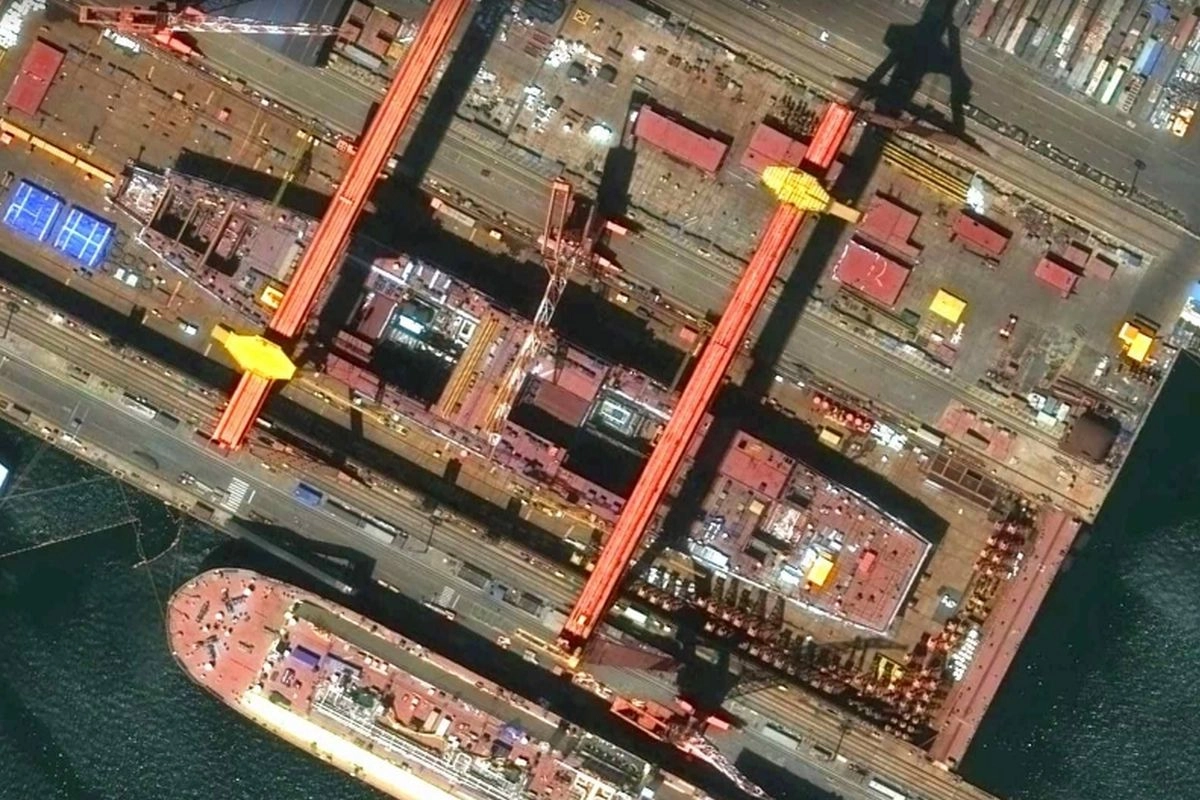
China's fourth aircraft carrier, a colossal vessel known so far only as the Type 004, is rapidly taking shape at the Dalian Shipyard in Liaoning province, with recent satellite imagery showing further progress on the hull, flight deck and bow.
Defence analysts say the ship -- expected to be China's largest and first nuclear-powered carrier -- could be launched as early as 2027, a development that would push Beijing closer to rivalling the United States Navy and reshape the security calculus across the Indo-Pacific, including for India.
As of October 2026, the unfinished hull measured approximately 322 metres from bow to stern and about 46 metres across, according to the Center for Strategic and International Studies (CSIS), which described the Type 004 as "far larger than any other class of surface combatant" in China's navy.
The carrier is expected to accommodate between 75 and 90 aircraft once deployed, according to the Asia program director at the think tank Defence Priorities.
Collin Koh, a senior fellow at Singapore’s Nanyang Technological University, said the fourth carrier was likely to be somewhat larger than the Fujian. With its basic hull already assembled, a launch in 2027 appeared possible, although operational deployment could still be five to ten years away.
The vessel is being assembled using modular construction, with large prefabricated sections joined in the same Dalian dry dock where China's first carrier, the Liaoning, was completed and the second, the Shandong, was built. CSIS has compared the Type 004's October 2026 construction stage to that of the Fujian in May 2021 -- roughly one year before the Fujian was launched.
A 2027 launch would coincide with the centenary of the People's Liberation Army on August 1, though there is no official confirmation of such a schedule.
Nuclear propulsion: the defining leap
The most consequential feature of the Type 004 is its likely nuclear propulsion. CSIS's October 2026 assessment judged nuclear power "likely," pointing to two approximately 15-by-15-metre compartments within the hull that appear consistent with shielded reactor containment structures -- and which were not present on the conventionally powered Fujian. Janes reached a similar preliminary assessment based on the compartments' dimensions and multilayered construction, though China has not officially confirmed the propulsion system.
David Silbey, a Cornell University professor specialising in military history and defence policy, told Navy Times that nuclear propulsion would substantially extend the carrier’s operating endurance by removing the need to refuel its propulsion system during routine deployments.
For flight operations, the advantages are equally significant. Nuclear propulsion would offer more electrical power than China's existing electromagnetic aircraft launch system (EMALS), eliminating the need for onboard power generators while enabling faster takeoffs -- without payload compromises -- and quick combat turnarounds for refuelling, Koh said.
Koh said the anticipated use of nuclear propulsion pointed to ambitions beyond coastal operations, suggesting China wanted a carrier capable of supporting a wider global naval presence.
Closing the gap with the US Navy
Silbey said the new vessel could approach American Nimitz- and Ford-class carriers in size and accommodate a considerably larger air wing than China’s earlier carriers, increasing its potential striking power. The US Navy operates 11 carriers, all nuclear-powered.
Even with a smaller fleet overall, a Chinese navy with nuclear-powered carriers can mount a challenge to the United States, Koh said -- particularly given US bases in Guam, Hawaii and Japan and treaty alliances with Japan and the Philippines. Silbey said China’s carrier expansion would give its navy a capacity for distant operations that it had not previously possessed, potentially bringing American assets elsewhere in the Pacific within reach of carrier-based aircraft.
The pace of construction at Dalian also contrasts sharply with American shipbuilding delays. An April 2026 Congressional Budget Office assessment found that US destroyers and submarines now take nine to ten years to build, up from five to six in the 2000s, while Ford-class carriers require an estimated ten to eleven years.
The Type 004's air wing is expected to mirror the Fujian's: J-35 stealth fighters, J-15T catapult-capable fighters, J-15DT electronic warfare aircraft and KJ-600 airborne early warning and control aircraft, with the potential to operate unmanned naval aircraft as well.
Geopolitical ripples across the Indo-Pacific
The carrier's emergence comes at a tense moment. China has deployed an especially large number of naval assets near Japan's southernmost islands since a political rift erupted in November 2025 over remarks by Japanese Prime Minister Sanae Takaichi, while the Philippines remains locked in a maritime sovereignty dispute with Beijing.
Analysts expect the Type 004 to add pressure on countries such as Japan and the United States that already maintain high alert for the Chinese military.
Alexander Huang, chairman of the Council of Strategic and Wargaming Studies in Taipei, said a fourth carrier would give China greater flexibility to maintain an operational deployment while other ships underwent maintenance or supported training. The vessel may also be used for training and maintenance as well as operations.
A December 2025 Pentagon disclosure indicated China plans to construct six Type 004 carriers by 2035, suggesting the ship now nearing completion is the leading edge of a much larger buildout.
What it means for India
For India, the Type 004 represents the most serious challenge yet to its traditional dominance of the Indian Ocean Region (IOR). Indian analysts note that China requires a minimum of four carriers to permanently deploy one carrier group in the Indian Ocean throughout the year -- a threshold the Type 004 would allow Beijing to cross.
India currently operates two carriers, INS Vikramaditya and INS Vikrant, both ski-jump designs, and is only now replacing its MiG-29K fighters with Rafale M aircraft. A Chinese carrier group with catapult-launched stealth fighters and airborne early warning aircraft would outclass either Indian carrier on paper, analysts note—a gap that is expected to intensify debate over whether India needs a third, larger carrier of its own.
Research from the National Maritime Foundation warns that the possibility of a dual-carrier PLA Navy presence in the Indian Ocean would force a substantial rethink within India's maritime security establishment -- covering fleet missions, exercises, operational plans, long-range intelligence, surveillance and reconnaissance employment, sub-surface concepts of operations and readiness levels.
The concern is compounded by China's lack of supporting infrastructure in the Indian Ocean. While a shortage of foreign bases has hampered Chinese power projection -- particularly in the IOR -- Beijing is working to mitigate that vulnerability, including through its deepening ties with littoral states.
Indian strategic thinking, per the National Maritime Foundation, centres on an "active denial strategy" in the eastern Indian Ocean: exploiting geography so that any Chinese carrier entering Indian Ocean waters through the narrow Southeast Asian straits would be vulnerable to attack by Indian submarines and fighter aircraft at longer ranges. Whether India can close critical gaps in carrier aviation, undersea warfare, maritime domain awareness and sea-denial capabilities will determine whether the Indian Navy can preserve a favourable balance of power in the region.
India, for its part, is not standing still. In May 2026, New Delhi approved the development of a strategic outpost near a key Indo-Pacific shipping lane, part of a broader effort to strengthen its position along critical maritime corridors.
The overall security picture
The Type 004's approach to completion marks a transition in Chinese naval strategy -- from regional sea denial toward sustained blue-water power projection across the Indo-Pacific. Nuclear propulsion removes the single greatest constraint on Chinese carrier operations: the need to stay near refuelling networks.
For the United States and its allies, the carrier adds a new dimension to an already intensifying competition. For India, it compresses the timeline available to modernise its fleet and deepen partnerships with like-minded navies in the Quad and beyond.
A launch -- possibly as early as 2027 -- would be a symbolic moment, potentially timed to the PLA's centenary. But analysts caution that a launch is not a commissioning: fitting out, sea trials and the mastery of complex carrier strike group operations would follow, an area where the US Navy retains unmatched institutional experience.
The true impact of the Type 004 will unfold over the decade that follows, as China works toward its ambition of a six-carrier navy by 2035.