Century-old mystery solved: Lost page of Archimedes’ legendary manuscript found
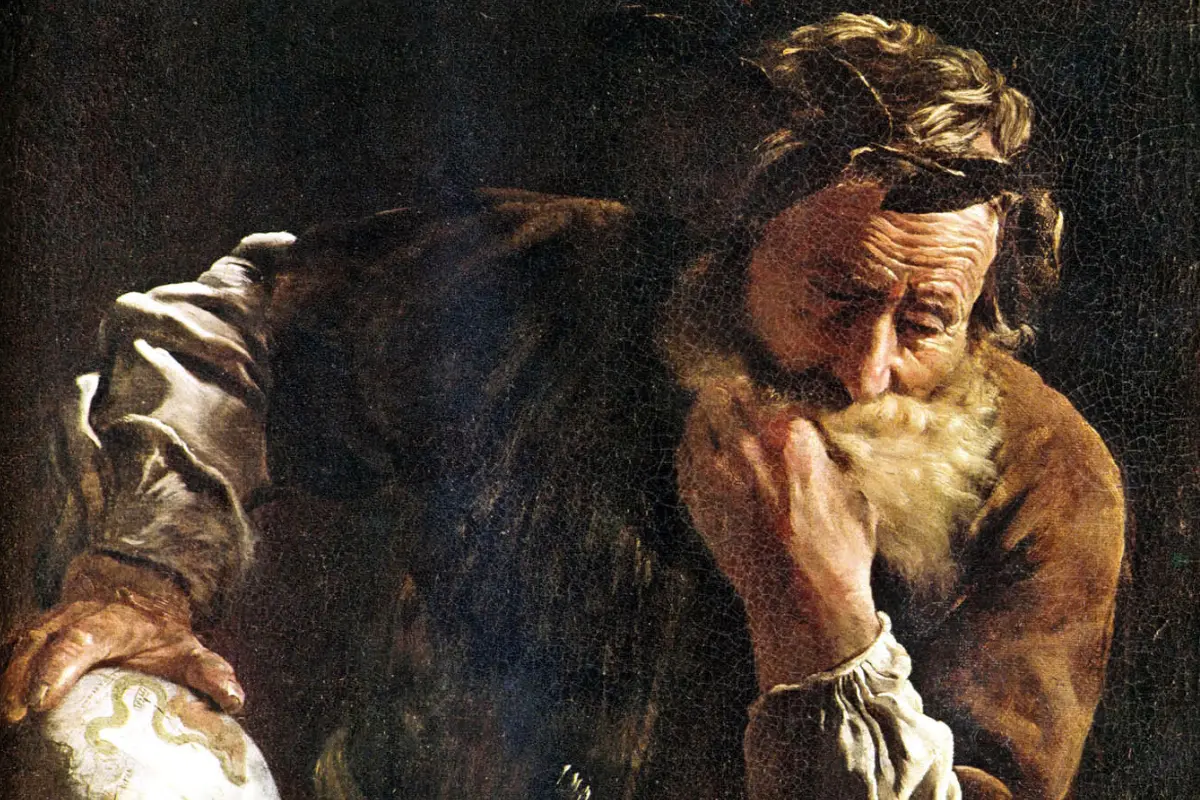
Paris: A long-missing page from the legendary manuscript of ancient Greek mathematician Archimedes has been discovered in the archives of a French museum, in what researchers describe as a remarkable find that sheds new light on one of history’s greatest scientific minds.
The discovery was made by researcher Victor Gysembergh of the French National Centre for Scientific Research (CNRS), who found the page of the famous Archimedes palimpsest while examining digitised manuscript catalogues.
“It all started off as a joke,” Gysembergh told AFP, explaining how a casual conversation with colleagues eventually led to the unexpected discovery.
Archimedes, widely regarded as one of the greatest mathematicians and inventors of antiquity, lived in the third century BC in the Greek city of Syracuse. Among his many discoveries was the principle of buoyancy — a moment famously associated with his cry of “Eureka!” after stepping out of a bath.
Many of his works survived through the centuries in a manuscript known as a palimpsest — a handwritten parchment whose original text was scraped off and overwritten, sometimes several times.
Gysembergh described the manuscript as a “treasure trove of lost texts from antiquity.”
Besides mathematical treatises, the document also contains Archimedes’s “philosophical, literary and religious” writings, he said.
The surviving manuscript was not written by Archimedes himself but was copied around the 10th century AD. Roughly two centuries later, the original scientific text was erased and the parchment reused as a Christian prayer book.
Over time, the manuscript travelled across several regions. By the 19th century it was held by the Greek Orthodox Patriarchate of Jerusalem and stored in a library in Constantinople, now Istanbul.
In 1906, Danish historian Johan Ludvig Heiberg photographed every page of the manuscript, preserving a crucial record of the document.
However, the manuscript disappeared during World War I and later resurfaced in the private collection of a French family. It was eventually auctioned in 1998 and purchased by an anonymous Western businessman. According to reports cited by Der Spiegel, insiders suggested the buyer may have been Jeff Bezos, though the identity has never been officially confirmed.
At the time, three of the manuscript’s 177 pages were missing.
Gysembergh, who studies palimpsests to uncover lost ancient texts, said: “I am interested in palimpsests because they are a way to discover lost texts.”
The rediscovery of the missing page happened unexpectedly. While chatting with colleagues, he recalled that French kings once kept part of their library in the central French city of Blois.
“Hey, let's see if there's a palimpsest in Blois,” he told his colleagues.
Searching through Arca, an online catalogue of digitised manuscripts, he found a listing in the city’s museum of fine art.
“It was very unexpected to stumble upon a Greek manuscript,” Gysembergh said.
“And even more so to find a 10th-century scientific treatise!”
After comparing the manuscript with the photographs taken in 1906, Gysembergh confirmed the match, noting that the handwriting, geometric diagrams and even scribal errors were identical.
One side of the page contains part of Archimedes’s treatise “On the Sphere and the Cylinder,” which presents early calculations of a sphere’s surface area and volume. The other side features a later drawing believed to have been added in the early 20th century in an attempt to increase the document’s value.
To reveal the hidden text beneath the drawing, Gysembergh plans to use advanced techniques such as multispectral imaging and X-ray fluorescence in the coming year.
He also hopes the discovery could lead to the recovery of the remaining two missing pages.
“Until this discovery, we had no reason to hope we would ever find them,” he said.
“Now, if institutions or private collectors have this kind of manuscript, they should think about whether it could be one of the other lost pages.”