Narrow margins over Cape Town: Why a low-level stadium flypast is raising aviation safety questions
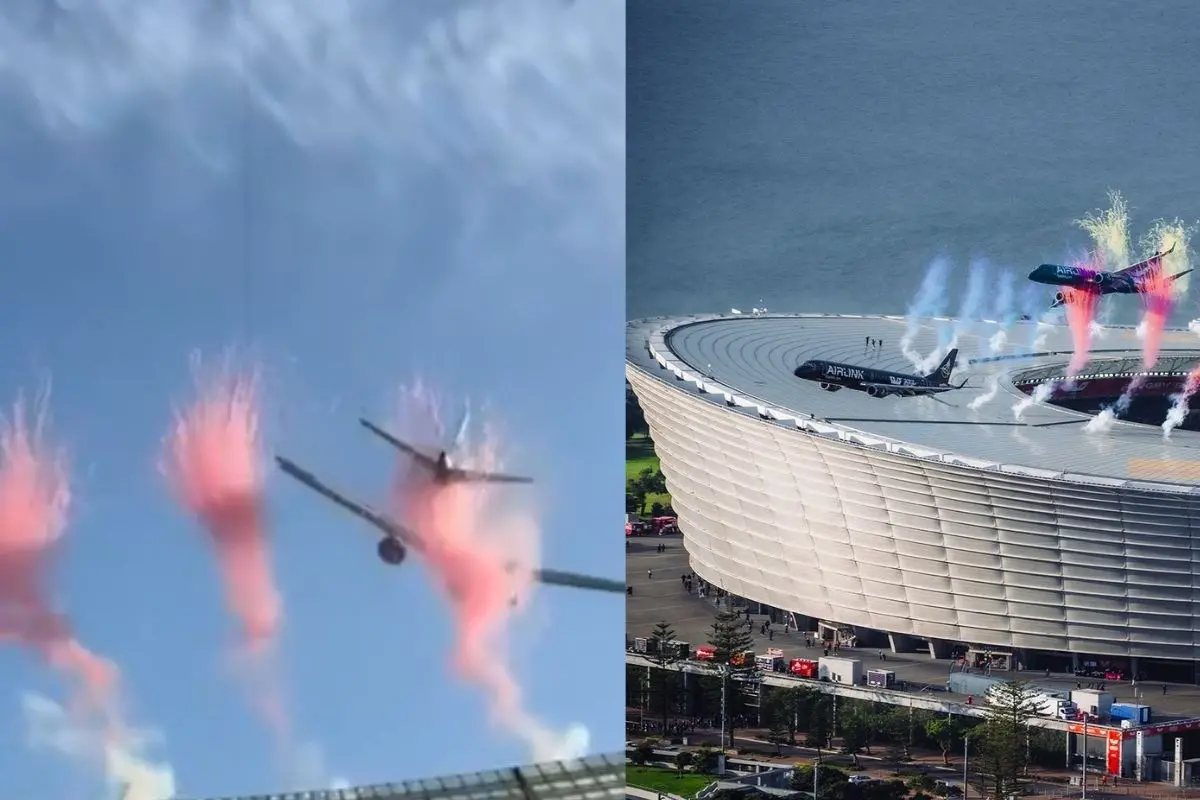
A spectacular formation flypast over Cape Town’s DHL Stadium ahead of the South Africa versus New Zealand rugby match has split opinion, sparking intense debate within the global aviation community regarding margins of safety and risk management.
The display featured two Airlink Embraer E-Jets—decked out in green and black liveries—performing a low-altitude pass above the 55,000-capacity venue. While thousands of spectators inside the stadium roared in approval, broadcast angles and telemetry data raised immediate concerns among professional aviators.
Flight-tracking telemetry indicated a minimum ADS-B pressure-altitude reading of 50 ft. After adjusting for local atmospheric pressure, experts calculated the jets’ actual altitude at roughly 205 to 210 ft above sea level. Given that the DHL Stadium stands approximately 164 ft high near sea level, the aircraft appear to have cleared the roof structure by a mere 40 to 50 ft.
Adding to safety concerns was the presence of active stadium pyrotechnics. Footage captured the lead aircraft sweeping dangerously close to, if not directly through, rising fireworks debris. Ingestion of pyrotechnic remnants into commercial jet engines presents severe risks of thermal damage or compressor stalls, whilst physical strikes can puncture or abrade control surfaces.
Airlink issued a statement reassuring the public that the flypast was fully authorised by the South African Civil Aviation Authority (SACAA) and Air Traffic and Navigation Services (ATNS). The regional carrier highlighted that each jet was crewed by three senior captains. However, aviation safety relies heavily on a mature safety culture that continually questions whether executed manoeuvres provide sufficient margins for error. In the event of an unexpected bird strike, atmospheric turbulence, or engine malfunction at such a low height, recovery options would have been virtually non-existent.
The public response online instantly reflected this sharp divide between thrill and technical alarm. Supporter sentiment celebrated the sheer audacity and technical execution of the flight, with Airlink themselves praising the display as a masterclass in planning, precision, and performance. Local fans applauded the event as a spectacular showcase of South African aviation skill, defending the flypast as a calculated display executed by exceptionally competent pilots who land passenger jets in harsh weather conditions every day.
Conversely, the aviation community on social media voiced deep discomfort with the flight path. Observers pointed out that both aircraft—and particularly the lead jet—appeared excessively low, raising concerns that stadium pyrotechnics had not been properly factored into the operational briefing. Other spectators described the maneuver as dicey and dangerously low to the point of being potentially catastrophic, pointing out that any tail-strike near the roof of a stadium packed with thousands of spectators left virtually zero margin for error.