Techies in Kerala's capital city join the Cockroach Janata Party wave
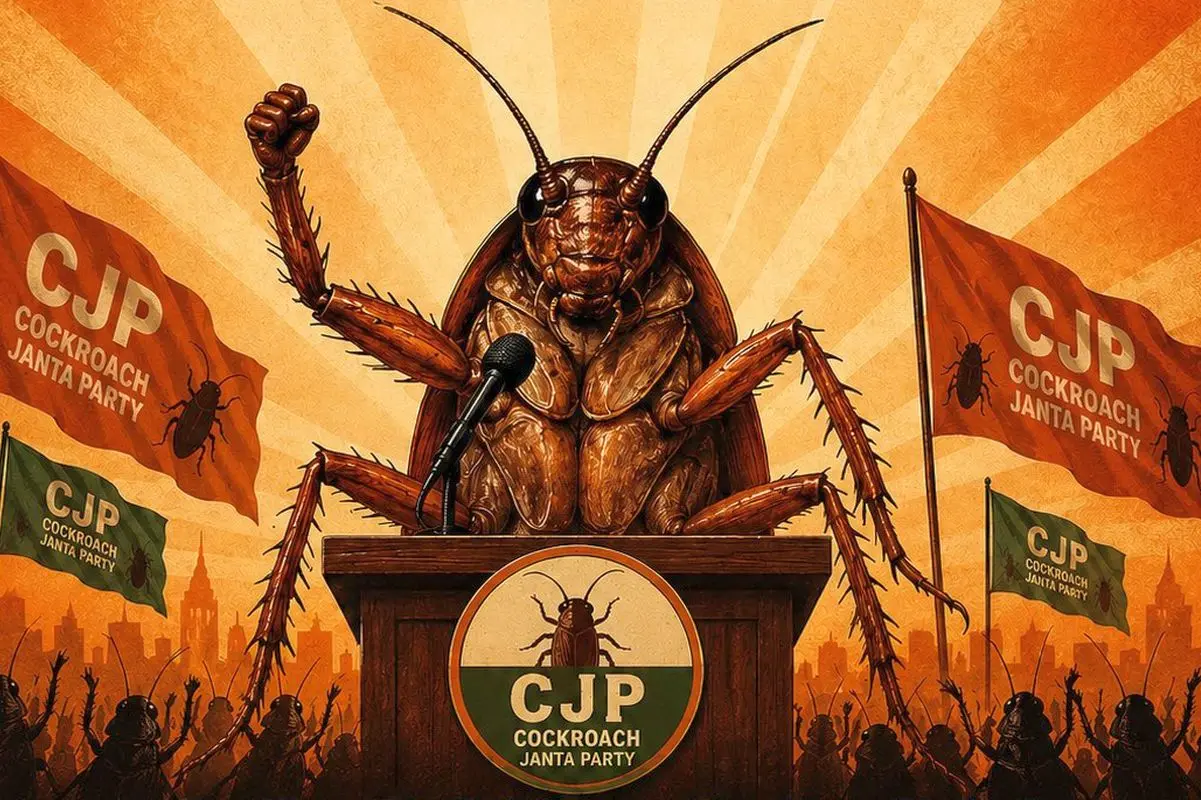
Thiruvananthapuram: The 'Cockroach Revolution' has arrived in Kerala. In the bustling corridors of Thiruvananthapuram’s Technopark, the Cockroach Janata Party (CJP), a satirical digital movement, is finding an unexpected and enthusiastic audience among the state’s tech-savvy youth.
The movement, which has already amassed over 21.9 million followers on Instagram, has become a regular topic of discussion during lunch breaks and office hours. In the capital city’s IT hub, which employs approximately one lakh professionals, an estimated 20,000 employees have already followed the CJP account. The movement is particularly popular with 'Gen Z' followers, who argue that being unemployed is not a crime and that the responsibility for job creation lies firmly with the government.
Legal expert J. Sandhya said the controversy surrounding the movement has struck a nerve. "The Chief Justice's remarks about unemployed youth could have been avoided; this has had a negative impact," she observed, adding that "a majority of the youth are unemployed, and this can be resolved by creating more jobs." Rohit, an employee at Technopark, echoed these sentiments, stating that "such remarks give a wrong message to society" and that "unemployment can be reduced with the Central government creating more jobs."
Allegations of a cross-border plot
However, the rapid rise of the CJP has met with strong resistance from the Bharatiya Janata Party (BJP) in Kerala. State BJP President Rajeev Chandrasekhar has alleged that the campaign is not merely satire but a "cross-border influence operation" designed to destabilise the nation. Describing the CJP as a coordinated gambit, Chandrasekhar claimed the initiative is driven by "vested interests" and supported by elements within the Indian Opposition to target the government of Prime Minister Narendra Modi.
The BJP has formally demanded an investigation by the National Investigation Agency (NIA) into the campaign. Chandrasekhar warned that in an era of social media and Artificial Intelligence, the weaponisation of bots and false narratives poses a serious threat to national stability. He maintained that India’s economic modernisation under the current leadership has drawn international resentment, leading to attempts to create hurdles to derail the country’s progress. Despite these "influence operations," the BJP leader asserted that the nation remained resilient through global crises such as the pandemic and international conflicts.
Origins of the satirical surge
The CJP was founded by political communications strategist Abhijeet Dipke following a controversy involving Chief Justice of India (CJI) Surya Kant. During a court hearing on senior designations for lawyers, the CJI reportedly used the terms "parasites" and "cockroaches". While the remarks triggered immediate online outrage, the CJI later clarified that his comments were taken out of context and were specifically directed at individuals entering the legal profession through "fake and bogus degrees" rather than legitimate practitioners.
Digital crackdown and resistance
The confrontation has now shifted to the digital space. On Thursday, the CJP’s account on X (formerly Twitter) was withheld in India. The move was swiftly followed by the emergence of a new handle, 'Cockroach is Back', carrying the defiant tagline 'Cockroaches Don't Die'.
This digital restriction drew sharp criticism from the Internet Freedom Foundation, a digital rights group, which described the withholding of the account as a "misuse of state power". Despite the crackdown and allegations of foreign interference, the movement continues to resonate with young Indians, particularly in states like Kerala, where the debate around unemployment remains a persistent political issue.