Not every fish frenzy is a Chakara: Understanding Kerala’s sardine dumping phenomenon
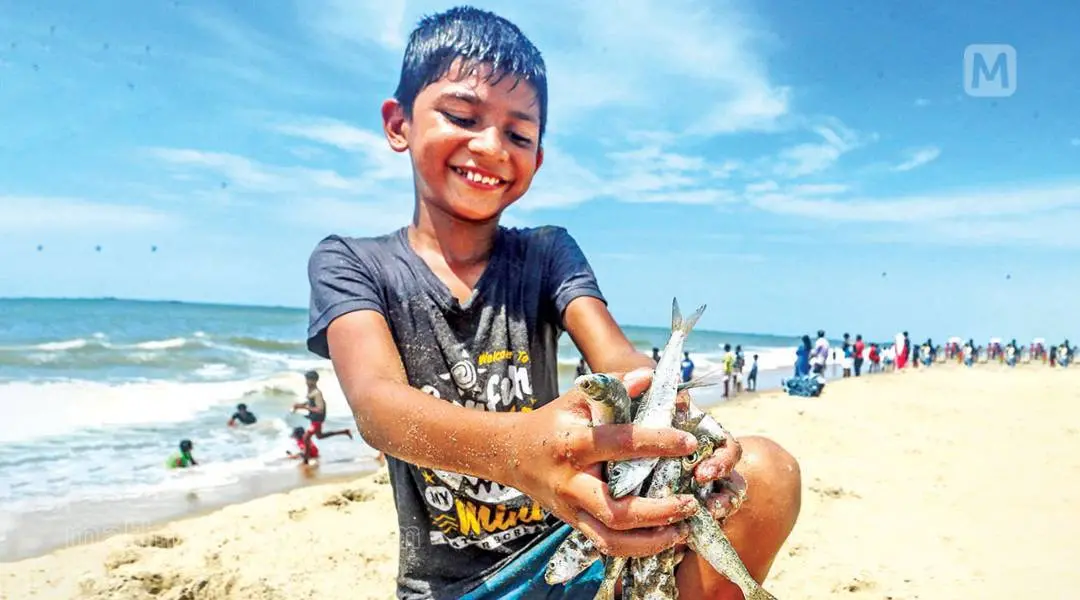
There is a recurring trend where media reports often use the term 'chakara' or mudbank formation when sardine dumpings occur at the seashores of Kerala. However, experts question the accuracy of these claims. According to them, fisherfolk and the media often use the term 'chakara' loosely to describe large quantities of fish, aiming to express abundance rather than to identify a specific phenomenon.
In October, initial media reports of sardine dumping at Kozhikode’s Konnad beach labelled it as 'chakara'. However, later reports clarified that the event was caused by changes in seawater salinity, not a 'chakara' formation. This is not an isolated incident; in 2019, a major sardine influx was reported near Kanhangad during the final phase of the summer monsoon. The waves deposited large quantities of sardines on the beach, which was initially called 'chakara'. A study by the Central Marine Fisheries Research Institute (CMFRI) later found that Fragilariopsis oceanica, a diatom, dominated the sardines' diet. The presence of this bloom suggested a feeding frenzy, not a 'chakara', and the event was reclassified as a "sardine run."
Sardine dumpings have been reported in various districts, including Thrissur, Malappuram, and Alappuzha. Experts assert that event-specific studies, like the one conducted in Kanhangad, are essential to determine whether sardine dumping is truly a 'chakara', a sardine run, or another phenomenon linked to climatic factors.
Mudbanks vs Sardine runs
To understand the sardine dumping phenomenon, it is essential to differentiate between the distinct phenomena of mudbanks and sardine runs. Mudbanks and sardine runs both impact local marine ecosystems but in very different ways.
A mudbank, or 'chakara', is a calm, nutrient-rich area of seawater formed by sediment settling, typically following the southwest monsoon. These conditions attract various fish species, including sardines, and lead to increased fishing activity due to easier catches.
In contrast, the sardine run is a seasonal migration where vast numbers of sardines move along the coast, driven by changes in water temperature, food availability, and ocean currents. Unlike mudbanks, sardine runs occur independently of sediment formation and bring large numbers of sardines near the shore.
Not all sardine dumpings are associated with mudbanks. Sardine accumulation near the shore can occur without the formation of a mudbank. While mudbanks attract multiple fish species, sardine runs primarily focus on large sardine schools, creating a distinct fishing event.
Grinson George, Director of CMFRI, pointed out that in Kerala, sardine dumping is more often caused by sardine runs than by mudbanks. “Sardine runs can be triggered by various factors, including sudden changes in the seawater environment, such as volume, temperature, and salinity. For example, localised, high-intensity rain over a short stretch of time can affect the salinity and temperature, causing sardines near the surface to move closer to shore, where they may even jump onto the shore due to these environmental shifts.”
Mudbanks and Kerala fisheries
A recent study has given a different perspective on understanding of mudbanks and their role in Kerala’s fisheries. A 2018 study titled 'Mudbanks and Fisheries along the Kerala Coast – Myth and Reality', published in the peer-reviewed journal Current Science, examined the relationship between mudbanks and fish productivity. While mudbanks have traditionally been believed to enhance fisheries, the study found that mudbanks themselves do not directly increase fish productivity. Instead, seasonal upwelling — when nutrient-rich, oxygen-poor water rises to the surface — pushes fish into an oxygenated layer near the coast. This aggregation of fish is driven by upwelling, not by the presence of mudbanks.
During upwelling, hypoxic (low-oxygen) conditions force fish to the surface, where they are easily visible and accessible to fishermen. This phenomenon occurs along the entire Kerala coast, not just in mudbank areas. While motorised fishing has lessened the reliance on mudbanks, these areas remain significant for non-motorised fishing during the monsoon, offering calm waters amid rough seas.