P Chidambaram looks back on his memories of MP Veerendra Kumar
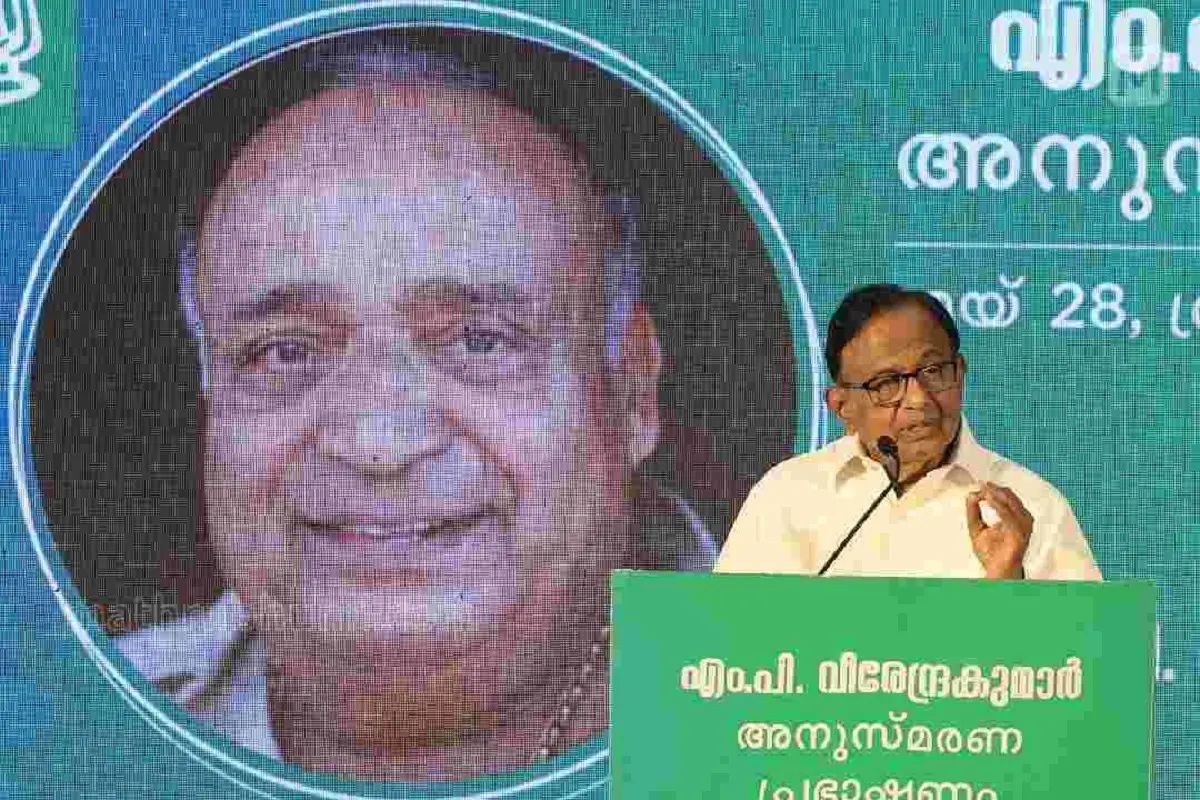
The fifth memorial speech in honour of the late MP Veerendra Kumar will be held at 11 am on May 28 at the Muhammed Abdur Rahiman Sahib Memorial Jubilee Hall, Kandamkulam, Kozhikode. The annual event is organised by Mathrubhumi to celebrate the late leader’s contributions to public life and social thought.
A staunch socialist and environmentalist, Veerendra Kumar left an enduring legacy through his speeches and writings. Known for championing ecological awareness and ethical journalism, his influence continues to resonate across generations, even five years after his passing.
This year’s keynote address will be delivered by N Ram, veteran journalist and a leading voice in Indian media. Closely associated with The Hindu Group, Ram has long been regarded as one of the most respected figures in Indian journalism.
The event will also feature the presentation of the National Thought Leadership Award to Pandurang Hegde, veteran environmental and social activist. Hegde is the founder of the Appiko Movement, a grassroots initiative credited with promoting forest conservation and environmental justice in India. The award will be presented by Rajendra Singh, acclaimed across India for his work in reviving rivers and promoting sustainable water management.
Last year, former Finance Minister and senior Congress leader P Chidambaram spoke at a commemorative event organised by the RJD in Kozhikode.
Chidambaram also spoke on the theme “Holistic Development – Myth and Reality”, offering a critical evaluation of the gaps between developmental rhetoric and on-ground implementation.
Excerpts from Chidambaram's speech:
Veerendra Kumar: A multifaceted personality
I consider it a great fortune in life that I was able to serve as a Union Minister alongside M.P. Veerendra Kumar. During 1996–98, in the Deve Gowda Cabinet, individuals of diverse ideologies worked together. A lifelong socialist, Veerendra Kumar always acted in line with the inspiration he drew from J.P. and Rammanohar Lohiya. He was known as a scholar, writer, a man who consistently fought injustice, a leader who stood firm on the side of justice despite personal losses, and someone who welcomed dissent with an open mind.
He was a visionary minister who issued an order that not a single tree should be cut down from the forest—a directive that has now become a law of the land. His decision to resign from ministership within 48 hours was unprecedented. Even after being requested by the Chief Minister to withdraw his resignation, Veerendra Kumar did not relent. It is difficult to find such an example either before or after in Indian politics. That decision reflected an unparalleled commitment to principle.
Holistic Development – Myth and Reality
I wish to describe the development in India backed by numbers and statistics. I fully acknowledge and welcome the fact that India has achieved a growth rate of 6 to 9 per cent over the past 35 years. However, I am disappointed when I ask: for whom is this development, and who actually benefits from it? Everyone deserves a fair share in the distribution of the fruits of development. On the remembrance day of Veerendra Kumar, a tireless guardian of justice, we must reflect on this. When will we be able to include everyone in society? It is a serious question. Every nation must be able to accommodate and uplift all its sections. Only then can our concept of development be deemed complete.
India’s population is 142 crore. Let me divide this directly into two halves. The top half — 71 crore people — possess 97 per cent of India’s wealth. The bottom half of 71 crore owns just 3 per cent. In terms of distribution of national wealth, our country is in one of the most unfortunate positions globally.
Figures will tell the story
Let me cite some more figures. Of the benefits of the country's economic growth, only 13 per cent reaches the bottom half, while 87 per cent goes to the top half. If ₹100 were distributed equally among 100 people, everyone would get ₹1. Such perfect equality is impractical, but a fair and proportionate economic distribution is a matter of justice. One per cent of the population — that is, 1.42 crore people — controls 40 per cent of the national income. The next 4 per cent control 29 per cent. As we go further down, we find the bottom 20 per cent. They are also Indians, equally entitled to the nation’s wealth. But their condition? No regular employment. If at all, they work as daily-wage earners or contract labourers. They do not have proper homes or access to adequate healthcare.
Let me also speak of the bottommost one per cent — 1.42 crore people. They have no shelter, no decent clothes, no employment. Many of them lack access to education or health. These realities are what most embarrass us before the world. Studies that assess global wealth distribution have identified India as the most unequal nation. Our country is now seen as a giant laboratory of economic disparity. World-renowned economist Thomas Piketty has studied and published reports on this crisis
The numbers on inequality
So far, I have spoken about economic inequality. Let me now address social inequality and its manifestations. Those in the top half economically are mostly from upper castes. Those at the bottom are predominantly SC/ST communities. OBCs are somewhere in the middle. I do not claim to speak for any caste or community. Nor do I wish to. I accept everyone. But we cannot close our eyes to facts. SC/ST communities remain backward both economically and socially.
Who reaped the benefits of liberalisation?
What I now say is self-critical — directed even at my own party — and at all mainstream political parties. I criticise every government that has ruled this country. When we drafted economic policies, we forgot the poorest. We assigned them an annual per capita consumption value of ₹1,286. In the accounts of 28 crore people (20 per cent of the population), no significant development benefits have reached yet. They remain forgotten. Life itself is a burden to them. They are in a constant struggle just to survive.
If you ask whether liberalisation brought gains to the country, I will always say yes. The private sector grew. A competitive economy emerged. We improved in international trade. A liberalised economy brought benefits. Start-ups flourished. Opportunities increased for the youth. Industries found favourable conditions. All this is good for national progress. Yet the original question remains. It is the top half that reaped the benefits. The bottom 50 per cent were tragically left behind.
Under the Ujjwala Yojana scheme, 10 crore families received gas stoves. I openly admit that this was a good move. But how many of them can afford to use it? At ₹1,100 per gas cylinder (the rate back then), how many could afford to refill? A family typically needs 8–12 cylinders a year. That’s not a small expense.
This is not holistic development
It is not enough to merely point out shortcomings. We must also think about solutions. Food, healthcare, and education must be accessible to all. The poorest must receive these, as far as possible, free of cost. We must realise that this is the standard in developed countries. A just society must emerge. In Sweden, when both a ruler and an ordinary citizen require hospitalisation, they are allotted the same type of room with equal facilities. We must not ignore the Scandinavian model of socialism. Inequality is a threat to that development.
Those at the lowest rungs, who often become the victims of every development project, must receive at least a portion of its benefits. It is not holistic development if the lowest strata continue in extreme poverty while the top strata grow unchecked. Let me conclude by saying that it is neither participatory development too.