Must revisit laws that undermine journalism: N Ram at MP Veerendra Kumar memorial event
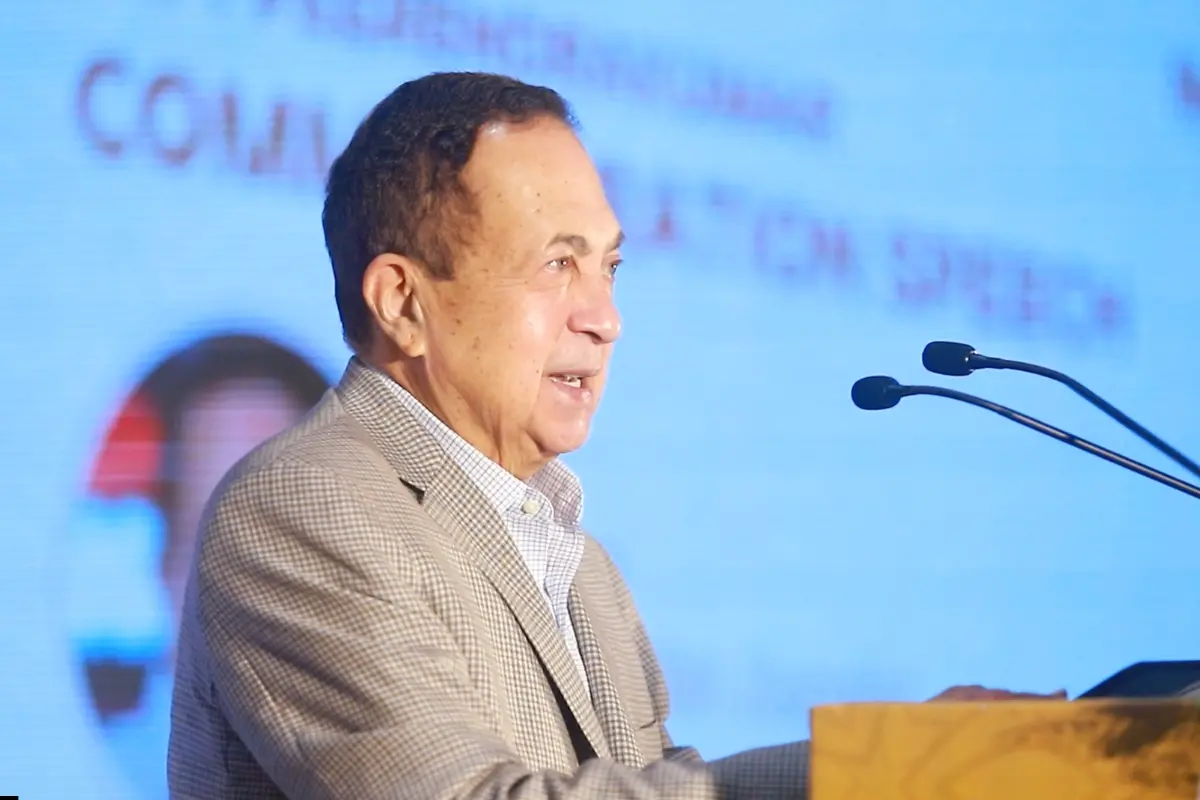
Kozhikode: In a commemorative address at the memorial event honouring writer, orator and journalist M.P. Veerendra Kumar in Kozhikode on Wednesday, veteran journalist and former editor-in-chief of The Hindu, N. Ram, offered insights into the changing landscape of news media and journalism in India.
"There are three basic reasons why we need to discuss the present state of the news media and journalism in India. Discussing this is particularly relevant to an occasion that honours Sri Veerendra Kumar and his passion for free speech and independent journalism, a journalism that matters to society and is valued by it," he said.
Full text of N. Ram’s commemorative address:
Valuing journalism as a democratic craft
The first reason is the intrinsic relevance and value of journalism as a democratic craft. Journalism, as it has evolved in modern times, is best understood as “a form of expression or brainwork that includes making news judgments, gathering evidence, constructing narratives and making sense of things” and as “a method of capturing and representing the world of events and ideas as they occur” (Adam, G. Stuart, a Professor of Journalism, “Thinking Ahead: The Difference between Journalism and Media”, Poynter Institute: https://www.poynter.org/archive/2008/thinking-ahead-the-difference-between-journalism-and-media/).
But journalism as a profession is not value-neutral. As a sort of trade-off for the robust and far-going freedom, including freedom from all forms of prior restraint, it lays claim to, it accepts the obligation of exercising social responsibility. In the best media organisations and among the best practitioners of the democratic craft, social responsibility brings in well-defined, teachable, and transparent standards of performance. Over the decades, a large literature has been produced on the constitutive elements of journalism and templates for socially and ethically accountable journalism. This literature has yielded codes of practice or professional ethics that privilege such principles as truth-telling, freedom and independence, fairness and justice, humaneness, and working for the social good. At a practical level, the journalistic method of “capturing and representing the world of events and ideas as they occur” emphasizes such disciplines as fact-checking, verification, investigation, rigorous data sourcing and analysis, providing context and meaning, and maintaining proportionality and perspective.
It is not for nothing that the writer Gabriel Garcia Márquez weighed in on the virtues of journalism as a democratic craft and on the need for journalism schools to “return to basic training on the job and to restore journalism to its original public service function.” In a 1996 address that was read out to the general assembly of the Inter-American Press Association (IAPA), the Nobel Prize-winning novelist, who had started out as a journalist and remained engaged with journalism and journalism education all his life, described why he was passionate about journalism:
“Journalism is an insatiable passion that can only be digested and humanised by its brutal confrontation with reality. No one who hasn’t suffered it can imagine that servitude that feeds on unexpected occurrences in life. No one who hasn’t lived it can even conceive the supernatural heartbeat produced by the news, the orgasm of having an exclusive, the moral demolition of failure. No one who wasn’t born for this and is willing to live only for this could persist in an occupation that is so incomprehensible and voracious, with an oeuvre that is over after every news item, as if it were going to last forever, but that doesn’t allow for a moment of peace while it starts all over again, with more ardour than ever in the next minute.”
In another speech titled “Journalism: The Best Job in the World,” which he gave in Los Angeles in 1996, Marquez laid down “three fundamental principles” for journalism training and education: “first and foremost, there must be aptitude and talent; then the knowledge that ‘investigative’ journalism is not something special, but that all journalism must, by definition, be investigative; and, third, the awareness that ethics are not merely an occasional condition of the trade, but an integral part, as essentially a part of each other as the buzz and the horsefly.”
Freedom of the press
It is self-evident that journalism as a democratic craft needs the widest freedom and space to flourish. I assume that no one in this audience has any problem with the proposition that a democratic Constitution and the rule of law must give high priority to freedom of speech and expression as a basic right available to all citizens. Article 19(1)(a) of the Constitution of India, which was adopted in 1950, guarantees “freedom of speech and expression” as a fundamental right. This right, hard-won in the freedom struggle against a highly repressive and censorious British Raj, is deemed to be unamendable thanks to the ‘basic structure’ doctrine propounded by the Supreme Court of India.
Freedom of the press is not explicitly mentioned by our Constitution but the Supreme Court has, through judicial interpretation, read it into Article 19. It has held that freedom of the press is a combination of two freedoms – Article 19(1)(a), “the freedom of speech and expression,” and Article 19(1)(g), “the freedom to practice any profession, or to carry on any occupation, trade or business.” The first is clearly the principal component. In a 2019 order on a matter relating to the admissibility as evidence, in a review petition, of classified or secret documents on the Rafale deal published by The Hindu, the Supreme Court unanimously upheld freedom of the press, rejecting the government’s contention that the documents must not be looked into since they had been unauthorisedly obtained.
Unfortunately, notwithstanding the Supreme Court’s judicial interpretations, freedom of speech and expression come up against an expansive Article 19(2). This provides for restrictions on the fundamental right prescribed by law – some reasonable, others not. Notable among the unreasonable restrictions that remain on the statute book or in practice are the law of criminal defamation, the undefined power of contempt of court, uncodified legislative privilege, the law of sedition (124A of the Indian Penal Code), other illiberal provisions of the IPC (especially 153A), the Unlawful Activities (Prevention) Act, the Official Secrets Act, and other draconian laws enacted in the name of fighting extremism and terrorism.
Further, media freedom in India is considered incomplete because the print media and the broadcast media have not been placed on an equal constitutional and legal footing. The higher courts have not judged it necessary to confer effective Article 19(1)(a) protection on radio and television.
There is a strong case for revisiting our laws relating to the press and the news media, repealing or amending the outdated and illiberal provisions, and strengthening media freedom through legal reform and constitutional amendment, as needed.
The second reason for discussing the state of journalism today is to offer a reality check so that young people who are drawn to journalism as a democratic craft come into the field with their eyes open. It is precisely because journalism, at least to a significant degree, has been performing its independent investigative and public service function effectively that journalists have come under increasing pressure, risk, and attacks in various parts of the world, including the United States and India.
The 2025 World Press Freedom Index compiled by Reporters Without Borders (RSF) speaks to this grim reality. The Index ranks India 151st from the bottom among the 180 countries and territories that figure in the assessment, which means that more than 80% of them rank above India. The ranking is based on five key indicators: political, economic, legislative, social, and security.
In all these, India fails to obtain a simple pass mark of 50; in fact, its global score is 32.96 compared with 92.31 for Norway, the top-ranked country in the World Press Freedom Index, 78.89 for the United Kingdom, 65.49 for the United States, and 55.20 for Nepal. In its latest country report on India, Reporters Without Borders observes that “with violence against journalists, highly concentrated media ownership, and political alignment, press freedom is in crisis.” The country report also notes that “with an average of two or three journalists killed due to their work every year, India is one of the world’s most dangerous countries for the media.”
Now, let us look at the data on the subject. The New York-based Committee to Protect Journalists (CPJ) has, after careful enquiry and strict verification, documented the work-related killing of journalists worldwide, including India.
Worldwide, from 1992 – the year the Committee to Protect Journalists began to collect the relevant data – to now (May 2025), 1823 journalists and media workers have been killed in the course of their work. Of the 1823 killed, 1686 were journalists. Of this number, 992 journalists were murdered in connection with their work; 324 were killed in crossfire; and 354 were killed while carrying out dangerous assignments.
In India, between February 24, 2004 and December 6, 2013, 20 journalists and media workers were killed. Of those killed, 17 were journalists. 11 journalists were murdered in connection with their work; 6 were killed while carrying out dangerous assignments; no one was killed in the crossfire. Category-wise, 14 of the journalists worked in Print; 3 worked in Television; no Internet journalist was killed. Almost all the journalists murdered had investigated and written about corruption, crime, human rights, and politics. The murders were in retribution for, or to prevent, news coverage or commentary. One of the 17 journalists killed was a woman (Asiya Jeelani, freelance). She was on a dangerous assignment and was killed in an explosion on April 20, 2004.
The data show that the situation has worsened drastically since 2014, with hate speech, Hindutva communalism, and intolerance on the rise and with disinformation and misinformation weaponised and rampant in social media. Between May 27, 2014 and January 2, 2025, 25 journalists and media workers were killed in the course of their work. All 25 were journalists. Of those killed, 21 were murdered in connection with their work; 1 was killed in crossfire; and 3 were killed while carrying out dangerous assignments. Category-wise, 14 had worked in Print, 10 had worked in Television, and 4 were Internet journalists. The numbers add up to more than 21 because some of these journalists worked for more than one medium.
Again, almost all the journalists murdered had covered corruption, crime, human rights, and politics and their murders, often involving torture, were in retribution for, or to present news coverage or commentary. A prominent journalist murdered was a woman, Gauri Lankesh, Editor of Gauri Lankesh Patrike, murdered on September 5, 2017, in Bengaluru.
It is surely significant that the number of journalists murdered in connection with their work – 21 compared with 11 – has doubled during the period from 2014 to the present.
But this is not all. Since 2008, CPJ has been publishing an annual Global Impunity Index, a quantified ranking of countries where journalists are murdered, the cases remain unsolved, and the killers go free. In other words, the Global Impunity Index is a graded indictment of countries where the rule of law does not seem to apply when journalists are murdered in the course of their work. India, along with six other countries, has figured in the Global Impunity Index every year over the decade. This is a shocking situation for a country that calls itself the world’s largest democracy.
Several journalists have been arrested on various charges over the past decade, with bail denied to them for extended periods. Anti-terrorism and national security laws, as well as other provisions of the penal code, including sedition and provisions covering creating enmity or distrust among communities or hurting the religious sentiments of someone or the other, have been invoked to curb, restrain, and punish independent and investigative journalism.
The wholesale assault on NewsClick and the arrest and prolonged imprisonment of its Editor-in-Chief, Prabhir Purkayastha, on absurd and over-the-top charges remain fresh in mind. Fortunately, Prabhir is out on bail thanks to some egregious procedural blunders committed by the police. This assault is not essentially a story about the police running riot. It is a political story. The story of the BJP and the Hindutva authoritarian regime at war with a medium-sized progressive and left-oriented digital news network and the independent, critical, and challenging journalism it represents.
Why has this happened? The main answer is provided by the intensely divisive and polarising communal climate, the orchestrated hate campaigns and crimes, and the fascistic violence directed at minorities and some other targets to send a message. India has witnessed and experienced some of this since the 1990s. The situation turned qualitatively worse in 2014 when there was a regime change that proved to be much more than a change of government. Communalism as a political mobilisation strategy, the re-jigging and manipulation of state institutions, the rise and enormous spread of social media in society, and the weaponisation of hate speech, disinformation, misinformation, and toxic propaganda in both the social media and sections of the mainstream media have combined to cast a shadow over Indian democracy and the Indian media landscape.
For a deeper analysis, we need to look at the political economy context in which the news media and journalism have struggled to play their roles. And to see this in a wider context, we need to look at what has been happening to the world’s “largest” and “oldest” democracies. While Modi and Trump have strikingly different backgrounds and styles, their administrations share an authoritarian disdain for their constitutions and the values, spirit and even the letter of these foundational charters.
According to India scholars Christophe Jaffrelot and Pratinav Anil, India’s first dictatorship—the Emergency imposed in June 1975 by Prime Minister Indira Gandhi and brought to an end 21 months later through a decisive electoral defeat for her party—was a complex phenomenon that was “neither a parenthesis, nor so much as a turning point, but a concentrate of a style of rule, an élan alive today.” This involves, among other things, “a dialectical relationship between populism and authoritarianism.”
It is this relationship that has been at play over the past decade, eating into the vitals of Indian democracy. The BJP regime, backed by the RSS and its affiliates, has taken the path of incremental authoritarianism, softening up and, wherever possible, suborning constitutional and democratic institutions and undermining India’s already stressed secular foundations. Though these actions have been extensively reported in the international media, they are worth repeating:
* The government has brought executive power to bear on the independence of two constitutionally empowered institutions, the election commission and the Supreme Court, which, in the assessment of some critical lawyers, has been turned largely into an “executive court”;
* The regime has conducted targeted assaults on freedom of speech and expression, media freedom, media independence, and other fundamental rights. It has used anti-terror, sedition and other draconian laws to incarcerate journalists, students, human rights defenders, civil society activists and troublesome critics of the government, often without bail or trial for prolonged periods. No wonder India has sunk to the rank of 151 among 180 countries and territories in Reporters Without Borders’ World Press Freedom Index;
* The government has almost certainly conducted illegal surveillance against many journalists, politicians, civil society activists, and other selected targets by deploying NSO Group’s military-grade spyware, Pegasus. The Supreme Court had the matter investigated by an expert committee, but has not yet made the findings public or come to a clear conclusion.
* It has made a concerted effort to police and censor the internet, social media, streaming platforms such as Netflix and digital news providers through the Information Technology (Intermediary Guidelines and Digital Media Ethics Code) Rules, 2021, which has been subsequently updated to make them more restrictive. The Digital Personal Data Protection Act 2023 “facilitates data collection and processing by the government and private entities rather than… data protection”. And now we have the Broadcasting Services (Regulation) Bill, 2024, which seeks to extend the government censor’s hand beyond OTT content and digital news to bring under its scope social media accounts and online video creators. It is notable that the 2024 draft of the Bill is a more draconian version of the 2023 draft. It is believed this change was triggered by the independent role played by some prominent creators of current affairs and news content on YouTube during the run-up to the 2024 Lok Sabha election, in which the BJP failed to secure a single-party majority. The fact that the Broadcasting Services Bill is yet to become law has not deterred the Union government from blocking websites at will, in a blatantly arbitrary and unconstitutional manner. We saw this recently when the website of Vikatan was blocked for publishing a cartoon on the Prime Minister, and the website of The Wire was blocked for reporting on a CNN news report on the reported loss of some Indian military aircraft during the recent conflict with Pakistan.
*The Income Tax department has revoked the non-profit status of two independent media organisations, the Reporters’ Collective, which specialises in producing investigative journalism on issues that matter in multiple formats and languages, and The File, a Bengaluru-based news site also specialising in investigative journalism.
* The Hindutva regime has amended the citizenship law to make Muslim (as distinct from non-Muslim) migrants from Bangladesh, Afghanistan and Pakistan ineligible for citizenship, thus introducing religion as a criterion for citizenship for the first time in the history of independent India. Viewed along with the National Population Register and National Register of Citizens—two bureaucratic exercises of unprecedented scale and potential menace, which significant sections of India’s more than 200m Muslims see as being directed against them, and which are likely to cause hardship and harassment to the poor and dispossessed—the Citizenship (Amendment) Act, 2019 poses a direct challenge to India’s democratic and secular polity and to political stability as well;
* The government has deployed brutal force to suppress democratic protests, notably demonstrations in December 2019 against those changes in the citizenship law that discriminate against Muslims, and through 2020 and 2021, demanded the repeal of three laws seen as favouring corporate India at the expense of farmers;
* It has systematically misused agencies of the state responsible for countering crime, corruption, income tax violations and money laundering in order to go after and arrest political opponents, including ministers, chief ministers and legislators;
* By abrogating, without discussion in parliament, Article 370 of the constitution, which granted a special autonomous status to Jammu and Kashmir, and by downgrading the state to the status of a union territory, the Modi government has dealt a serious blow to the concept of Indian federalism.
* Finally, it has made use of governors who are openly partisan, in an attempt to undermine elected state governments run by opposition parties, thus embittering relations between the states and the national government in several cases.
The list is not exhaustive, but it is sufficient to make my point.
The third reason why we need to discuss the state of journalism has to do with the economics of contemporary journalism. I refer here to the digital disruption that was first experienced by the ‘mature media markets’ of developed countries and has spread, at varying speeds, to other parts of the world. This unprecedented disruption in the media ecosystem was brought on by transformative digital technologies and by digital hegemons, the so-called GAFAT companies, Google, Apple, Facebook, Amazon, and Twitter. And now we have what is being heralded as the AI Revolution.
One aspect of the media crisis in Western countries has been the decline and fall of the well-established 20th-century business model. In this model, buoyant advertising revenues paid for expansive journalism in print, radio, and television and brought handsome profits, and in some cases super-profits, to the media owners. The other aspect of the crisis has been the complex set of changes in audience behaviour and news consumption accompanying the mass migration from print and other analogue platforms operated by the traditional news media to digital platforms with their constantly transforming tools and techniques. We can understand this as the challenge of engagement of the audience that has been getting away, and this trend has been particularly evident among young people, those between the ages of 12 and 30.
All this has caused deep anxiety about the future of journalism. Alan Rusbridger, former Editor of The Guardian, conveys this sense of anxiety vividly in his book, Breaking News: The Remaking of Journalism and Why it Matters Now:
By early 2017 the world had woken up to a problem that, with a mixture of impotence, incomprehension and dread, journalists had seen coming for some time. News – the thing that helped people understand their world, that oiled the wheels of society, that pollinated communities, that kept the powerful honest – the news was broken.
More recently, some major news organisations like The New York Times, The Washington Post, and The Financial Times and their counterparts in non-English languages have reshaped and, in a sense, re-invented themselves as effective digital age players. The subscription model, fine-tuned to attract and retain a mix of loyal and fence-sitting readers, seems to be working for them. There are also several pure-play digital news ventures which are making a go of it in the media marketplace. But the sense that the news media are not in control of their future persists in many parts of the world.
Until ten years ago, India seemed to be in a better place, with growth continuing in print, television, and digital news platforms. But the Covid-19 pandemic dealt a heavy blow to this trend. Today print readership is stagnant, while readership on digital platforms is growing. The key factors identified by the political scientist Robin Jeffrey as the drivers of India’s Newspaper Revolution seem to have exhausted their potential. These factors are improved technology, steadily expanding literacy, better purchasing power, aggressive publishing, and finally, political excitement.
The digital age took its time to arrive in our country. For well over a decade, India lagged behind several developing countries, notably China, in internet use and broadband development. This led to a general attitude of complacency and denial in mainstream media organisations towards what was coming. But that situation has changed dramatically. here has been a rapid rise in the number of users of social media, search engines, and messaging apps, with India now leading the world in the number of Facebook, WhatsApp, Instagram, and YouTube users. Most tellingly, urban as well as semi-urban and rural India has seen an exponential growth in the use of smartphones.
Cite here some data on social media users and the rampant spread of disinformation and misinformation in India.
Let there be no doubt about this: the digital age is truly upon us; the Indian media landscape is being transformed by the same forces and trends that operate elsewhere; and the same kind of vital challenges must be faced, although the time scale and effects might be somewhat different.
Not surprisingly, the established media, newspapers, television, and radio across India, are currently engaged in a process of scaling up, diversifying, and enhancing their digital operations.
Then there are the digitally native, young journalistic ventures which are doing interesting things, as of now mostly on a modest scale.
It is in this challenging context that free, independent, and brave journalism as a democratic craft needs to re-establish its credentials and play the kind of role that history has prepared it for.
Our press is more than two centuries old. Its strengths have largely been shaped by its historical experience and, in particular, by its association with the freedom struggle as well as with movements for social emancipation, reform, and amelioration. The long struggle for independence; the sharp ideological and political divides; controversies and battles over social reform; radical and revolutionary aspirations and movements; compromising as well as fighting tendencies; and the competition between self-serving and public service visions of journalism – these have all found reflection in the character and performance of the Indian press over the truly long term.
There is still considerable diversity in the Indian newsroom, whether we are speaking about newspapers, television, radio, or the new media. Pluralism in the Indian media can be said to reflect the vast regional, linguistic, socio-economic, and cultural heterogeneity of the subcontinent. A positive factor for our news media is that over the past quarter-century, their social representativeness has broadened. For one thing, there has been a rapid feminization of the newsroom. Alongside this, the composition of the journalistic workforce has become more inclusive in socio-economic and regional terms. However, the number of Dalit journalists in the mainstream news media continues to be insignificant.
The problem is that this diversity cannot conceal the growing concentration of ownership in the media industry, and most prominently in television. The 2025 RSF Country report on India notes that Prime Minister Modi has “engineered a spectacular rapprochement between his party…and the big [business] families dominating the media. Reliance Industries group’s magnate, Mukesh Ambani…owns more than 70 media outlets that are followed by at least 800 million Indians. The NDTV channel’s acquisition at the end of 2022 by Gautam Adani…signalled the end of pluralism in the mainstream media.”
I think this is an exaggerated assessment but it does point to what could turn out to be a difficult-to-reverse trend.
A conceptual framework for journalism
The long-term Indian press experience, set in a broader framework, suggests two extremely valuable central functions that the country’s best newspapers have performed in modern and contemporary times. These functions may be termed (a) the credible-informational and (b) the critical-analytical-investigative. An accompanying condition, which evolves over time, typically as an outcome of a democratic or working people's struggle, is that the political system, for whatever reason, gives newspapers free or relatively free rein and a public culture of valuing these functions develops. Performed over time, the two central functions working together build trust in the press, or more accurately, in individual newspapers.
There are also valuable derivatives of the two central, twinned functions. The first derivative is the agency of the press in public education. A second is serving as a critical forum for analysis, disputation, and comment, in which different opinions and ideas are freely discussed, debated, and have it out. A third derivative is agenda building. Socially conscious media can trigger agenda-building processes to help produce democratic and progressive outcomes; and this can be done best when an authentic public opinion and a congenial context of attitude, feeling, and critical democratic values and practice exist.
A third function of the news media is the pastime or entertainment function. At its worst, it seeks to purvey escapist entertainment, celebrity worship, vapid talk shows, scandal, and even voyeurism at the expense of everything else. But it can be something quite different: engaging, entertaining, delving into life’s small pleasures, covering hobbies and recreation, mixing in humour and satire, lightening solemn, heavy, ponderous journalism, and in general serving the ‘pleasure principle’ as the French use that term.
Four core tasks for 21st-century journalism
In his book on newspapers, journalism, and the business of news in the digital age, George Brock, an experienced British journalist and journalism educator, identifies four core tasks as “the irreducible core…the foundation on which journalism in the 21st century is going to be rebuilt”. These tasks are verification, bearing witness, sense-making, and investigation. (Brock, George (2013), Out of Print: Newspapers, Journalism and the Business of News in the Digital Age, London: Kogan Page.)
Over the decades, journalism in India has performed these tasks with competence, skill, impact, and at times distinction. Its contribution to empowering the public with relevant and timely information and knowledge has been many-sided. The democratic and progressive role of the Indian press in blowing the whistle on hunger as a crisis, as during famines or severe droughts, has been recognised and praised by no less than Amartya Sen. Some of the finest work done by Indian journalism, historically and in contemporary times, is its investigation and exposé of political corruption, ministerial misconduct, and government misdeeds.
The present is a period in which independent and fearless journalism is at a premium in India, or so it seems. Several Indian television news channels and mainstream newspapers, daily and periodical, are clearly and conspicuously engaged in propagandising and manufacturing consent for the ideology, policies, and actions of the ruling party and the dominant saffron political formation. However, there is evidence that independent, investigative journalism is alive, active, and productive.
Let me cite The Hindu’s Rafale investigation as an example; we did the main investigation of various aspects of the deal but the investigative or contextual articles published by The Caravan, The Wire, and Business Standard helped provide a more rounded picture of what happened. Let me cite another recent example: Somesh Jha’scomprehensive investigation of unemployment trends and the official cover-up of the unprecedented crisis, published in a series of eye-opening articles in Business Standard. NDTV’s analysis of hate speech during the current protracted election campaign is another example of independent public service journalism.
A few words on investigation as perhaps the most important of the four core tasks. When Márquez and several old-world journalists insist that there is nothing special that needs to be called investigative journalism, what they mean is this. All journalism worth the name must aspire, and be held up, to the higher standards demanded by the profession, not necessarily as it is practised in many places, but at its best. This means that truth-seeking, verification, digging deep, placing facts and events in context and in historical perspective, exercising the journalistic and, where possible, the literary imagination, analysing and commenting independently and freely, acting justly, humanely, and ethically should become an integral part of journalism.
When you take the broad view of journalism that sees the investigation as one of its integral tasks, rather than as a super-speciality or a sequestered discipline, a vast and wonderful vista opens of work that is truth-seeking, richly themed, exploratory, imaginative, creative, literary, and, above all, passionate about freedom, humanity, and justice.
While investigating, exploring, and experimenting, journalists of the first rank are not satisfied with bringing to light a mass of material facts that they manage to unearth through diligent work, or that fall into their lap by a stroke of luck. Their real pursuit is to invest these hitherto concealed or inaccessible facts with social, moral and, often, historical meaning and weave them into a coherent and compelling story so that the journalism contributes significantly to raising social awareness of the issues involved and stands the test of time.
Looking forward
The Wire recently celebrated 10 years of its founding, terming the event “A Decade of Living Dangerously.” Founding Editor Siddharth Varadarajan elaborated on the reasons he and the other two Founding Editors, M. K. Venu and Sidharth Bhatia, launched The Wire. After dealing with the harassment, the threats, the pressures, and the assaults independent news media have faced during the dangerous decade, Siddharth ended on a high note: “Above all, let’s resolve to keep that unmute button pressed at all times. There is no place for fear or anxiety. Indians have to speak up. Because that is the only way to ensure Naya Bharat is Apna Bharat.”
I entirely agree. The only way to protect media freedom is to exercise your right to free speech and independence, come what may. Journalists in India are lucky that a number of lawyers, including some of our top lawyers, are coming forward to appear pro bono in their defence. I think we can maintain our independence, whatever pressure comes at us.