‘I apologise’: TN CM Vijay steps in after minister names ex-CM Karunanidhi without honorific
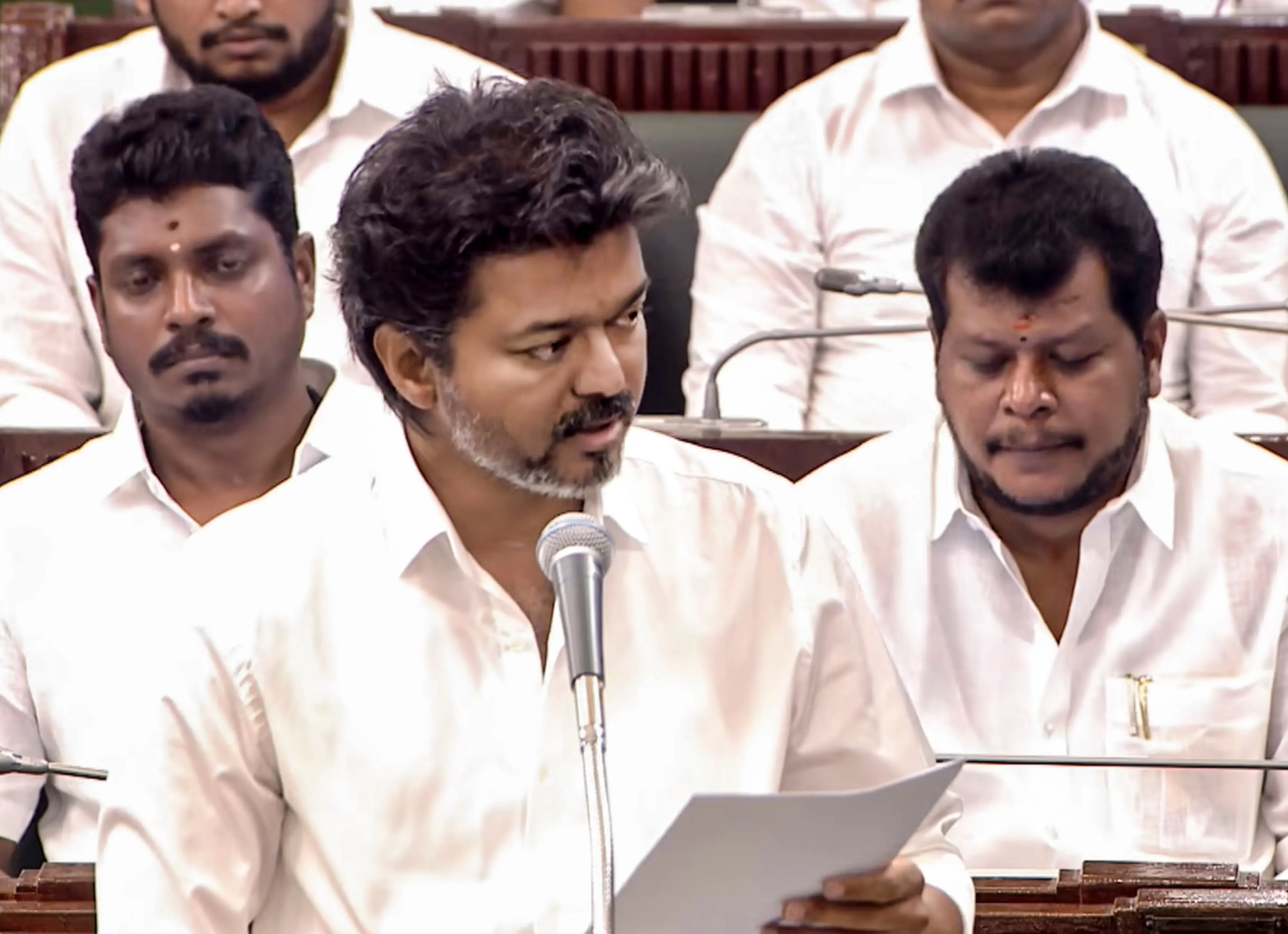
Chennai: Tamil Nadu Chief Minister C Joseph Vijay apologised in the state Assembly after Forest Minister R V Ranjith Kumar referred to former chief minister and DMK patriarch M Karunanidhi simply by his name during a debate.
The reference triggered immediate objections from DMK members, prompting Vijay to intervene and say the manner of reference was inappropriate.
What happened in the Tamil Nadu Assembly?
The controversy occurred during the Assembly's discussion on the demands for grants for the Health and Revenue departments.
Forest Minister R V Ranjith Kumar was speaking about alleged cash-for-votes practices during earlier elections and referred to the so-called "Thirumangalam formula".
While discussing previous election strategies, Kumar mentioned former Tamil Nadu chief minister M Karunanidhi by name without using the customary honorific "Kalaignar" or referring to him as a former chief minister.
The reference immediately drew objections from members of the opposition DMK.
Why did the reference trigger an uproar?
Karunanidhi, who died in 2018, was a five-time chief minister of Tamil Nadu and served as DMK president for several decades. He is widely referred to by supporters and political figures as "Kalaignar", meaning "scholar" or "artist".
In the Tamil Nadu Assembly, references to former chief ministers and other prominent leaders are generally made using formal or respectful titles.
DMK members therefore objected to the minister mentioning Karunanidhi only by his name.
Former minister K K S S R Ramachandran was among those who raised the objection.
The dispute was not primarily over the subject of the minister's speech, but over the manner in which the former chief minister was referred to.
What did Chief Minister Vijay do?
As the objections grew, Chief Minister Vijay intervened while Ranjith Kumar was speaking.
Vijay acknowledged that the reference to Karunanidhi without the customary form of address was inappropriate and apologised on behalf of his minister.
He said: "I apologise on his behalf."
The intervention helped bring the immediate confrontation in the Assembly to an end.
What was the minister talking about?
The controversy emerged during a wider political argument over cash-for-votes.
Ranjith Kumar referred to the "Thirumangalam formula", a term that has entered Tamil Nadu's political vocabulary in connection with allegations of systematic cash distribution to voters during the 2009 Thirumangalam Assembly by-election.
The minister claimed that voters in his Kancheepuram constituency had received as much as ₹1,500 per vote in earlier elections.
He contrasted what he described as past cash-for-votes practices with the current administration, arguing that the present government came to power without distributing money to voters.
It was during this discussion of election strategies and earlier political practices that he referred to Karunanidhi.
What is the Thirumangalam formula?
The phrase "Thirumangalam formula" is associated with the 2009 Thirumangalam by-election in Tamil Nadu.
The term is commonly used in political discussions to describe alleged organised distribution of cash to voters.
The episode became controversial because of allegations that voters were systematically paid to influence the outcome of the election.
The expression subsequently came to be used more broadly in Tamil Nadu politics whenever allegations of organised cash-for-votes practices arose.
The minister's reference to the formula was therefore part of a broader criticism of previous election practices.
Who is M Karunanidhi?
Muthuvel Karunanidhi was one of Tamil Nadu's most influential political leaders and a central figure in the Dravida Munnetra Kazhagam (DMK).
He served as Tamil Nadu chief minister five times and was associated with the state's politics for more than seven decades.
Karunanidhi became chief minister for the first time in 1969 following the death of C N Annadurai.
He subsequently returned to office several times, most recently serving as chief minister from 2006 to 2011.
He also remained DMK president for nearly five decades, from 1969 until his death in August 2018.
His political career was closely connected with the Dravidian movement, Tamil language and cultural politics, social welfare policies and the development of the DMK as one of Tamil Nadu's dominant political parties.
Why is "Kalaignar" significant?
"Kalaignar" was the honorific widely associated with Karunanidhi.
The Tamil word broadly refers to an artist or scholar, and the title reflected his background as a writer, screenwriter, speaker and political leader.
Karunanidhi wrote extensively for newspapers and magazines and was involved in Tamil cinema before becoming one of the state's most prominent politicians.
His supporters and members of the DMK routinely use "Kalaignar" when referring to him.
That political and cultural significance explains why the omission of the honorific became an issue inside the Assembly.
Is there a formal law requiring the title?
The controversy appears to concern legislative convention and decorum rather than a law specifically requiring the word "Kalaignar".
The Assembly has established practices concerning how members refer to the Speaker, ministers, former chief ministers and other public figures.
The objection raised by the DMK was therefore about the manner of reference and perceived disrespect towards a former chief minister and party patriarch.
Vijay's decision to apologise effectively acknowledged the breach of convention and prevented the dispute from escalating further.
Why is this politically significant?
The incident comes against the backdrop of an increasingly competitive political environment in Tamil Nadu.
The DMK remains one of the state's principal political forces, while Vijay's political movement has emerged as a significant new presence in the state's electoral landscape.
A dispute involving Karunanidhi therefore carries political symbolism beyond the immediate Assembly exchange.
For the DMK, Karunanidhi remains a foundational figure in the party's history.
For Vijay's government, maintaining legislative decorum and managing relations with the opposition is particularly important as the Assembly deals with contentious political issues.
The Chief Minister's immediate apology helped shift the discussion away from a potentially prolonged confrontation over the remark.
Did Vijay apologise for the minister's political argument?
No. The apology concerned the manner in which Karunanidhi was referred to, rather than an endorsement or rejection of the minister's broader argument about cash-for-votes or previous election practices.
Ranjith Kumar's remarks about the Thirumangalam formula and alleged cash distribution formed part of the political debate in the Assembly.
Vijay's intervention addressed the issue of legislative decorum.
This distinction is important because the apology did not amount to a withdrawal of the government's broader political position on cash-for-votes allegations.
What happens next?
The immediate controversy appears to have been defused by the Chief Minister's apology.
The larger political debate over cash-for-votes, however, is likely to continue, particularly as parties use past elections to criticise one another's political record.
The episode also highlights how language, protocol and political symbolism can become contentious issues inside the Tamil Nadu Assembly.
For the government, the priority will be to prevent such disputes from repeatedly disrupting legislative business.
For the DMK, references to Karunanidhi are likely to remain politically sensitive because of his central place in the party's history and identity.
The bigger picture
The incident was sparked by a seemingly small issue — whether a former chief minister should be referred to by his name alone or by his customary honorific.
But in Tamil Nadu politics, the names and titles attached to major Dravidian leaders carry considerable political significance.
Karunanidhi was not only a former chief minister but also the longest-serving president of the DMK and one of the most influential figures in the state's modern political history.
That is why the Assembly reference immediately became a political issue.
Vijay's decision to intervene and say "I apologise on his behalf" brought the immediate dispute to a close.
The larger debate, however, remains focused on cash-for-votes allegations, election practices and the political legacy of the leaders who shaped Tamil Nadu's electoral history.