‘Court has jurisdiction’: Supreme Court on ‘superstitious’ practices in Sabarimala case
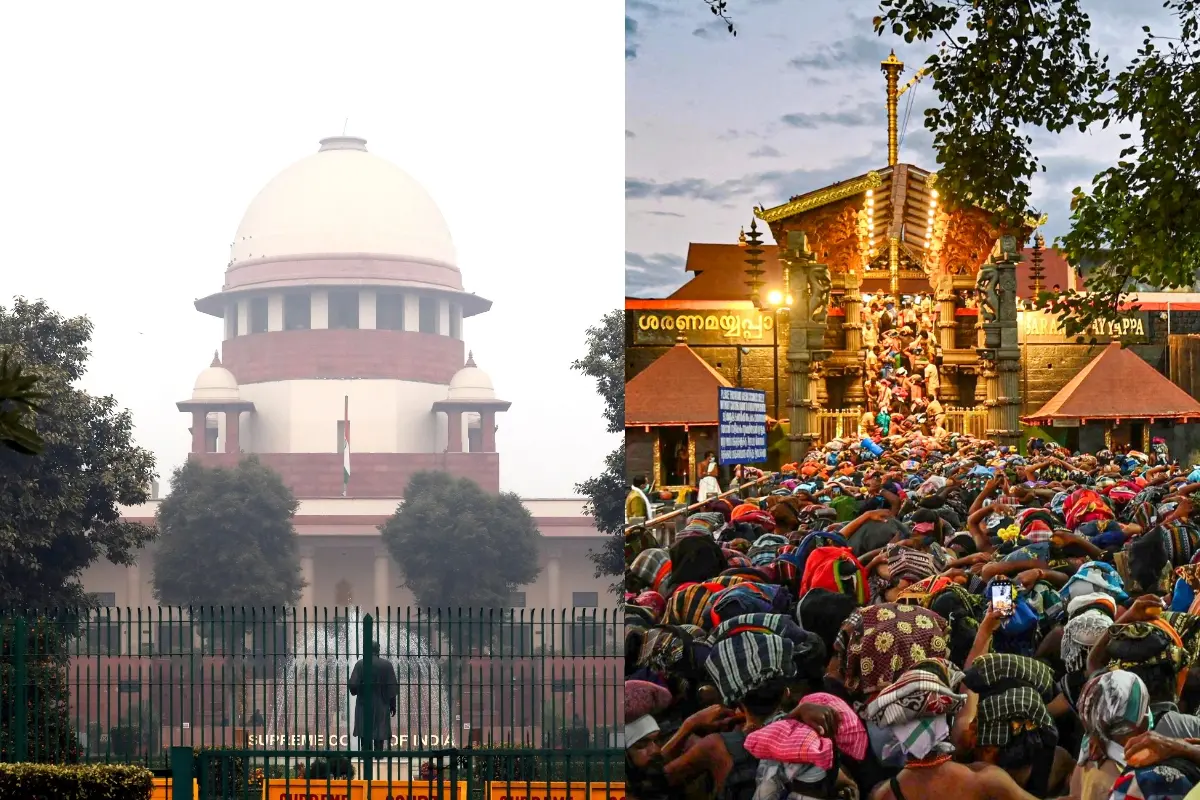
New Delhi: The Supreme Court of India on Wednesday observed that it has the authority and jurisdiction to determine whether a practice within a religion can be regarded as superstitious, during a hearing on issues concerning religious freedom and gender discrimination
A nine-judge Constitution bench, led by Chief Justice of India Surya Kant, is currently examining petitions related to discrimination against women at religious sites, including the Sabarimala Temple, as well as the broader scope of religious freedom across faiths.
At the outset, Solicitor General Tushar Mehta, representing the Centre, questioned how courts could determine what constitutes a superstitious practice. He argued that even if a practice is deemed superstitious, it is not for the judiciary to make that determination. Instead, he said, such matters fall within the domain of the legislature under Article 25(2)(b) of the Constitution, which empowers it to enact reform laws.
Mehta noted that several laws already exist to curb practices such as black magic, suggesting that legislatures are better equipped to identify and regulate such issues. He further contended that courts, being secular institutions, lack the expertise in religious scholarship necessary to label practices as superstition.
ALSO READ | ‘Woman can’t be ‘untouchable’ for 3 days’ : SC Justice Nagarathna on Sabarimala case
Responding to this, Justice Ahsanuddin Amanullah remarked that the argument was overly simplistic. He stated that courts do possess the authority to determine whether a practice is superstitious, even if subsequent action may lie with the legislature. “You cannot say that whatever the legislature decides is the final word,” he observed.
Mehta maintained that perceptions of superstition vary widely in a diverse society. What may be seen as a religious practice in one region, such as Nagaland, could be viewed differently elsewhere. He cited state-specific laws, including those in Maharashtra, addressing black magic and similar practices.
Justice Joymalya Bagchi raised a hypothetical scenario, asking whether practices like witchcraft, if claimed as religious, could still be challenged in court. He suggested that if the legislature remained inactive, courts might intervene under Article 32 using principles such as the “doctrine of unoccupied field,” particularly where issues of health, morality, and public order are concerned.
In response, Mehta clarified that judicial intervention would be justified on those constitutional grounds, rather than on labelling a practice as superstition.
ALSO READ | Lord Ayyappa is a 'Naishtika Brahmachari'; Young women's entry must not be allowed, Centre tells SC
Justice B V Nagarathna added that courts must assess what constitutes an essential religious practice through the philosophical framework of the religion in question. She emphasised that such evaluations must still remain subject to considerations of health, morality, and public order.
The ongoing hearings stem from earlier rulings on the Sabarimala Temple issue. In September 2018, a five-judge bench, by a 4:1 majority, lifted the ban on the entry of women aged 10 to 50, declaring the practice unconstitutional. Subsequently, in November 2019, a bench led by former Chief Justice Ranjan Gogoi referred broader questions on religious freedom and gender equality across faiths to a larger bench.
The matter remains under consideration.