She has Aadhaar, PAN, and a voter ID, yet India won’t issue her a passport: Why?
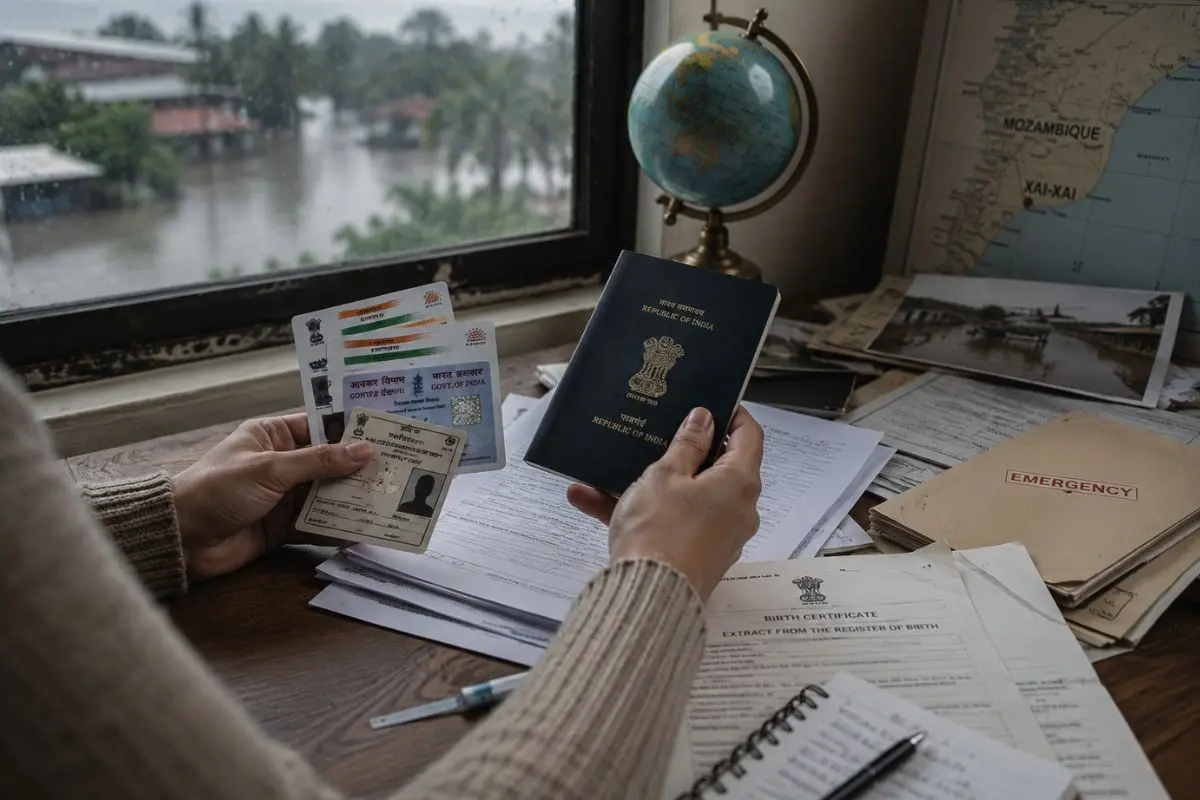
At 26, Dolly Vadalia has almost every document that marks her as Indian, an Aadhaar card, PAN card, voter ID, university degree, and even a marriage registered in India. But there is one thing she still does not have: A passport.
And without it, she cannot leave the country, join her husband in Canada, or even prove she officially belongs anywhere in the world.
What has trapped the Gujarat woman in this extraordinary legal limbo is a flood that struck Mozambique just one day after she was born. A newborn, a flood, and a hurried escape
Vadalia was born on February 18, 2000, in Xai-Xai province of Mozambique, where her father Ketan Baria and mother Aarti were running a wholesale grocery business.
However, within hours of her birth, devastating floods triggered by cyclones ripped through southern Mozambique, swallowing homes, roads, and marketplaces. The family says survival became the only priority.
With floodwaters rising and disease fears spreading, the Indian families living in the region began fleeing.
Vadalia’s parents obtained an emergency certificate from the authorities and escaped first by helicopter to Maputo before flying back to India with their 18-day-old daughter.
In the chaos, one crucial formality never happened: Her birth was not registered with the Indian consulate within one year, a requirement under Indian citizenship law for children born abroad to Indian parents.
That missed deadline would come back to haunt the family decades later. The Baria family eventually settled in Gujarat and rebuilt their lives.
Vadalia grew up like any other Indian child.
She studied in Indian schools and colleges, earned a Master’s degree in dietetics, and obtained every major Indian identity document without difficulty. Her family believed citizenship could be formally claimed once she turned 18.
However, when Vadalia later applied for an Indian passport after marrying a Canada-based man, officials informed her that she first needed proof of Indian citizenship. That is when the family realised the scale of the crisis.
The citizenship deadlock
Indian authorities rejected her passport applications twice, saying she had failed to establish citizenship by descent because her birth abroad had never been registered with the Indian mission in Mozambique.
At the same time, Mozambique authorities reportedly refused to issue her a passport because the emergency certificate used to bring her to India had expired years ago.
The result is a bizarre Catch-22 situation: Vadalia cannot apply for Indian citizenship because the process requires a valid foreign passport, but she also cannot obtain a foreign passport because no country currently recognises her citizenship.
For the last two years, the family has been moving between courts, government offices, and embassies searching for a solution.
In one dramatic legal attempt, the family approached a Rajkot court seeking to have Dolly’s birth legally treated as having occurred in India.
A local court directed the Rajkot Municipal Corporation to issue a birth certificate showing Rajkot as her birthplace, but authorities challenged the move, arguing it recorded incorrect information.
On April 30, the Gujarat High Court dealt another setback by refusing her plea for an Indian passport and observing that she had failed to prove Indian citizenship under the existing law.
Now, Vadalia plans to challenge the order before a division bench. For her family, the issue is not just legal; it is deeply personal.
They insist the missing paperwork was not negligence, but the consequence of a disaster that nearly cost them their lives.
More than two decades after the Mozambique floods, the family says the emergency escape that once saved Vadalia has now left her stranded between nations, recognised by documents, but not by citizenship.