Nehru–Babri storm rocks Parliament: Watch Jairam Ramesh dropping Patel diary on Rajnath Singh
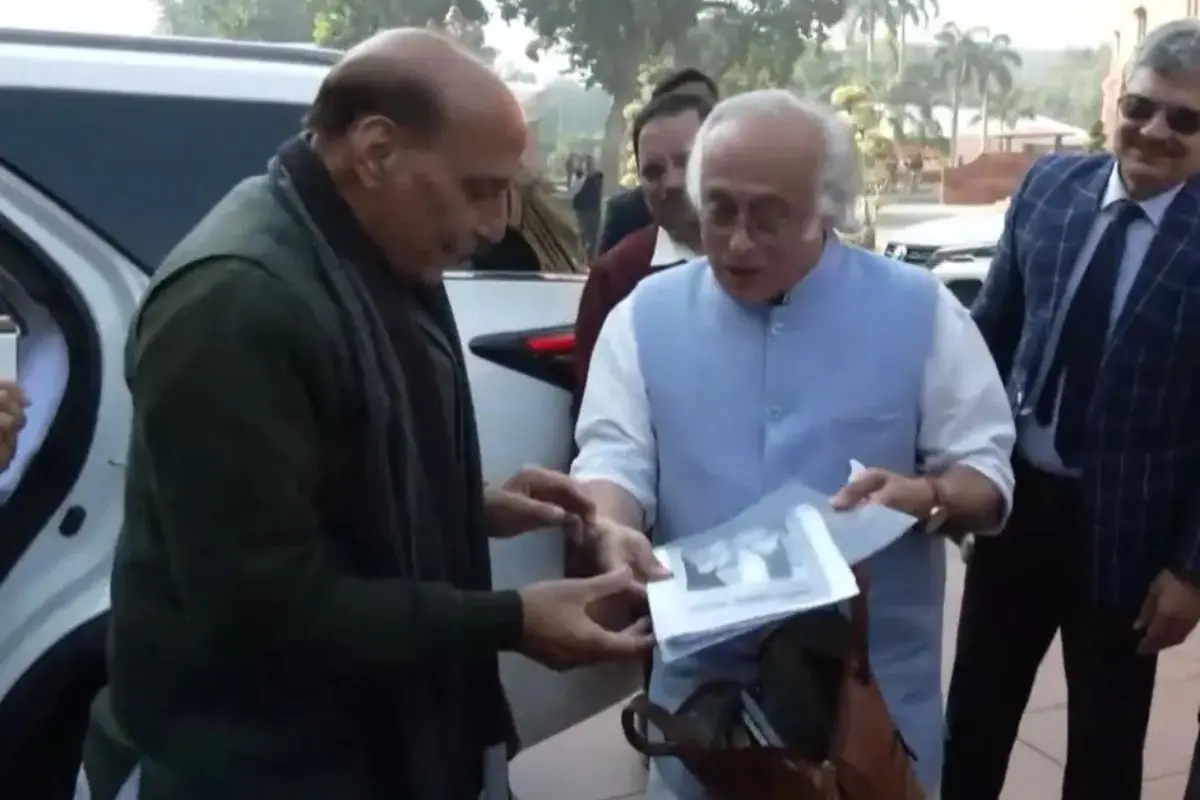
The Nehru–Babri political storm intensified on Thursday when Congress MP Jairam Ramesh walked up to Defence Minister Rajnath Singh outside Parliament and handed him pages from 'Inside Story of Sardar Patel: The Diary of Maniben Patel'.
The gesture, theatrical and pointed, unfolded just as both parties continued trading barbs over Singh’s claim that Jawaharlal Nehru once proposed using public funds to build the Babri Masjid.
Ramesh, holding the Gujarati translations of the diary entries, delivered them with a sharp line: “Sir, I have brought you a Gujarati translation of Maniben Patel’s diary, especially for you. Please do read it.” Singh, smiling but unmoved, replied, “I don’t know Gujarati,” as he took the papers.
However, behind the seemingly light-hearted exchange was a blistering political tug-of-war over Nehru’s legacy and the BJP’s attempt to reframe historical narratives.
The Congress has accused Singh of spreading “falsehoods,” insisting that the diary entry he cited does not support the explosive claim that Nehru wanted to rebuild the Babri Masjid with government funds.
Hours later, Ramesh escalated the attack online, posting screenshots of the original Gujarati pages and accusing the Defence Minister of distorting history. He warned that there was a “huge difference” between what the diary records and what “fellow distorians”—a jab at BJP leaders—were circulating.
This comes after Singh, speaking in Vadodara’s Sadhli village, asserted that Nehru proposed state-funded construction of the Babri mosque, only to be stopped by Sardar Vallabhbhai Patel. The BJP has doubled down on the claim, arguing that the same diary also quotes Nehru expressing distaste for certain South Indian temples despite their architectural grandeur.
BJP spokesperson Sudhanshu Trivedi even cited Page 24 of the diary as proof, claiming Nehru raised the Babri issue and Patel rejected state funding outright.
The Congress, however, is positioning the controversy as a battle not just over facts but over the political weaponisation of legacy. With both parties refusing to retreat, the Patel diary has unexpectedly become the hottest political document of the week—fueling a fresh round of ideological combat in the long-running Nehru vs. BJP narrative war.