Melting permafrost, sudden floods: Scientist warns of need for better alerts
New Delhi: Early warning systems should be expanded beyond rainfall-triggered disasters to cover other events capable of causing sudden catastrophes, climate scientist Tapio Schneider has said, stressing that even a few minutes of advance warning could save lives downstream.
Schneider, professor of environmental science and engineering at the California Institute of Technology (Caltech), made the remarks in an interview with PTI during his visit to Ashoka University, where he interacted with students and participated in a panel discussion.
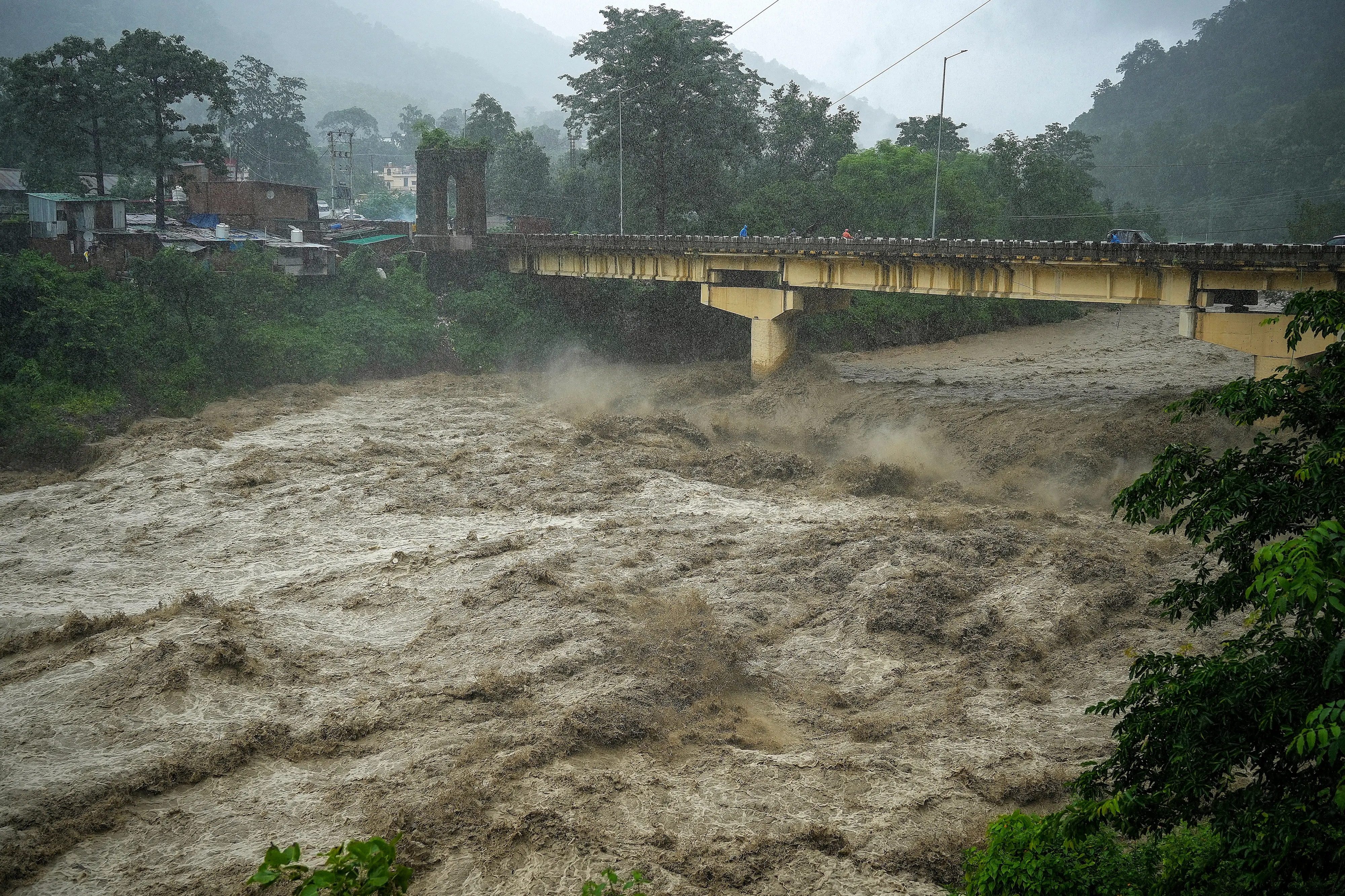
Nepal is still dealing with the aftermath of the August 26 flash floods, which were triggered by a high-altitude collapse involving ice and rock. Debris swept down from Tibet through central Nepal, killing more than 1,200 people and leaving thousands missing.
"Early warning systems are important. We probably need to expand them beyond events triggered by rainfall to such events so that you can have at least a few minutes of warning for people downstream and save some lives that way," Schneider told PTI.
He said rising temperatures are causing permafrost to melt and could contribute to more such disasters, although the immediate causes of individual events may differ.
Schneider said global temperatures have been around 1.5 degrees Celsius above pre-industrial levels in recent years and that it is "inevitable" that the world will experience a decade with warming of 1.5 degrees Celsius.
The Caltech scientist also heads the Climate Modelling Alliance, a collaboration involving scientists, engineers and applied mathematicians from Caltech, the Massachusetts Institute of Technology and NASA. The initiative is developing a new Earth system model.
He said the group wanted to "exploit modern computing architectures and use (the available) data more extensively".
"...to inform the small-scale processes in the model because that's where all the uncertainties (in climate projections) come from. (Projections from existing climate models) are widely divergent and the problem is the small-scale processes that you need to represent better and that's where we invested most effort," he said.
Schneider said India could experience greater impacts from global warming as efforts to improve air quality gather pace, even as the country has already witnessed more extreme hot days and intense precipitation.
"More data (from India) will be helpful for our model, for all models. I think where one big opportunity now lies for places like Ashoka (University) is that climate modelling, weather prediction and assessing climate risk has been confined to rich countries."
"It doesn't have to be that way anymore. You can run climate models on relatively affordable GPU resources anywhere else. You can do it with university teams," Schneider said.
Addressing the difficulty of predicting rainfall in India, he suggested that university research groups could develop AI models that are cheaper to operate than large-scale systems and use data from the India Meteorological Department (IMD).
"The extensive monsoon rainfall record IMD has, for example. Use those data to make AI models better," the Caltech professor said.
Schneider also commented on the recent announcement by US-based AI company OpenAI that it had solved a longstanding open problem related to the Navier-Stokes equation in mathematics.
If verified, the development would represent the second solution to one of the seven Millennium Prize Problems, each carrying a USD 1 million prize. The announcement has drawn differing reactions from mathematicians, with some welcoming the achievement while others have described it as an existential crisis for the mathematics community.
Asked about the role of AI in research, Schneider said current machine-generated output remains difficult to interpret and requires human intervention to turn it into meaningful knowledge. He said AI systems could eventually become better at explaining their results and accelerate research.
He stressed that mathematical proofs serve a broader purpose than simply establishing a yes-or-no answer. Their role is to "enhance the global mathematical knowledge" and "enlarge the canon of what we understand about math and that needs to remain true".
"AI can help there. Right now, the output of the AI systems is pretty messy and not easy to comprehend (and) so, it requires human work to make this into something that contributes," Schneider said.
"... They (AI models) might get better at producing better explanations and then I would say, 'it's an accelerator to progress in math, just as it's an accelerator to progress for what we do in climate modelling already,'" the climate scientist concluded.