Forest cleared, tribal rights overlooked? Inside Maharashtra's controversial Karjat power project
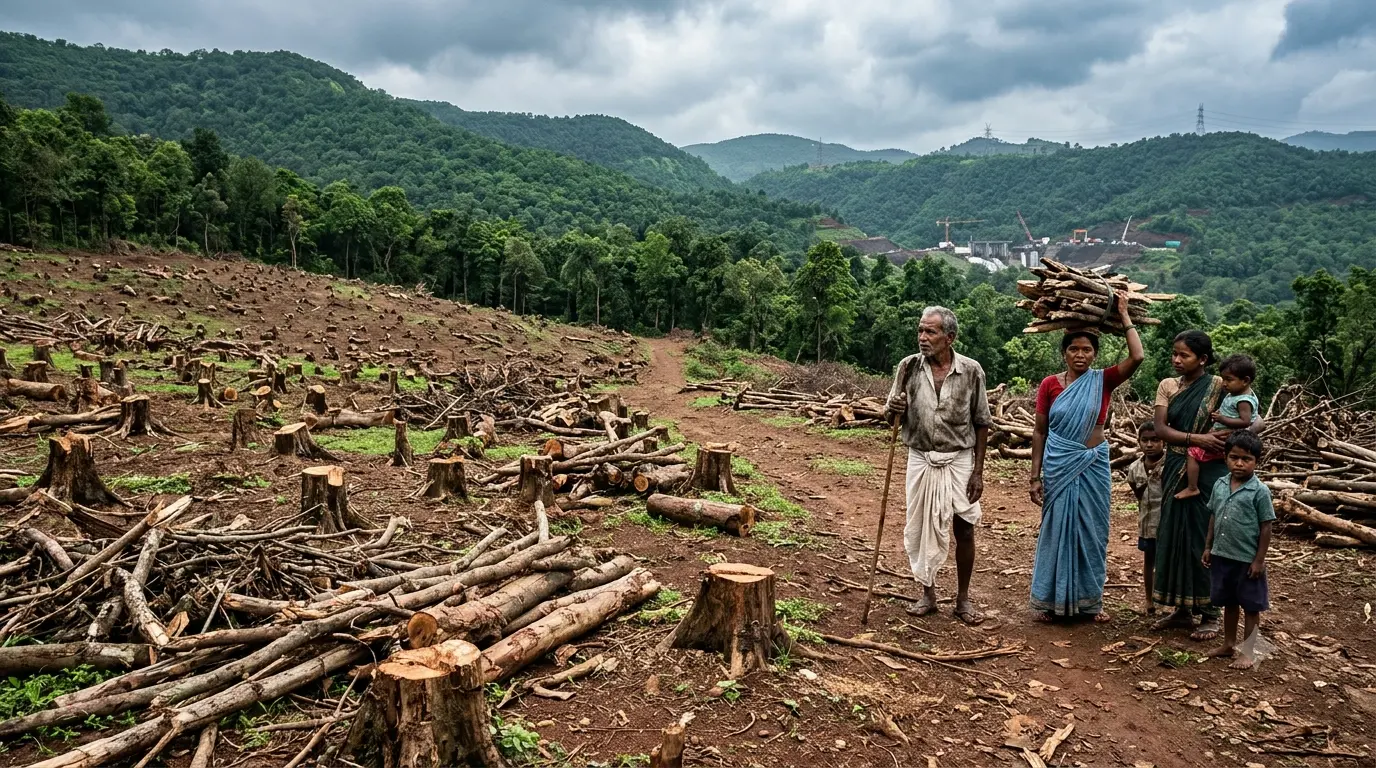
Mumbai: A Rs 13,505-crore hydropower project in Maharashtra's Karjat has triggered a growing confrontation between clean energy ambitions and forest conservation. While the proposed 3,000-MW facility is expected to help reduce dependence on coal-based electricity, its construction could require the diversion of 377 hectares of land and the felling of more than 32,000 trees.
The controversy has also exposed how around 150 Katkari tribal families who depend on the forest were left out of the process for recognising forest rights and compensation.
1. Why a Rs 13,505-crore power project has triggered protests
The proposed Saidongar-I pumped-storage hydropower project in Karjat, Raigad district, has become the centre of an escalating environmental and political controversy in Maharashtra.
Developed by Torrent Power at an estimated cost of Rs 13,505 crore, the 3,000-MW project is expected to become operational by 2029.
However, its construction requires approximately 377 hectares of land, including 233 hectares of forest land, and could lead to the removal of more than 32,000 trees in the Western Ghats.
Tree-felling began on Dussehra morning, with nearly 1,100 trees reportedly cut before protests by villagers and environmental activists forced a temporary halt.
The project has triggered concerns over forest destruction, wildlife habitats, water availability and the livelihoods of communities dependent on the affected forest.
2. 150 tribal families face loss of their forest-based livelihoods
One of the biggest concerns surrounding the project is its impact on approximately 150 families living across six hamlets: Saidongar, Dhak, Pali, Potal, Ambot and Bhaliwadi.
Most belong to the Katkari tribal community, whose livelihoods have traditionally depended on the surrounding forest.
Residents collect firewood and sell it in nearby markets, earning approximately Rs 150-200 a day. They also depend on forest produce such as honey, mahua, jamun and guava.
The forest provides medicinal plants, including neem, giloy and adulsa, which residents use to treat common illnesses and wounds.
The nearby Pej river also supports their livelihoods. During the monsoon, families catch fish and crabs for consumption and sale.
With access to the forest restricted following the tree-felling operation, residents fear losing an important source of income, food and traditional healthcare.
3. Why the Forest Rights Act has become central to the controversy
The controversy has raised questions about the implementation of the Forest Rights Act, 2006.
The legislation recognises the rights of forest-dwelling communities over land and forest resources they have traditionally used.
Under Section 6, the Gram Sabha is responsible for initiating the process of identifying and verifying community and individual forest rights claims before forwarding them to the relevant authorities.
In the Karjat case, forest officials told The Indian Express that the Pali Gram Sabha had not submitted records identifying families dependent on the forest.
Officials said the absence of these records meant there were no formally recognised claims to process for compensation or rehabilitation.
Consequently, the environmental clearance issued to the project states that no rehabilitation of families or villages is envisaged.
This has raised a critical question: can communities lose access to forests they have depended on for generations simply because their traditional dependence was never formally documented?
The issue goes beyond compensation. It concerns whether administrative gaps in recognising forest rights can leave vulnerable communities without adequate protection when large infrastructure projects are approved.
4. Western Ghats deforestation could have consequences beyond Maharashtra
The environmental implications of the project extend beyond the immediate tree-felling site.
The Western Ghats are an ecologically significant mountain range that influences rainfall patterns, biodiversity and water availability across several parts of peninsular India.
A 2018 study titled Moisture Supply From the Western Ghats Forests to Water Deficit East Coast of India, conducted by researchers from IIT Bombay and CSIR, examined how moisture released by Western Ghats forests contributes to rainfall in regions downwind.
The study highlighted the role of evapotranspiration, through which water moves from soil and vegetation into the atmosphere.
This moisture is transported towards Tamil Nadu and contributes to rainfall in the Cauvery basin.
According to the research, Western Ghats forests contribute approximately 3 mm of rainfall per day during August and September across large parts of Tamil Nadu and the Cauvery basin.
The study also estimated that removing vegetation could increase average surface temperatures in Tamil Nadu by around 0.25 degrees Celsius.
Scientists have cautioned that the precise rainfall impact of clearing the specific Karjat project site cannot be directly quantified from the available research. However, the findings underline how changes in forest cover can influence atmospheric moisture transport and rainfall patterns far beyond the location of deforestation.
5. Wildlife concerns: Leopards, sloth bears and other protected species
The project area is part of an ecologically important landscape adjoining the Bhimashankar forest.
Its environmental clearance report identifies 26 species listed under Schedule I of the Wildlife (Protection) Act, 1972, in the broader study area.
These include 14 mammals, six bird species and six reptiles.
The recorded mammals include leopards, Indian sloth bears, Indian porcupines, sambar deer, jungle cats and Indian wolves.
The birds include Indian peafowl, ospreys, black eagles and white-eyed buzzards. The reptiles include Indian cobras, Russell's vipers and Indian pythons.
However, the report does not establish that all these species were sighted within the exact 377 hectares earmarked for the project.
The project proposal also includes Rs 3.26 crore for a Biodiversity and Wildlife Conservation Plan.
The concerns centre on whether habitat loss and changes to the surrounding landscape could increase human-animal conflict and affect wildlife movement.
6. Why Maharashtra says it needs the project
The Maharashtra government has defended the project on the grounds of electricity security and the transition towards renewable energy.
According to the NITI Aayog India Climate and Energy Dashboard, coal-based power plants account for approximately 74.19% of Maharashtra's electricity generation.
The proposed facility will have a capacity of 3,000 MW, equivalent to nearly a tenth of the state's electricity demand, according to the figures cited in the report.
The central argument for the project is that solar and wind power generation is intermittent. Solar plants generate electricity during daylight hours, while wind generation depends on wind conditions.
Pumped-storage hydropower facilities can help address this challenge by storing energy for periods of higher electricity demand.
The proposed plant will have two reservoirs at different elevations.
During periods of surplus electricity, water will be pumped from the lower reservoir to the upper reservoir. When demand increases, the stored water will be released through turbines to generate electricity.
This allows excess renewable energy to be stored and used during peak-demand periods.
Torrent Power has stated that the reservoirs will primarily use seasonal monsoon runoff rather than depending on the Pej river's existing flow throughout the year.
7. What Torrent Power has promised in return
Torrent Power has defended the project by highlighting its proposed social and environmental commitments.
In its response to The Indian Express, the company said it plans to construct a 50-bed multispeciality hospital offering free treatment to tribal residents.
It has also proposed schools, skill development centres and employment opportunities.
The environmental clearance application estimates that the project could generate around 2,000 jobs during construction.
The company has also cited compensatory afforestation measures.
As part of this plan, 253 hectares of land in Maharashtra's Satara district, approximately 200 km from the project site, have been transferred to the Forest Department.
The land reportedly has an estimated existing tree density of 70,000 trees, with another 30,000 trees proposed to be planted.
Torrent has argued that the environmental benefits of this arrangement would substantially exceed the loss caused by the project.
However, the central concern remains whether plantations in another district can adequately compensate for the ecological functions of an established Western Ghats forest.
8. Forest Minister examines ways to save trees as opposition grows
The controversy has also intensified political opposition to the project.
Maharashtra Forest Minister Ganesh Naik said on November 1 that he was examining options to preserve the maximum possible number of trees and undertake compensatory plantation.
Naik clarified that the project had received approval before he took charge of the Forest Department and that he was reviewing its details.
Chief Minister Devendra Fadnavis has defended the project, describing pumped-storage facilities as necessary for balancing renewable energy generation and electricity demand.
He has also dismissed some of the criticism as politically motivated, while saying genuine concerns and alternatives could be considered.
Opposition leaders, including Aaditya Thackeray and NCP (SP) MLA Rohit Pawar, have raised concerns about forest diversion, biodiversity and the impact on local communities.
MNS chief Raj Thackeray has also visited the project area and met residents.
Environmental organisations, including NatConnect Foundation and Vanashakti, have questioned the project's ecological implications.
Meanwhile, tree-felling remains temporarily suspended following protests. Forest officials have said that the halt was intended to maintain law and order and that no decision had been taken on when the operation would resume.
Can clean energy justify the loss of an established forest?
The Karjat project highlights a difficult question in India's energy transition: how should the country balance the need for renewable energy storage with the protection of forests and communities?
1. Renewable energy infrastructure also has an environmental cost
Pumped-storage projects can help integrate solar and wind power into the electricity grid. However, their environmental impact depends on where they are constructed, how much land they require and whether existing ecosystems are disturbed.
A project supporting clean electricity is not automatically environmentally harmless.
2. Compensatory plantations cannot immediately replace natural forests
Planting trees elsewhere may increase green cover, but an established forest performs several ecological functions simultaneously.
It supports wildlife, stores carbon, regulates local temperatures, maintains soil moisture and contributes to the movement of atmospheric moisture.
A plantation in Satara cannot automatically replicate the ecological functions of the mature forest ecosystem being cleared in Karjat.
3. Recognition of tribal rights is as important as environmental clearance
The absence of formally documented forest-rights claims raises questions about the sequence in which clearances and land transfers were processed.
The Forest Rights Act was designed to recognise the relationship between forest-dependent communities and their traditional resources.
The Karjat controversy demonstrates why proper identification and settlement of these rights are essential before communities lose access to forest land.
4. The impact could extend beyond the project boundary
The Western Ghats influence ecological and climatic processes across state boundaries.
Research linking Western Ghats forest moisture to rainfall in the Cauvery basin makes the controversy relevant to regions beyond Maharashtra.
However, further site-specific scientific assessment is necessary before attributing a particular rainfall impact to this project.
5. The bigger question is whether alternatives have been adequately examined
The government and the company need to address whether the project layout can be modified to preserve more trees, reduce forest diversion and protect wildlife corridors.
The Forest Minister's review could provide an opportunity to examine these alternatives.
Ultimately, the debate is not simply about choosing between electricity and forests. It is about whether India's clean-energy transition can be planned without transferring its environmental and social costs to forest-dependent communities.