US becomes a ‘lonelier power’: Jaishankar defends India’s Russia ties
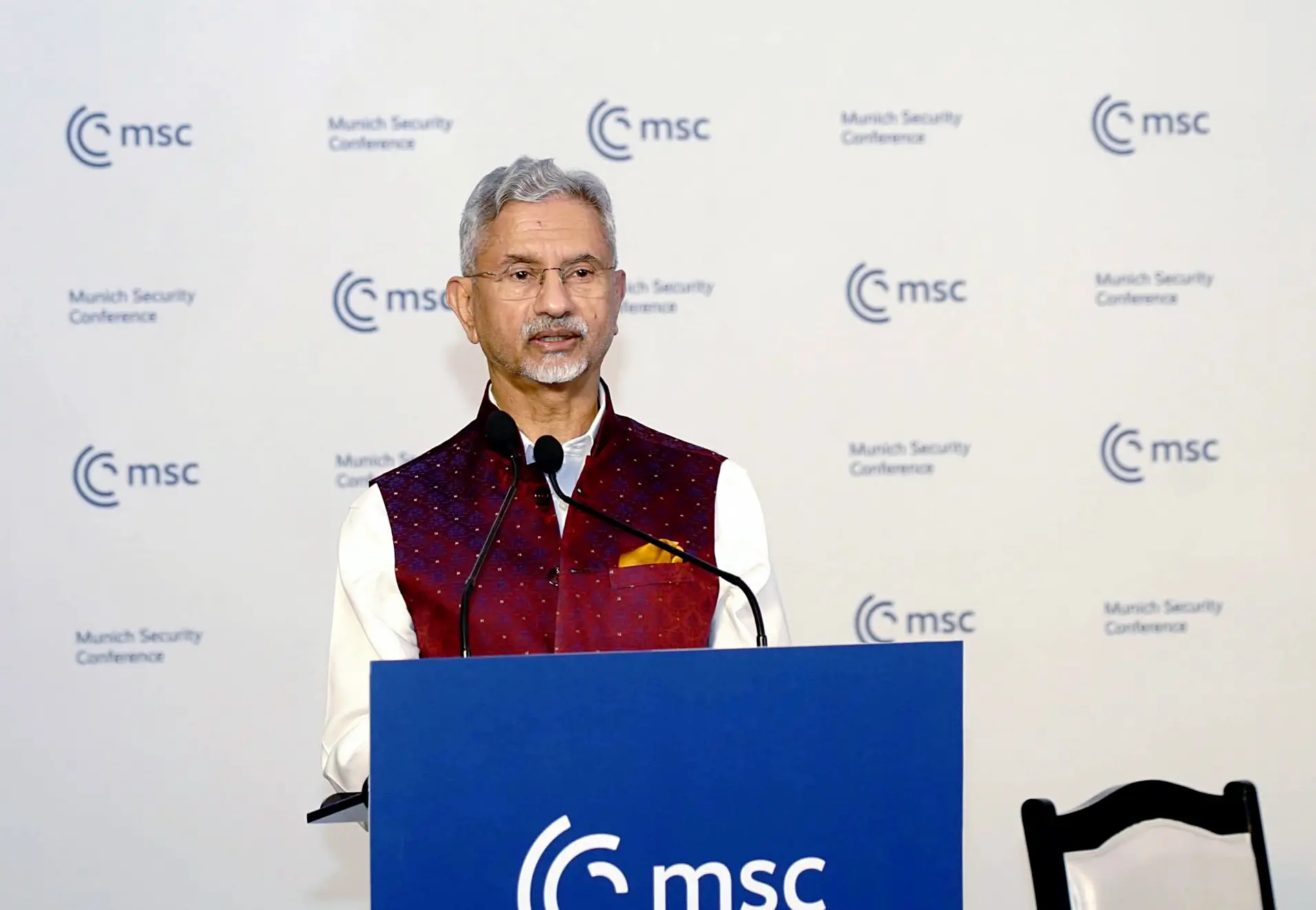
External Affairs Minister S Jaishankar has described the United States as having “deliberately become a lonelier power”, while highlighting China’s growing influence and the increasing importance of flexible partnerships among emerging and middle powers.
Speaking at the Munich Security Conference, Jaishankar said the international landscape was being shaped by two major developments: what he called a “radical repositioning” of the US and the rise of China.
He described the US approach as “a posture of choice” and said Washington had “deliberately become a lonelier power”.
Jaishankar also pointed to the scale of China’s economic influence, noting that the country accounts for about one-third of global manufacturing. He said its economic capabilities were increasingly translating into political influence.
According to the minister, competition between Washington and Beijing has expanded beyond the two countries, with states increasingly using their economic, technological and strategic advantages as leverage.
Middle powers move towards flexibility
Jaishankar said emerging and middle powers were becoming more conscious of their own interests and seeking greater self-reliance.
He said countries were pursuing diversification and de-risking not only in economic matters but also across security and strategic relationships. Instead of relying on a single major power or bloc, countries are increasingly developing partnerships based on specific areas of common interest.
Jaishankar argued that countries do not necessarily need identical positions on every issue to cooperate.
He said a “reasonable degree of convergence” could be sufficient for countries to work together, marking a shift away from the expectation of complete alignment.
Quad, BRICS and connectivity initiatives
Jaishankar cited the Quad and BRICS among examples of countries working together despite differences in their wider foreign-policy positions.
He also referred to connectivity initiatives including the India-Middle East-Europe Economic Corridor, the International North-South Transport Corridor and the Northern Sea Route.
The minister highlighted the International Solar Alliance and the Coalition for Disaster Resilient Infrastructure as other examples of cooperation around specific shared objectives.
He said this pattern of agenda-based cooperation was contributing to an evolving global architecture in which countries could maintain different partnerships simultaneously.
Jaishankar defends India-Russia ties
In a separate discussion, Jaishankar defended India’s longstanding relationship with Russia amid criticism from Western countries over New Delhi’s continued engagement with Moscow.
He said India’s foreign-policy choices are shaped by its own historical experience and recalled Russian and Soviet support for India since the 1950s.
“People don’t forget good history or bad history,” Jaishankar said.
He referred to the period when much of the Western world supported Pakistan’s military regime and recalled the Soviet Union’s support for India during the 1971 war.
Jaishankar said India’s experience with Russia had been “positive and consistently positive”, while acknowledging that the relationship has evolved over the decades.
Russian oil remains a point of contention
India’s continued purchases of Russian oil have become a major point of criticism from the US and some European countries following Russia’s invasion of Ukraine.
New Delhi has maintained that its energy decisions are based on national interests and the need to protect consumers by maintaining multiple sources of supply.
Jaishankar also reiterated India’s position that the war in Ukraine should end through dialogue, diplomacy and negotiations.
He said India has engaged with both Russia and Ukraine and has discussed issues including Black Sea shipping, grain supplies, energy exports and attacks on critical infrastructure.
What Jaishankar’s remarks mean
Jaishankar’s comments reflect India’s broader approach of maintaining strategic flexibility rather than aligning completely with any single major power.
His remarks on the US and China underline the changing balance of influence, while his defence of India-Russia ties highlights New Delhi’s emphasis on historical relationships and national interests.
The wider message was that emerging and middle powers are increasingly seeking room to work with different countries on different issues. Rather than choosing between competing blocs, they are pursuing diversification, de-risking and partnerships based on specific areas of convergence.