Inside India's defense strategy to deal with Pakistan's arsenal
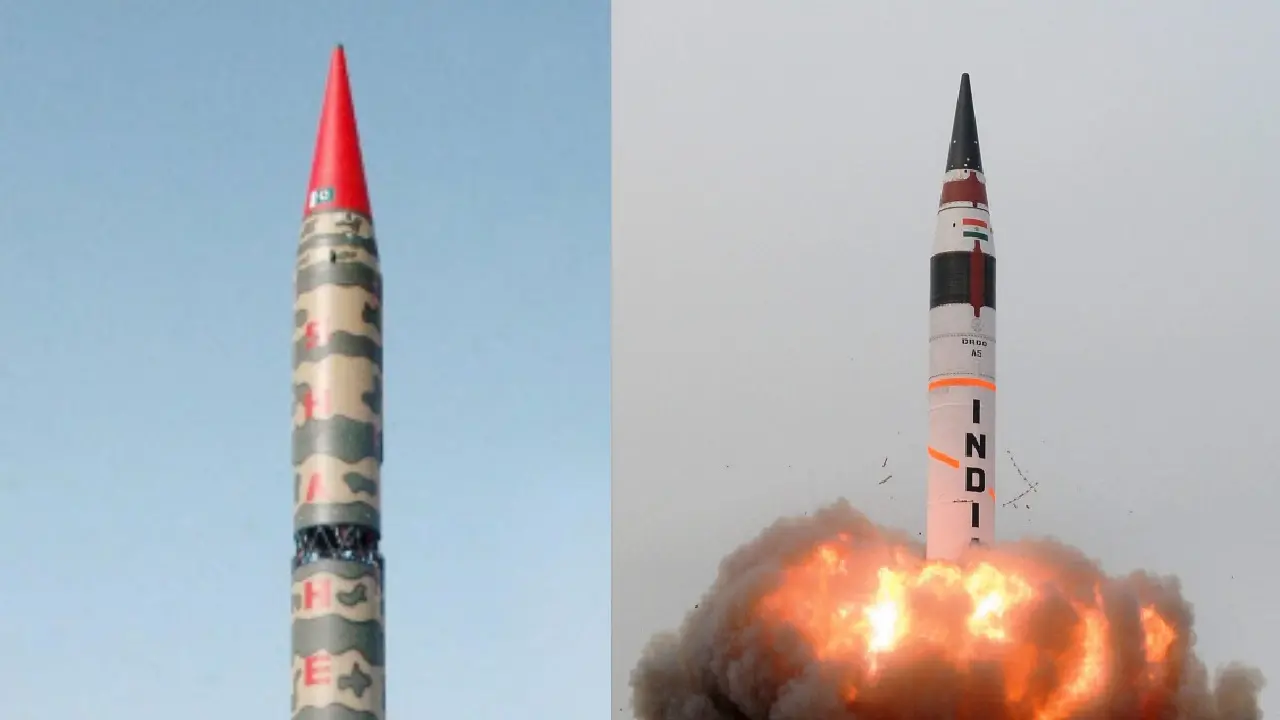
India and Pakistan, two neighbours with a long history of tension, have been locked in a silent but intense arms race for decades. Pakistan’s growing missile arsenal, designed to counter India’s military strength, poses a serious challenge to India’s security. From short-range tactical missiles to long-range ballistic ones, Pakistan has built a range of weapons that can target Indian cities, military bases, and strategic assets. But India, with its advanced technology and smart defence strategies, is not sitting idle. This article dives into Pakistan’s missile capabilities, the threat they pose, and how India is preparing to tackle this danger head-on.
Pakistan’s missile programme is India-centric, built to deter and, if needed, strike key Indian targets. One of the most talked-about missiles is the Shaheen-III, a ballistic missile with a range of 2,750 km. This missile can reach almost every corner of India, including major cities like Delhi, Mumbai, and even the Andaman and Nicobar Islands. Its ability to carry nuclear warheads makes it a significant threat. According to reports, Pakistan has been testing and improving the Shaheen-III to ensure precision and survivability, making it harder for India to intercept. Another missile, the Ababeel, adds to the worry. This missile uses Multiple Independently Targetable Re-entry Vehicles (MIRVs), meaning a single missile can hit multiple targets hundreds of kilometres apart. This technology makes it tough for any defence system to stop it, as the warheads split and strike different locations. Posts on X have claimed that the Ababeel could “kill any chance of a full-scale war” because of its ability to overwhelm defences. While such claims may be exaggerated, they highlight the growing concern about Pakistan’s missile advancements.
Then there’s the Nasr, a short-range ballistic missile with a range of about 70 km. What makes Nasr dangerous is its ability to carry tactical nuclear warheads, designed to be used on the battlefield against Indian troops or armoured units crossing into Pakistan. Pakistan calls it a “deterrent” against India’s Cold Start doctrine, which involves rapid, limited military strikes across the border. The Nasr’s low-yield nuclear capability raises the stakes, as even a small miscalculation could escalate into a nuclear conflict. Another missile, the Babur, is a cruise missile with a range of around 700 km. It can fly low to avoid radar detection and strike with pinpoint accuracy, making it ideal for targeting military bases or infrastructure. Pakistan has also tested the Fatah-II, a guided rocket system with a range of 400 km, which some claim can take out India’s S-400 air defence system. While this claim is unverified, it shows Pakistan’s focus on countering India’s advanced defences.
Pakistan’s missile development is not just about homegrown technology. It has leaned heavily on China for support. For example, China has supplied Pakistan with advanced submarines and possibly helped with missile technology. The Shaheen series is believed to have roots in Chinese designs, and recent reports suggest Pakistan is seeking help from Belarus and China to boost its missile capabilities. This external support has allowed Pakistan to close the gap with India in some areas, despite its smaller economy and resources. According to an ABP News report, Pakistan possesses around 170 plutonium-based nuclear warheads, enough to cause massive destruction. The United States has expressed concerns about Pakistan’s long-range missiles, with officials like John Finer questioning their necessity given their ability to hit all of India.
So, how is India planning to counter this fiery challenge? India’s defence strategy is a mix of advanced technology, missile defence systems, and a strong offensive capability. First, India has invested heavily in missile defence systems to intercept incoming threats. The S-400 Triumf, bought from Russia, is a game-changer. This air defence system can detect and destroy missiles, aircraft, and drones at ranges up to 400 km. India is also developing its own Ballistic Missile Defence (BMD) system in two phases. Phase 1, already operational, can intercept missiles with a range of up to 2,000 km. Phase 2 aims to tackle longer-range missiles like the Shaheen-III. The Defence Research and Development Organisation (DRDO) is working on advanced interceptors like the AD-1 and AD-2, which can neutralise ballistic missiles in mid-flight. These systems give India a shield against Pakistan’s missile threats.
But defence is only half the story. India’s offensive capabilities are equally impressive. The Agni-V, an intercontinental ballistic missile with a range of 5,000–8,000 km, outranges anything in Pakistan’s arsenal. It can strike deep into Pakistan or even beyond, serving as a strong deterrent. The BrahMos, a supersonic cruise missile, is another trump card. With a range of up to 800 km in its extended version, BrahMos can hit targets with deadly precision, whether on land or at sea. India is also developing the Pralay, a tactical ballistic missile with a range of 150–500 km, designed to counter Pakistan’s Nasr and other battlefield threats. Unlike Pakistan’s nuclear-focused Nasr, Pralay uses conventional warheads, making it a flexible option for limited strikes without crossing the nuclear threshold.[
India’s air and naval power further strengthens its position. The Indian Air Force’s Rafale jets, armed with SCALP missiles, can strike targets over 300 km away without crossing the border. The Indian Navy’s INS Surat, a guided-missile destroyer, recently test-fired a Medium-Range Surface-to-Air Missile (MRSAM) that can shoot down low-flying threats like Pakistan’s Babur cruise missile. India is also working on cutting-edge weapons like the Surya laser system, which can destroy missiles and drones up to 20 km away. These advancements show India’s focus on staying ahead in the technology race.
Beyond hardware, India’s strategy includes diplomatic and strategic moves. After the recent Pahalgam terror attack, India suspended the Indus Waters Treaty, closed borders, and expelled Pakistani nationals, signalling a tough stance. While India has avoided military retaliation so far, experts believe it could opt for “surgical strikes” like those in 2016 and 2019 if tensions escalate. These precision strikes target terrorist infrastructure without triggering a full-scale war. India’s military is also prepared for rapid response, with the Army and Air Force ready to counter any provocation along the Line of Control (LoC).
However, the nuclear shadow looms large. Both nations are nuclear-armed, and any miscalculation could lead to catastrophic consequences. Pakistan’s “first-use” nuclear doctrine contrasts with India’s “no-first-use” policy, adding complexity to the equation. Experts warn that nuclear weapons act as both a danger and a restraint, forcing both sides to tread carefully. India’s focus on precision and limited retaliation, as seen in past crises like Pulwama, shows its intent to avoid escalation while responding firmly.
In conclusion, Pakistan’s missile arsenal, from the Shaheen-III to the Nasr, is a serious challenge for India. With support from China and a focus on nuclear deterrence, Pakistan aims to keep India on edge. But India is not backing down. With advanced missile defence systems, powerful offensive weapons like Agni-V and BrahMos, and a smart mix of diplomacy and military readiness, India is well-prepared to counter any threat. The key is balance—staying strong without tipping the region into chaos. As tensions simmer, India’s strategy of deterrence, defence, and dialogue will shape the future of this high-stakes rivalry.
(The author is a defence analyst)