I-Day 2026: PM Modi's 'Sapt Dhara' call to action from Red Fort
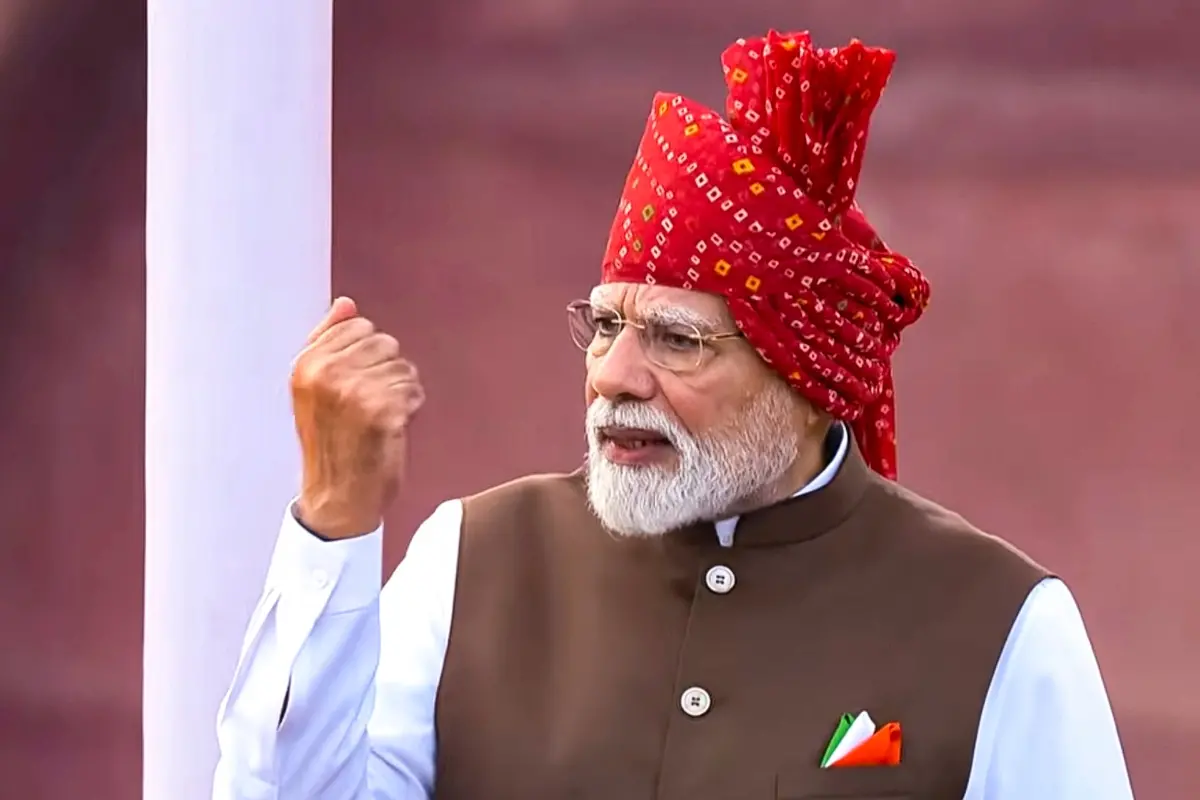
Prime Minister Narendra Modi's Independence Day 2026 address from the Red Fort laid out an ambitious roadmap for India's next phase of growth, with a call to build strength across seven key areas — from manufacturing and technology to defence, the green economy and India's global soft power.
Described as 'Sapt Dhara' or seven streams of strength, the vision focuses on building domestic capabilities, achieving global scale and positioning India as a leader across strategic and emerging sectors.
What is PM Modi's 'Sapt Dhara' vision for India?
The first pillar is manufacturing power, with a push to build complete domestic, end-to-end value chains — from design and components to finished products. The focus, according to the vision, is on zero-defect quality, competitive costs and the ability to operate at a global scale.
The second is agriculture and food processing. The emphasis is on integrated farm-to-export supply chains for products such as millets, spices and fruits, alongside a transition towards chemical-free farming.
Technology and innovation form the third pillar. The vision calls for India to move beyond being a technology market and become a global innovation hub, with leadership in areas including artificial intelligence, quantum technology, space, robotics, digital public infrastructure and Made-in-India 6G.
The fourth pillar, Gati Shakti, centres on seamless multimodal connectivity. The aim is to link cities, highways, railways, airports and modern industrial seaports through a high-speed logistics network.
Under Defence Shakti, the focus is on achieving strategic self-reliance by developing and exporting next-generation defence technologies. Drones, counter-drone systems and hypersonic technologies were among the areas highlighted.
The sixth stream combines the green and blue economy, with a focus on green hydrogen, renewable energy and energy storage, while also seeking to make fuller use of India's ocean, coastal and marine potential.
The seventh pillar is India's soft power. The vision seeks to take Indian culture, Yoga, Ayurveda and tourism to a wider global audience while building leadership in gaming, visual effects, animation and the broader creative economy.
'No compromise on quality'
Quality was also placed at the centre of India's ambition to build globally trusted products.
Prime Minister made a direct appeal to industry, stressing that there should be no compromise on quality, as the quality of Indian products will play a key role in building trust in Indian brands globally.
The roadmap also sets out a broader ambition for Indian companies and institutions to achieve global stature.
The targets include having 50 Indian companies among the Fortune 500, an Indian bank among the world's leading banks and an Indian pharmaceutical company among the world's top five.
The vision also extends to an Indian law or rating agency achieving global leadership, an Indian consulting or accounting firm becoming one of the world's top firms and an Indian technology company joining the ranks of the world's leading companies.
The larger goal is to create Indian brands whose names are recognised globally and associated with India with enthusiasm.
'Nasha Mukt Yuva Abhiyan' appeal
The Prime Minister also highlighted the Nasha Mukt Yuva Abhiyan, urging families to join the campaign against drug abuse.
He called for collective participation to eliminate the menace of drugs and protect society from its impact.
PM Modi urges families to participate in Digital Census
The Prime Minister also spoke about India's first Digital Census, which is currently underway.
He urged families to sit together and provide correct information about their households during the census process. Accurate information, he said, would help in better policymaking.
Push for cooperative federalism and reforms
The Independence Day address also called for the Centre and states to work together on the next phase of reforms.
The emphasis was on cooperative federalism, with governments working together and aligning development efforts towards the larger goal of Viksit Bharat.
The approach also extends beyond governments, with the vision calling for a whole-of-government and whole-of-society effort to drive India's next phase of development.
Appeal for political cooperation on Nari Shakti
The Prime Minister also made a direct appeal to political parties to respect women's aspirations and cooperate in implementing one-third reservation for women in Parliament and state assemblies.
The call for greater participation of women forms another part of the broader vision for India's development as the country works towards its larger ambitions.
Taken together, the Sapt Dhara roadmap and the wider calls made from the Red Fort present a vision centred on domestic capability, global competitiveness, technological leadership, social participation and stronger institutions as India seeks to shape the next phase of its development.