How can CJI be involved in executive appointments, asks Vice President, says it's `time to revisit'
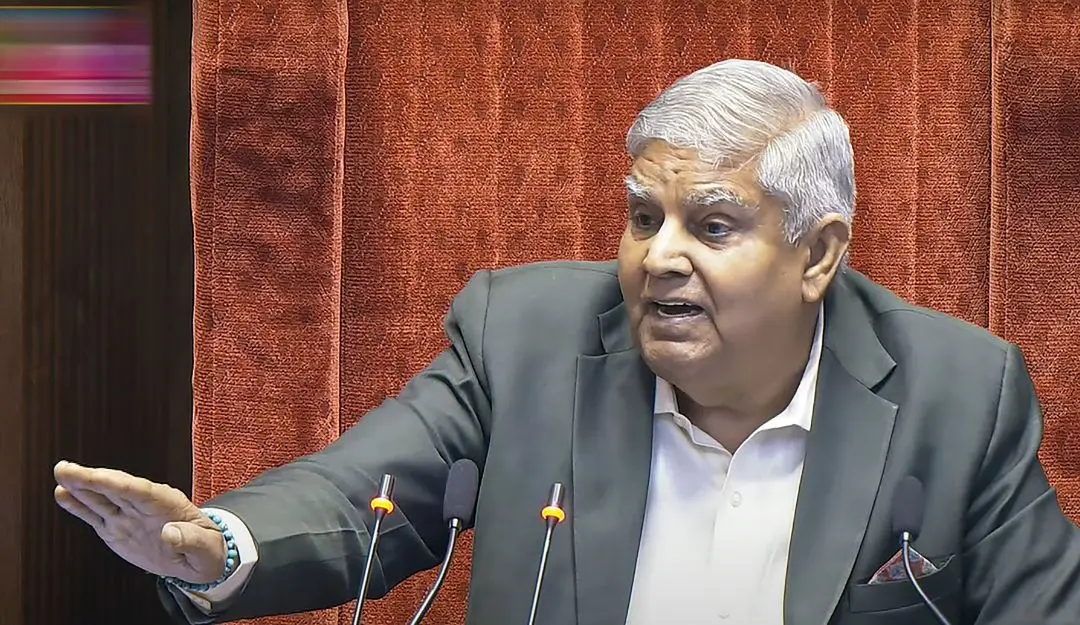
New Delhi: Vice President Jagdeep Dhankhar on Friday raised questions about the involvement of the Chief Justice of India in executive appointments, such as that of the CBI Director, and suggested that it was time to "revisit" such norms.
Speaking at the National Judicial Academy in Bhopal, Dhankhar wondered how the Chief Justice of India, by "statutory prescription," could be involved in selecting the head of an executive agency. He said, "To stir your minds, how can in a country like ours or in any democracy, by statutory prescription, the Chief Justice of India participate in the selection of the CBI director?"
He further questioned the legal rationale behind such a process, acknowledging that it originated due to the executive yielding to judicial verdicts.
However, he stressed that "time has come to revisit" this practice, stating, "This surely does not merge with democracy. How can we involve the Chief Justice of India with any executive appointment!" Dhankhar labelled executive governance by judicial decree as a "Constitutional paradox that the largest democracy on the planet cannot afford any longer."
The Vice President emphasised that all institutions must operate within their constitutional bounds. He said, "Governments are accountable to the legislature. And periodically accountable to the electorate. But if executive governance is arrogated or outsourced, enforceability of accountability will not be there."
He added that any intervention by the legislature or judiciary in governance was "antithetical to constitutionalism."
"Democracy thrives not on institutional isolation, but in coordinated autonomy," he continued. "Indisputably, institutions contribute productively and optimally while working in their respective domains. Out of deference, I will not advert instances except to observe that executive governance by judiciary is being frequently noticed and discussed nearly in all quarters."
On the issue of judicial review, Dhankhar stated that it was a "good thing" as it ensures that laws conform to the Constitution. However, he clarified that when it comes to amending the Constitution, the ultimate authority lies with Parliament. "The judiciary's public presence must be primarily through judgments. Judgments speak for themselves....Any other mode of expression... undermines institutional dignity," he remarked.
Dhankhar also revisited the debate surrounding the basic structure doctrine, which asserts that Parliament cannot amend certain core features of the Indian Constitution. Referring to a book by former solicitor general Andhya Arjuna on the Kesavananda Bharati case, Dhankhar said, "Having read the book, my view is that the doctrine of the basic structure of the Constitution has a debatable, very debatable, jurisprudential basis."
Drawing from his experience as Parliamentary Affairs Minister in 1990, Dhankhar pointed out that the Supreme Court's strength at the time was only eight judges. He recalled that under Article 145(3), when the court had just eight judges, at least five judges were required to sit on a bench for constitutional interpretation. "More often than not, all the eight judges sat together (on a bench hearing a case)," he said.
He added, "Please note, when this strength was eight, it (size of constitutional bench) was five. And the Constitution allows the highest court of the land to interpret the Constitution." Dhankhar emphasised that under the guise of interpretation, there should be no "arrogation of authority," and that the essence and spirit envisaged by the framers of the Constitution under Article 145(3) must be respected.
"If I analyse arithmetically, they were very sure the interpretation will be by majority of judges, because the (total) strength then was eight. That five stands as it is. And the number (of total judges) is more than fourfold," he explained.
The Vice President also underscored the importance of dialogue and deliberation in democracy, stating, "If the right to express oneself is throttled or diluted, democracy gets thinner and thinner and thinner."