'Go back': Mamata Banerjee camp locks TMC office used by Saayoni Ghosh
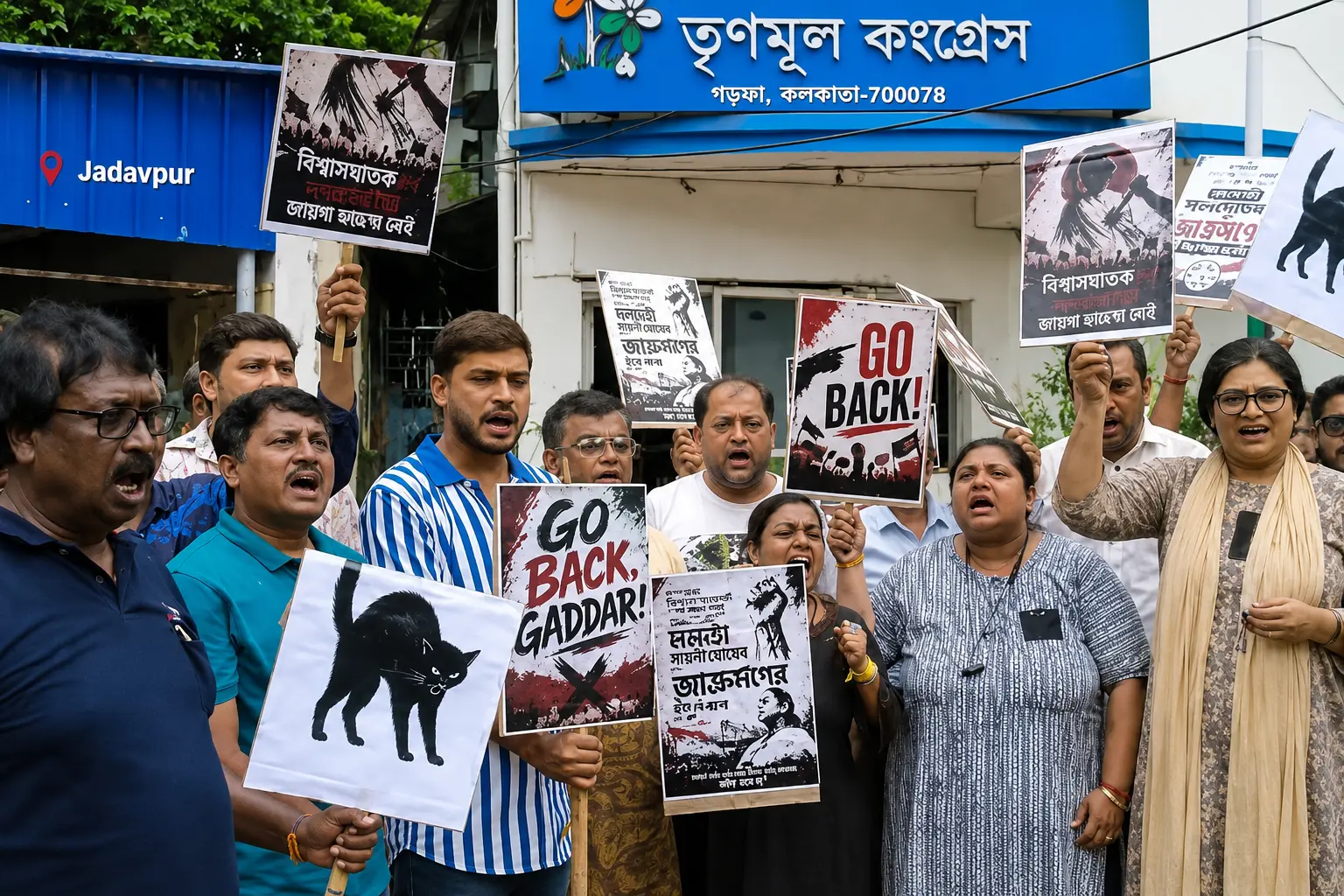
Go Back Saayoni' and 'No place for traitors' were the slogans outside a TMC office in south Kolkata on Monday, as the party's escalating organisational crisis spilled into a confrontation over who has the right to use its political infrastructure.
Supporters of Mamata Banerjee locked the TMC office in Ward 106 of Garfa, which Jadavpur MP Saayoni Ghosh had used for meetings, organisational discussions and public outreach.
The move came after Ghosh aligned herself with the breakaway National Congress Party of India (NCPI), which has subsequently allied with the BJP-led NDA at the Centre.
The protesters questioned why Ghosh, despite having moved into the dissident camp in Parliament, should continue to operate from a TMC office. A nameplate bearing her name was also still displayed outside the premises.
A group of young men and women claiming to be supporters of Mamata Banerjee and the 'real TMC' arrived at the Garfa office carrying banners demanding that Ghosh leave.
A person described as Ghosh's secretary was present when the protesters reached the office. They asked him to vacate the premises and subsequently locked the office.
Supporters of the Mamata camp said their action was aimed at preventing a TMC facility from being used for another party's political activities.
'The TMC office cannot be used for public outreach on behalf of the NCPI. You cannot sit in a TMC office and do political work for another party. That is why this step was taken,' they said.
TMC leader Kunal Ghosh said Ghosh's nameplate has no place in a party office after she joined NCPI.
Praising Sudip Bandyopadhyay, he said the senior leader's decision to avoid setting up a party office reflected 'matured politics'.
Ghosh's reaction to the incident was not immediately available.
The confrontation is significant because it shows how the TMC's organisational rupture is moving beyond competing claims of leadership and into a battle for control of the party's physical and grassroots infrastructure.
Ghosh won the Jadavpur Lok Sabha seat on a TMC ticket in the 2024 elections and is among 20 party MPs who have aligned themselves with the NCPI and the NDA.
Petitions seeking their disqualification under the anti-defection law are pending before Lok Sabha Speaker Om Birla.
The developments follow the TMC's defeat in the 2026 Assembly elections, which triggered an unprecedented organisational crisis within the party.
The camps led by Mamata Banerjee and rebel leader Ritabrata Banerjee have since been engaged in an increasingly bitter contest over control of the party and its elected representatives.
The first major flashpoint emerged over the post of Leader of the Opposition. As many as 65 of the TMC's 80 MLAs backed Ritabrata Banerjee's claim and rejected the nominee supported by the Kalighat leadership.
The dissident camp subsequently convened a special organisational session, elected senior MLA Arup Roy as its chairperson and announced a parallel national leadership structure.
The rebels argued that the existing leadership had lost the confidence of a majority of elected representatives.
With the dispute subsequently reaching Parliament, the TMC's internal battle has expanded into a wider struggle over legitimacy, organisational authority and political identity.
The Garfa confrontation marks another turn in that conflict. The fight over who controls the TMC is no longer restricted to Assembly numbers, parliamentary alignments or rival organisational meetings.
It is increasingly being played out on the ground, over party offices, nameplates, symbols and the right to conduct political activity in the TMC's name.
Monday's incident in Garfa therefore offered a stark glimpse of the party's deepening divide, where the battle for control is now reaching the neighbourhood level.