Delhi's winter air hasn't improved in four years despite pollution curbs, study finds
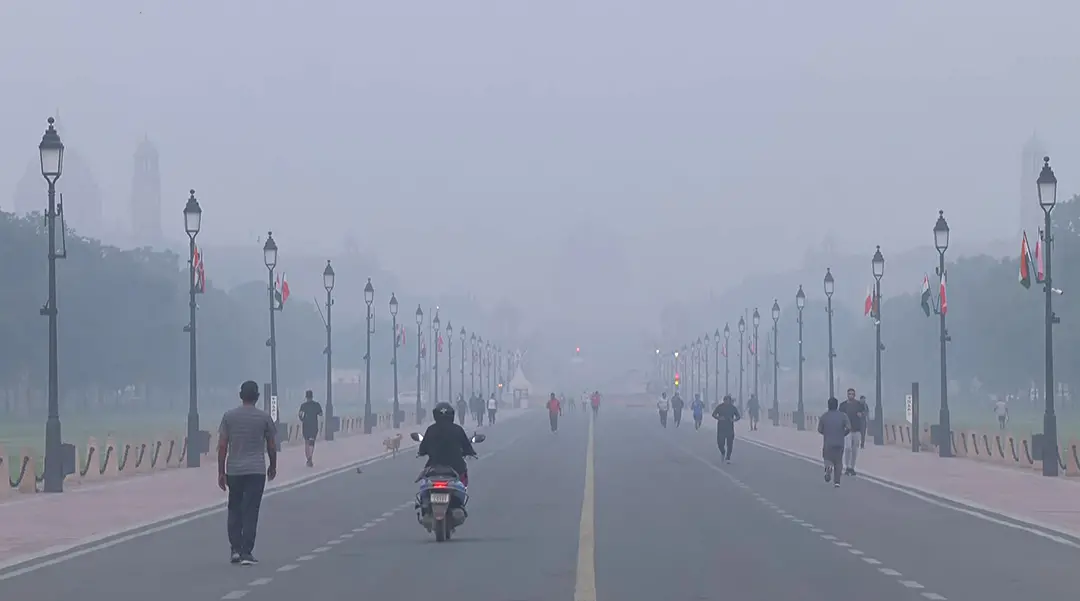
New Delhi: Delhi's winter air pollution has shown no sustained improvement over the past four years despite repeated enforcement of stringent restrictions under the Graded Response Action Plan (GRAP), according to an analysis by the Centre for Research on Energy and Clean Air (CREA).
The findings suggest that emergency pollution-control measures have done little to alter the capital's recurring pattern of hazardous winter air quality, raising questions about the effectiveness of relying heavily on temporary restrictions rather than addressing pollution at its source.
The analysis, covering four winter seasons between October 2022 and February 2026, found that Delhi's average Air Quality Index (AQI) remained persistently high even after the GRAP framework underwent a major revision in 2022.
According to CREA analyst Manoj Kumar, the city's mean AQI increased from 280 in the winter of 2022-23 to 304 in 2023-24. It subsequently dropped to 285 in 2024-25 before rising again to 295 during the 2025-26 winter season.
A similar pattern emerged in the median AQI, which stood at 294 in 2022-23, climbed to 324 in 2023-24, declined to 289 in 2024-25 and increased again to 305 in the most recent winter.
Both indicators were higher in 2025-26 than in 2022-23, indicating that the national capital has failed to achieve a consistent reduction in winter pollution levels since the revised GRAP measures came into effect.
The study also found that Delhi remained under Stage II or higher GRAP restrictions for approximately 78 to 83 per cent of the observed days across the four winter seasons.
"That is roughly four out of every five days," the analysis mentions.
The number of days under the more stringent Stage III and Stage IV restrictions also remained substantial. Delhi recorded 32 such days in 2022-23, followed by 39 in 2023-24 and 57 in 2024-25. The figure declined to 42 days during the winter of 2025-26.
Despite the reduction in the number of days under the strictest curbs last winter, the city's mean and median AQI continued to exceed the levels recorded four years earlier.
CREA also examined whether pollution levels improved immediately after authorities escalated restrictions to Stage III or Stage IV.
For this assessment, researchers studied 12 instances of GRAP escalation, selecting three episodes from each winter between 2022-23 and 2025-26.
The results showed that in 10 of the 12 instances, the average AQI during the seven days following the imposition of stricter restrictions was higher than during the preceding week.
The most pronounced deterioration was recorded after November 2, 2023, when the mean AQI surged from 317 in the previous seven days to 431 in the following week, an increase of 114 points.
Significant increases were also observed following the escalation of restrictions on October 29, 2022, and January 3 and January 28, 2025.
A day-wise examination revealed that average AQI levels during the first two days after stricter measures were introduced were approximately 25 per cent higher than the average recorded during the preceding week.
Even seven days after the restrictions were intensified, pollution levels remained around 15 per cent above the earlier baseline.
However, the researchers cautioned against interpreting these figures as evidence that GRAP restrictions themselves contributed to worsening pollution.
The analysis noted that air quality is influenced by several factors, including meteorological conditions, while the GRAP framework and its implementation have also changed over the four winter seasons.
Introduced in 2017 and substantially revised in 2022, GRAP is designed as an emergency mechanism that activates progressively stricter restrictions as pollution levels deteriorate.
Kumar stressed that sustained improvements in Delhi's air quality would require a shift towards reducing emissions at their source across the wider National Capital Region (NCR) airshed.
He said GRAP should function as a last line of defence against severe pollution episodes rather than becoming the principal strategy for controlling air pollution.
The analysis recommended coordinated action targeting multiple sources of pollution instead of depending predominantly on short-term restrictions or interventions confined to selected sectors.
It also called for greater attention to the underlying reasons behind persistently high emissions that repeatedly push Delhi into severe pollution episodes during winter.
According to the researchers, tackling these structural problems is essential to achieving lasting improvements in air quality, rather than concentrating primarily on emergency measures after pollution has already reached dangerous levels.
The study was based on daily AQI bulletins published by the Central Pollution Control Board (CPCB) and GRAP-stage records maintained by the Commission for Air Quality Management (CAQM).