Delhi wakes up to severe smog: AQI hits 385; India Gate shrouded in haze
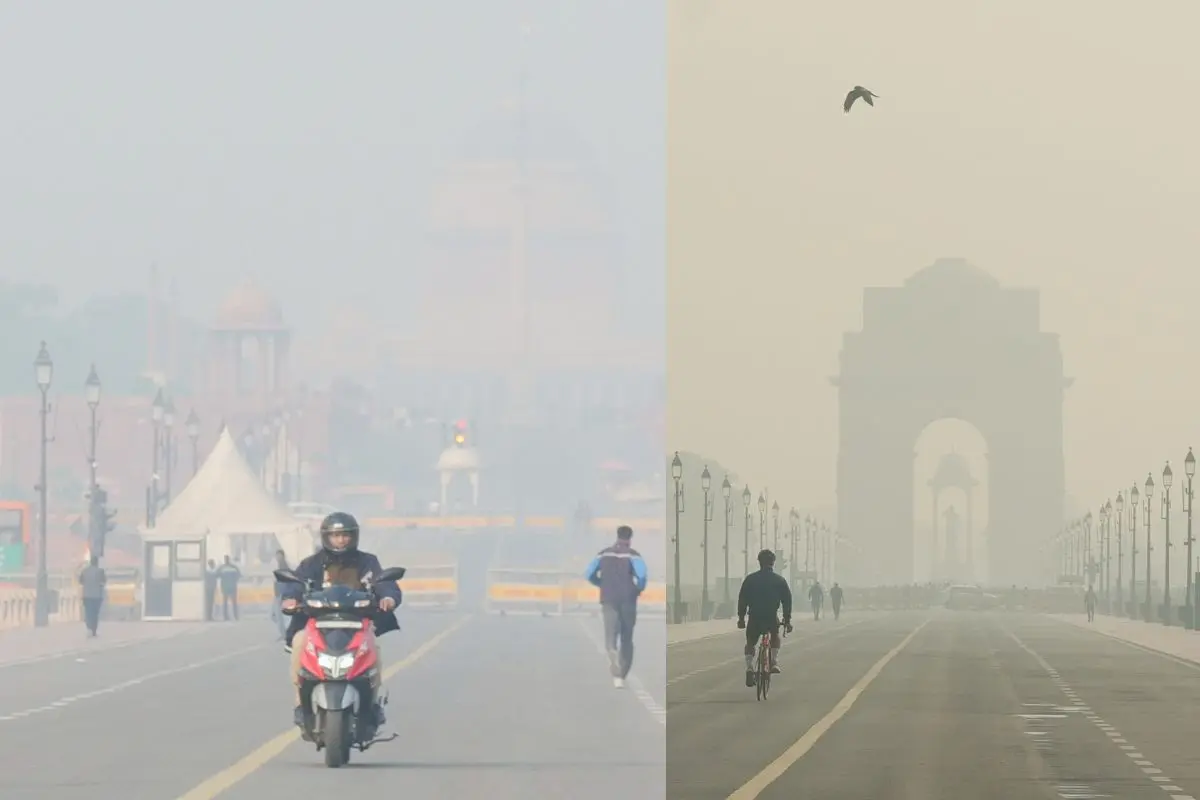
New Delhi: A thick layer of smog blanketed large parts of the national capital on Sunday morning, as Delhi recorded an Air Quality Index (AQI) of 385, firmly in the ‘very poor’ category and showing virtually no improvement from Saturday’s reading of 386.
At India Gate, the iconic monument was barely visible behind the dense haze as joggers and morning walkers attempted to continue their routines. Conditions were worse at Rajghat and ITO, where the AQI reached 417, placing both areas in the ‘severe’ category, according to data from the Central Pollution Control Board (CPCB).
Several other neighbourhoods, including Anand Vihar, Alipur and Ashok Vihar, also reported ‘severe’ air quality with readings between 400 and 415. Chandni Chowk registered an AQI of 420, while Dwarka recorded 378. At Dhaula Kuan, vehicles moved slowly through thick smog as the area reported an AQI of 338.
Alongside the deteriorating air quality, temperatures across the city continued to hover around 10°C, with some pockets experiencing even lower readings. On November 15, shallow fog was reported at Safdarjung Airport between 7 am and 8.30 am.
With pollution levels worsening, the Commission for Air Quality Management (CAQM) has enforced Stage III of the Graded Response Action Plan (GRAP) across Delhi. The measures introduce tighter curbs on construction activity, vehicular movement and industrial emissions.
Under GRAP-III, most non-essential construction is banned, BS-III petrol and BS-IV diesel cars are restricted, in-person classes are suspended for students up to Class 5, and industries using non-clean fuel face operational limits. The use of non-emergency diesel generator sets has also been prohibited.
Meanwhile, the Supreme Court has directed the governments of Punjab and Haryana to submit status reports on steps taken to tackle stubble burning, a major contributor to pollution in the Delhi-NCR region. A bench comprising Chief Justice of India BR Gavai and Justice K Vinod Chandran ordered both states to outline the measures being implemented to curb the practice.