Delhi AQI stays ‘poor’: 65% pollution blown in from outside NCR; Fog, cold chills add to smog woes
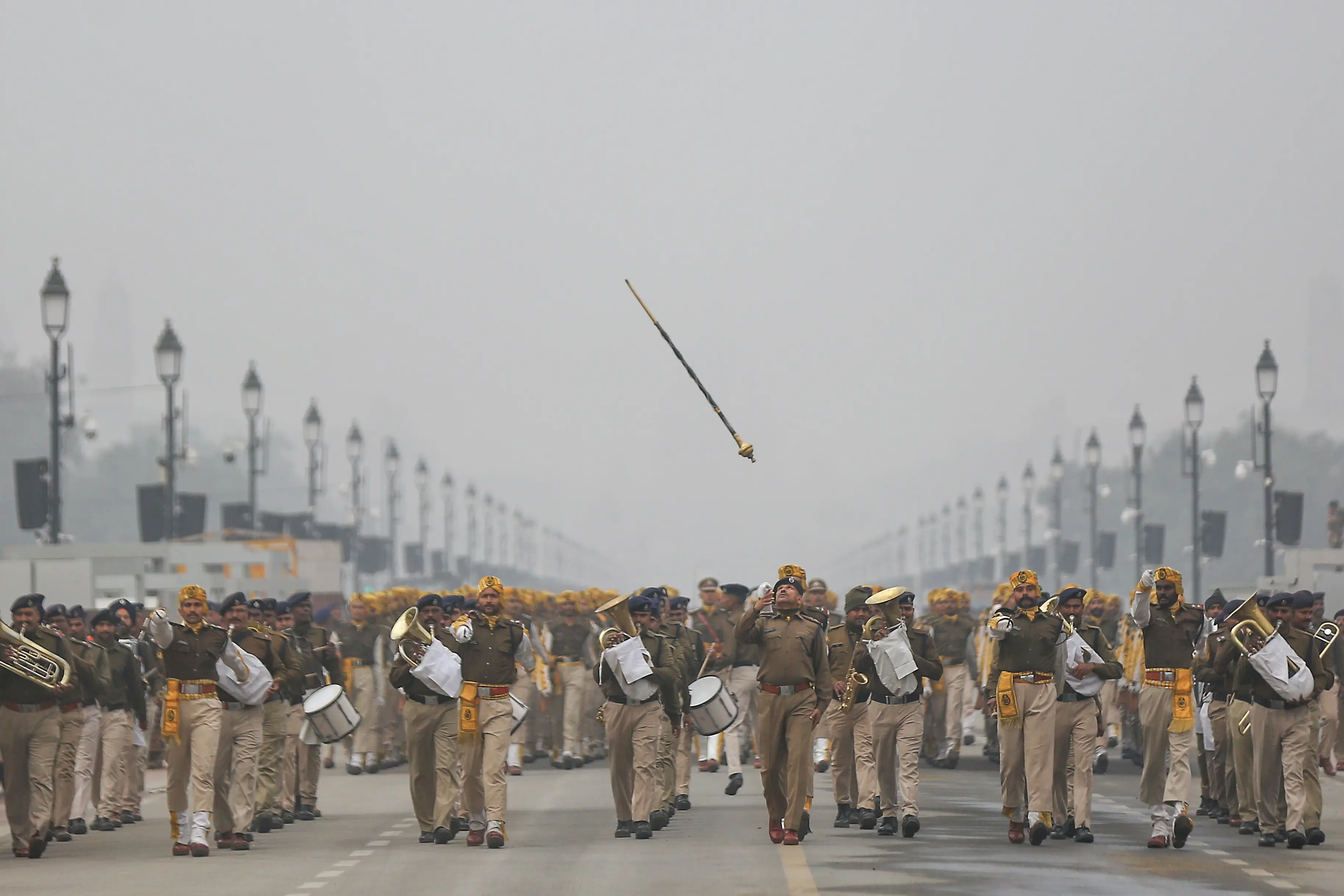
New Delhi: Delhi’s air quality remained in the ‘poor’ category on Sunday, with the national capital recording an overall Air Quality Index (AQI) of 248, according to data released by the Central Pollution Control Board (CPCB). The deteriorating conditions caused breathing discomfort for many residents during prolonged exposure, as the city woke up to a chilly and windy morning.
Despite the smoggy conditions and reduced visibility, rehearsals for the Republic Day parade continued at India Gate. Security personnel and parade participants carried on with preparations as scheduled for the upcoming national celebrations.
Several monitoring stations across the capital reported air quality in the ‘very poor’ range. Anand Vihar recorded an AQI of 351, Rohini 361, Chandni Chowk 357, Mundka 326 and R K Puram 320, while ITO registered an AQI of 309. In contrast, air quality was relatively better at NSIT Dwarka and the Indira Gandhi International Airport, where AQI levels stood at 177, placing them in the ‘moderate’ category.
Temperature dips further as cold wave continues
The India Meteorological Department (IMD) said Delhi recorded a minimum temperature of about 9 degrees Celsius on Sunday morning. Fog was observed during the early hours, although weather conditions are expected to improve later in the day. The IMD has forecast a maximum temperature of 18°C to 19°C for Sunday, with the minimum likely to range between 7°C and 8°C.
Meanwhile, the Sub-Committee on the Graded Response Action Plan (GRAP) under the Commission for Air Quality Management (CAQM) in the National Capital Region and adjoining areas lifted Stage III restrictions on Friday evening, citing a significant improvement in air quality due to favourable meteorological conditions.
Authorities have, however, urged residents to strictly adhere to the measures under Stages I and II of the GRAP to prevent further deterioration. The government also clarified that construction and demolition sites that were ordered to shut for violations or non-compliance with statutory norms will not be permitted to resume operations without explicit approval from the Commission.
65% of pollution transported from outside capital
About 65 per cent of Delhi’s air pollution in 2025 originated from outside the city, largely from neighbouring National Capital Region (NCR) districts, while local sources accounted for the remaining 35 per cent, according to an analysis by the Centre for Science and Environment (CSE).
The study found that pollution transported into the capital during the winter months outweighed emissions generated within Delhi. Data from the Decision Support System showed that transboundary pollution remained the dominant contributor to overall air pollution levels in 2025.
While external sources played the largest role, vehicular emissions emerged as the biggest local contributor to fine particulate matter (PM2.5), accounting for nearly half of Delhi’s locally generated pollution. This exceeded emissions from industry, construction activities and other combustion sources.
“Transboundary pollution from NCR districts and neighbouring states plays a major role in Delhi’s air pollution. Delhi’s geographical location makes it particularly vulnerable, as northerly and north-westerly winds transport polluted air from surrounding regions into the city,” said Manoj Kumar N, an analyst from the Centre for Research on Energy and Clean Air (CREA). He added that tackling the crisis would require coordinated, airshed-level action rather than city-specific measures alone.
Stubble burning declines
The analysis also pointed to a sharp decline in the contribution of stubble burning during the 2025 winter season. Crop-residue burning accounted for an average of 4.9 per cent of PM2.5 pollution between October 15 and November 30, down from 15.5 per cent during the same period in 2024 — a reduction of about 10.6 percentage points. The highest stubble-burning contribution in 2025 was recorded on November 12 at 22.47 per cent, significantly lower than the peaks seen in 2024, when the contribution exceeded 37 per cent on some days.
Bahadurgah top pollution hotspot; November most polluted month
In terms of pollution hotspots, Bahadurgarh emerged as the largest NCR contributor to PM2.5 levels in 2025, recording the highest concentrations during January and the October–December period. The area reported an annual average PM2.5 level of around 173 micrograms per cubic metre. Within Delhi, November remained the most polluted month, with an average PM2.5 concentration of 215 micrograms per cubic metre, compared with 249 micrograms per cubic metre in November 2024.
On an annual basis, Delhi’s average PM2.5 concentration declined to 96 micrograms per cubic metre in 2025 from 105 micrograms per cubic metre in 2024, marking a year-on-year reduction of about 8.6 per cent.
For coarser particulate matter (PM10), Dharuhera in Haryana continued to be the largest external contributor, with an annual average concentration of approximately 278 micrograms per cubic metre in 2025. November again recorded the highest monthly PM10 levels, averaging 365 micrograms per cubic metre, down from 395 micrograms per cubic metre in November 2024. Delhi’s annual average PM10 concentration fell to 197 micrograms per cubic metre in 2025 from 211 micrograms per cubic metre a year earlier, a decline of about 6.6 per cent.
AQI remains a concern
Despite these modest improvements, air quality remained a concern. Delhi’s annual average Air Quality Index (AQI) stood at 201 in 2025, with no ‘good’ air quality days recorded throughout the year. The city logged 79 satisfactory days, 121 moderate days, 86 poor days, 71 very poor days and eight severe days.
The analysis noted that the marginal improvement in 2025 was largely driven by relatively better air quality during the monsoon months of June and July, which helped bring down the annual average AQI.
ANI