Nitish Kumar unleashes tiger roar in Bihar elections, proving Mr Flip-Flop still rules
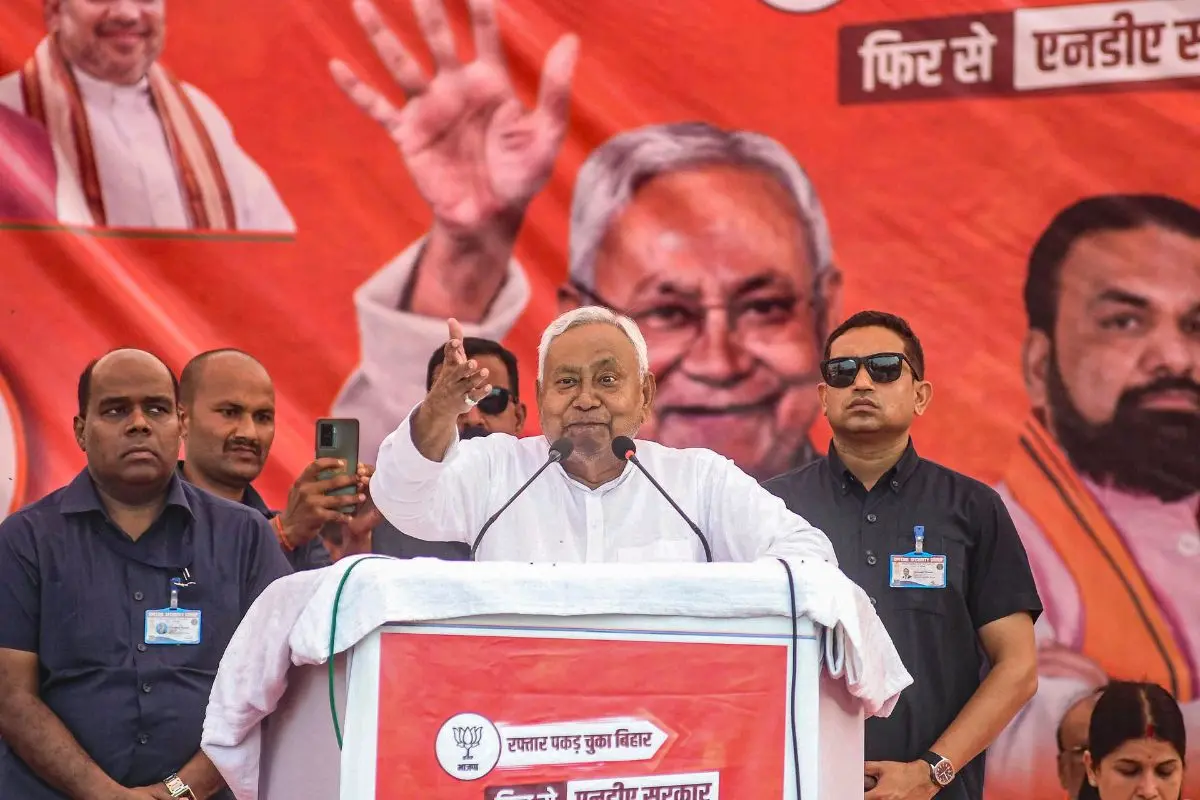
The political theatre of Bihar on Friday witnessed a reaffirmation of Nitish Kumar’s enduring influence, a veteran leader who has governed the state for two decades. Despite constant talk about his health and political strength, the multi-term chief minister successfully led his Janata Dal (United) (JD(U)) to the top once again. This shift has cemented his image not just as a survivor, but as an indomitable kingmaker, returning to prominence like a tiger in his den.
The initial rounds of counting, released on Friday, showed Kumar’s strong comeback. By 11:30 am, the JD(U) led in 83 of Bihar’s 243 constituencies, making it the state’s single largest party. This is a sharp rise from the 43 seats the party won in 2020, when it ranked third. Notably, JD(U) has now overtaken its alliance partner, the Bharatiya Janata Party (BJP), which led in 78 seats.
The ruling coalition, the National Democratic Alliance (NDA), owes much of its strength to the "Nitish factor". While the NDA appeared set to dominate with leads across more than 180 seats, the success story belongs to Kumar, whose victory proves his political influence in Bihar remains unmatched. For those who doubted his ability to turn public support into votes, the results offered a clear answer.
The Brand: Development and Inclusivity
Known for his political adaptability, earning him the nickname "Mr Flip-Flop," Nitish Kumar’s longevity reflects his strategic skill in Bihar’s shifting politics. He has a history of calculated alliances, moving between the BJP-led NDA and the Mahagathbandhan (Grand Alliance) with the Rashtriya Janata Dal (RJD). Rejoining the NDA in January 2024 and taking oath as chief minister for the ninth time, his latest strategy has yielded strong results.
However, Nitish Kumar’s core strength is not just about alliances. He has built a reputation as a pro-development leader, moving Bihar away from the troubled "jungle raj" era. His political model focuses on inclusivity, aiming to appeal to all sections of society.
JD(U) leaders credit Kumar’s quiet, methodical campaigning across the state, arguing that voters had already decided to make their voices heard. The electorate is now more aspirational, leaving traditional opposition strategies less effective.
A key factor in this success was the high turnout of women voters. Their support for the NDA was driven by welfare schemes such as the Mukhya Mantri Mahila Rojgar Yojana and the “dashazari” scheme. Analysts highlight this mobilisation of women as a central element of the turnaround.
The Zenith Reclaimed
Social analysts compare this victory to Kumar’s 2010 performance, widely seen as his peak, when JD(U) won 115 seats. Replicating such a level of acceptance shows his continuing dominance. His success combines proven social strategies with a focus on development, proving difficult for the opposition to challenge.
This win sends a strong signal nationwide: Nitish Kumar’s strategic power and political importance in Bihar remain unmatched. As results came in, the poster outside the party office declaring ‘Tiger abhi zinda hai’ (the tiger is still alive) seemed prophetic, marking the emphatic return of a leader poised to play a critical role in national politics.