15 critical observations revealed in AAIB’s probe into Air India crash
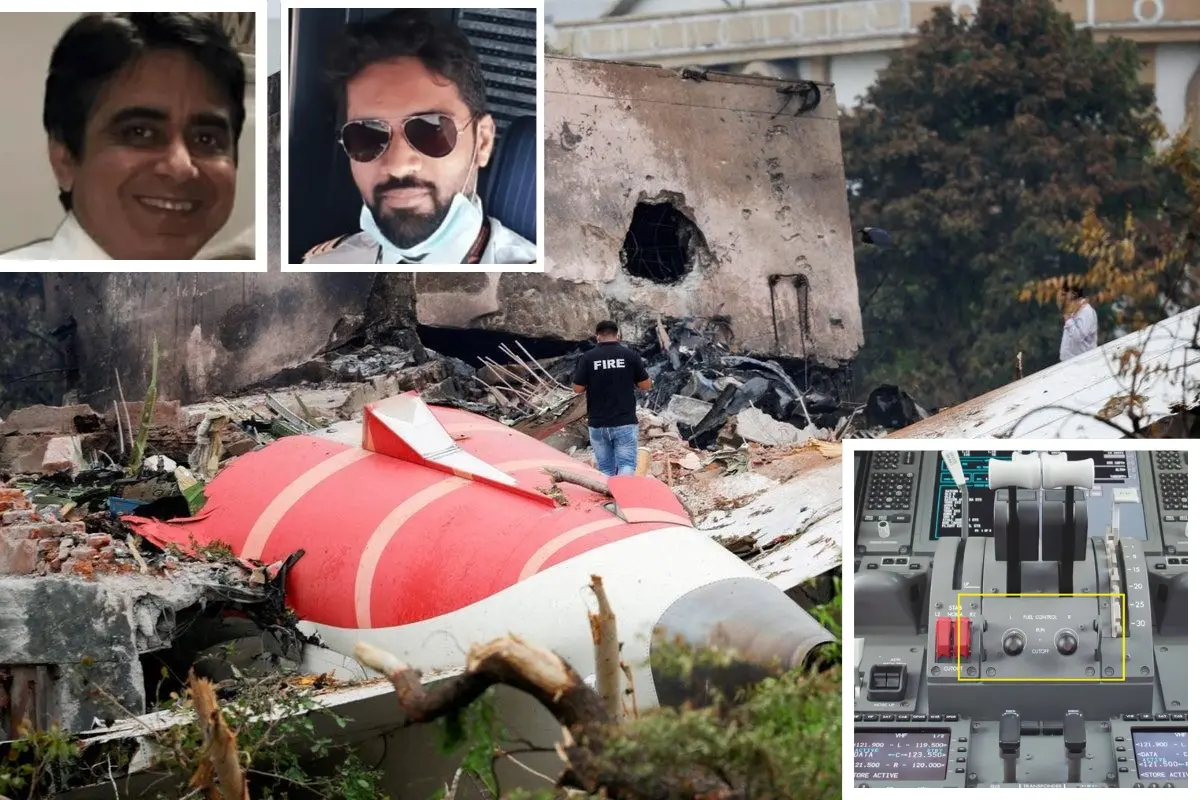
New Delhi: The preliminary report by the Aircraft Accident Investigation Bureau (AAIB) into the crash of Air India Flight AI171 reveals a tragic sequence of technical anomalies, cockpit confusion, and failed recovery attempts that led to the Boeing 787-8 aircraft crashing shortly after take-off from Ahmedabad on 12 June 2025.
Here are 15 key observations made in the AAIB preliminary report regarding the Air India B787-8 crash:
- The aircraft crashed at 0809 UTC (13:39 IST) on June 12, 2025, immediately after take-off from Ahmedabad, while operating Flight AI171 to Gatwick.
- The aircraft was destroyed due to impact with buildings on the ground and subsequent fire, resulting in 12 crew fatalities, 229 passenger fatalities, and 19 fatalities among others.
- The aircraft had four CAT ‘C’ Minimum Equipment List (MEL) items active (flight deck door visual surveillance, airport map function, core network, FD printer) invoked on June 9, 2025, valid until June 19, 2025, and a CAT A MEL for Nitrogen generation performance, valid until June 20, 2025.
- Before the accident flight, a Pilot Defect Report (PDR) for a “STAB POS XDCR” status message was entered and troubleshooting was performed, after which the aircraft was released for flight at 06:40 UTC (12:10 IST).
- The flight crew of AI171 underwent a pre-flight Breath Analyzer test at 06:25 UTC (11:55 IST) and were found fit to operate the flight.
- The aircraft started its take-off roll at 08:07:37 UTC (13:37:37 IST) after being cleared for take-off from Runway 23 at 08:07:33 UTC (13:37:33 IST).
Also read: Did a fuel cutoff cause the AI171 crash — and what have Air India and Boeing said so far?
- The aircraft achieved liftoff (air/ground sensors transitioned to air mode) at 08:08:39 UTC (13:38:39 IST), and reached its maximum recorded airspeed of 180 Knots IAS at approximately 08:08:42 UTC (13:38:42 IST).
- Immediately after achieving maximum airspeed (08:08:42 UTC (13:38:42 IST)), the Engine 1 and Engine 2 fuel cutoff switches transitioned from RUN to CUTOFF position, one after another, with a 1-second time gap.
- The cockpit voice recording captured one pilot asking the other why they cut off the engines, and the other pilot denying doing so.
- CCTV footage showed the Ram Air Turbine (RAT) deploying during the initial climb immediately after lift-off.
- Both engine fuel cutoff switches transitioned back from CUTOFF to RUN at 08:08:52 UTC (13:38:52 IST) (Engine 1) and 08:08:56 UTC (13:38:56 IST) (Engine 2), with Engine Gas Temperature (EGT) observed rising for both, indicating a relight attempt.
- While Engine 1’s core deceleration stopped and progressed to recovery, Engine 2 was able to relight but could not arrest core speed deceleration, repeatedly re-introducing fuel.
- A “MAYDAY MAYDAY MAYDAY” call was transmitted by one of the pilots at approximately 08:09:05 UTC (13:39:05 IST), and the Enhanced Airborne Flight Recorder (EAFR) recording stopped at 08:09:11 UTC (13:39:11 IST).
- Post-impact inspection revealed the flap handle firmly seated in the 5-degree takeoff position (consistent with EAFR data) and the landing gear lever in the “DOWN” position. Although the thrust levers were found near the aft (idle) position, EAFR data showed they remained forward (takeoff thrust) until impact.
- The forward EAFR was successfully downloaded, yielding approximately 49 hours of flight data and 2 hours of audio, including the accident flight, while the aft EAFR was substantially damaged and could not be downloaded conventionally.
The cause of the uncommanded engine shutdown is now the focus of intense investigation.