Men must get sensitised on what women go through: Rishab Seth, Pratik Gandhi on 'Dhaam Dhoom'
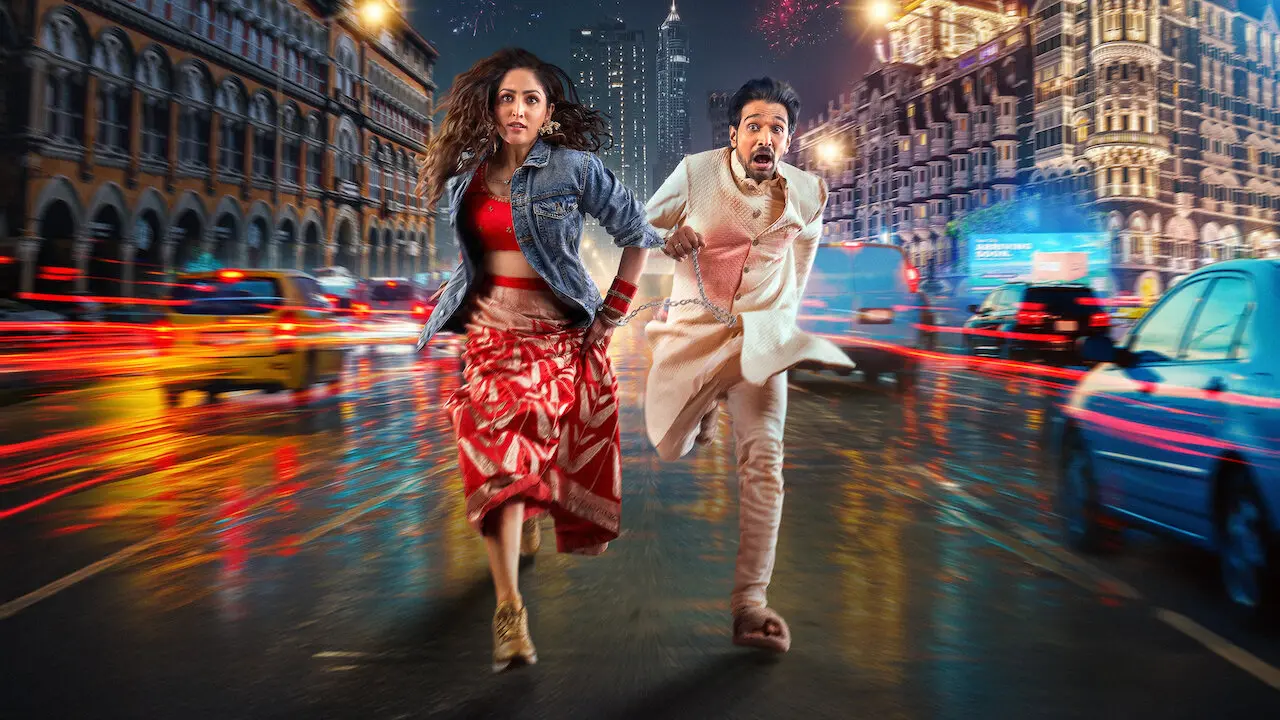
The recently released Netflix comedy-drama 'Dhoom Dhaam,' starring Yami Gautam Dhar and Pratik Gandhi, has taken the world by storm, trending globally on the OTT platform. Helmed by Rishab Seth, the film has struck a chord with audiences, seamlessly weaving humour with poignant social commentary.
In an exclusive conversation with Mathrubhumi English, Pratik and Rishab delve into the making of the film, sharing insights on how they tackled sensitive topics like women's safety with humour and nuance, including the thought process behind Yami's powerful monologue and Pratik's show-stopping striptease sequence. Dive into the excerpts from their candid chat.
Watch the full interview below
‘Dhoom Dhaam’ is trending globally on Netflix. How does it feel about this success, and what went behind this movie?
Rishab Seth: A very, very long struggle went behind in making this film. The first draft of the movie was written 10 years ago. The script has had its journey—it went to a number of studios, went to a number of actors, and due to various unforeseen circumstances, the film did not take off. I guess it was finally meant to happen with Pratik and Yami Gautam Dhar in the lead and for me to direct it, and that is why it has come to the world today via Netflix.
The writers of the film, Aditya Dhar and Aarsh Vora, have had a long struggle with this film, and one has to applaud Aditya for his conviction that through all the ups and downs, he put all his weight behind it; he produced the film and made it today.
How were the dynamics on the sets between Yami, Pratik, and you? Was there ever a difference of opinion?
Rishab Seth: Largely we three were on the same page, but that’s not fun. It’s very good to be on different pages. That’s what makes filmmaking fun. You have an opinion, I have an opinion, I have a perspective, and you have a perspective, and it is about how we bring our visions to align and bring forward the best for the audience. We, of course, had a few disagreements, and of course, we had a few arguments, but I always see it as a churn. Usko aap argument ki jagah agar manthan ki tarah dekhe, the whole perspective on the thing changes. (If you look at it as an introspective discussion rather than an argument, your entire perspective on the issue changes.)
And ultimately, we are all here not to massage our egos but to make a film for the audience. In this case, we’ve been told that our film is being called a ‘Dhamakedar family entertainer,’ toh kahi humne kuch sahi kiya hoga (we must have done something right). Our audiences are embracing the film and applauding the film from across the globe.
Pratik, what were your initial thoughts when ‘Dhoom Dhaam’ was offered to you?
Pratik Gandhi: My initial thoughts were that this is a character that is not celebrated much in society. These kinds of men aren’t really celebrated. In fact, nice guys are used in a bad way to compliment the other person. It’s not a compliment anymore. Creating a hero out of this nice guy, so-called nice guy Veer, is an interesting challenge.
Veer’s character is also interestingly layered. Physically, if you see at one point in the film, he is a different guy, but mentally he has his own issues. He has his own fears, he has his phobias, he doesn’t want to pick fights, he is ok not taking the lead in all the situations in life, and he wants to be a safety net to his partner, which is a very unique thing to see on screen. And though we see such characters every day in our lives, we hardly celebrate them.
Veer has a lot of phobias in ‘Dhoom Dhaam’. Does Pratik Gandhi also have any phobias in real life?
Pratik: Not something that I know of.
Rishab: I’ll tell you the one that I know of. I think Pratik has a major phobia of sitting at home. He needs to go out all the time. He can’t take a breath for two minutes. His wife told me that if Pratik stays home for two days, he starts getting restless. That’s the phobia he should talk about.
Pratik: If that is a phobia, then I might have it.
Your film presents a striking contrast between two pivotal scenes: Yami's powerful monologue on women's safety and the subsequent scene where Pratik's pole dancing performance is met with objectifying gazes from women. This juxtaposition cleverly highlights the reversal of traditional power dynamics, exposing the vulnerability of the male character. Can you walk us through the thought process behind these two scenes? What inspired you to convey this subtle yet impactful message?
Rishab: I think a film always gives you a platform to make a statement. Some films end up getting preachy; some films end up giving a message in a nice, subtle, sublime way. Whatever little commentary we have in our film about gender roles and marriage, we said we will always keep them laced with humour. Of course, there are some statements that we want to make about marriage, which we have in the film.
We felt that through Yami’s monologue, we had an opportunity to sensitise people about a female’s experience. Pratik and I were also discussing earlier that there are some things about women that we don’t understand. I’m not talking about emotionality; I’m talking about how they view the world, which is very different from how we (men) view it. A woman steps out of the house, and she is told what she should wear. She is worried about if she is going to attract any unnecessary attention. I think men don’t have that mindset whatsoever. When a woman gets on a train, she is worried about her safety. I am worried about getting squished in a crowd; I’m not thinking about if I might get molested.
So, somewhere we just felt that we got a platform, an opportunity, to send out a message. We really hope that there are men out there who are listening and probably take something away from it and get sensitised towards what women go through.
Pratik, how was your experience of shooting the pole dance and striptease sequence?
Pratik: It was a little discomforting. It is a fun sequence, meant to be funny and entertaining for the audience also, but I know that there are so many women in that one place, and I had to take off my clothes. I wasn’t comfortable doing it.
I actually realised that all this while we had these item numbers performed by female actors. I’m sure of the kind of discomfort they must have felt. After all, it’s a piece of art, we are in a controlled environment, and everything is ok, but there still is a little discomfort that you feel physically and mentally in that place at that point. I actually felt it.
But at the same time, because it is meant to be entertaining and fun, I had too much fun performing that entire sequence.
Pratik, did filming the pole dance and striptease sequence, where you were objectified by women, give you a deeper understanding and sensitivity towards the uncomfortable experiences women often face?
Pratik: Of course, it took that sensitivity in me a notch higher. When you firsthand experience something like this, you realise what it must be. But as Rishab said earlier, we men can still never understand what women think in a lot of situations.
What inspired the subtle yet humorous writing approach in 'Dhoom Dhaam,' and do you think double-meaning jokes are necessary to make a film comedic?
Rishab: I feel that humour should come in all shapes and forms. I’m okay with cringe humour, I’m okay with physical humour, and I’m okay with abusive humour. I like the genre in general. But as a personal choice, I like to make family-friendly films. I like making something that you don't have shame watching with your parents or kids. If an entire family can watch a film together, I think my job is done.
Even for Pratik, the huge draw to doing this film was that he felt it was good and wouldn’t make anyone cringe or uncomfortable. We wanted to make it an easy experience while watching. There are many times when you have to derive humour from discomfort. Our idea was to make a film that entertains the whole family.
There is a video that I shared with Pratik a few days back where my friend recorded the striptease sequence and panned the camera at his 85-year-old grandmother, who is watching Pratik and has a huge smile on her face, enjoying the film. For us, that is symbolic of what we wanted to achieve through the film, and we probably have.
Pratik, your impeccable comic timing has won hearts in both 'Dhoom Dhaam' and 'Mudgaon Express'. How challenging is it to master the art of comedy as an actor?
Pratik: Comedy is very difficult. Comedy needs a lot of attention. It needs a lot of sincerity when you prepare a joke and have to perform it multiple times. As an actor, one has to know when to stop with comedy; it’s a slippery line, and you can keep going. So, it’s very easy to play to the gallery immediately. But as an actor, one has to understand that comedy is something where the phrase “less is more” applies the most. It is a difficult genre in all aspects. I enjoy doing it too much.
Do you think it is the most difficult genre compared to doing action or drama?
Pratik: For me, I love drama as a genre. But I find comedy very difficult.
Rishabh: Comedy requires a lot of discipline. It’s so easy to get carried away with your own jokes. There are those people who laugh at their own jokes, and we’re like, ‘Ok, that’s not so funny.’ That is a very common trap that we fall into with comedy. I have to create something collaboratively in a way that captures the way the actors are performing and make sure that every joke is tasteful to the audience. It is terrifying. There is nothing more terrifying than walking into a cinema hall or any room where people are watching comedy, and you hope they laugh. That is the maker’s experience in making a comedy film.
Pratik: From an actor’s point of view, I’ve realised—I don’t know how right or wrong I am, but this is what I was trying to understand. In drama, if I’m angry, sad, or playing any other emotion apart from humour, there is a range that you can perform. Whereas in comedy, there is no range. It is that one particular point, which we call ‘timing.’. For anybody who performs (comedy), the timing has to be pitch-perfect. If the timing goes by a microsecond also, the joke will not land. You don’t get a range there. You have to strike that point time and again. That way it makes it even more challenging for the actor.
Speaking of the film and the comedy scenes, which were your favourite comic moments from the movie?
Pratik: There are so many of them. In fact, some of the couple of gestures didn’t even survive till the edit. For me, in the whole film, I am just reacting more than delivering the lines. I was in a place where I had to catch those punches well and just make them land. My job was more of reactions.
Rishab: I would say, “I am an animal doctor; I can’t eat my patients” was definitely one of our favourites internally. We all loved that line. I think also towards the climax where Pratik’s character, Veer, is trying to send the message out and the message is not going for the obstacles that come in the way… I think that was a section that we really enjoyed the jokes of.
Pratik: Yeah, I enjoyed the variation of saying the same line in a different way as the stakes were going higher and higher. That was absolutely hilarious.
Do you think that ‘Dhoom Dhaam’ should have been released in theatres instead of OTT? Also, what factors made you decide to release it on the OTT?
Rishab: There is always a context to these decisions. A, for us, we feel extreme pride in being on Netflix. When you go to a platform where your film is being deemed in 190 countries, you can’t ask for more. Of course, theatres are beautiful. Of course, that community experience of watching a film, especially comedy, is a special feeling. But you might know how volatile the market is currently. People’s cinema-going choices… I’m completely mystified by them. I don’t know what finally brings them to the theatres. Ultimately we made this film with a lot of love; we wanted to put it on the right platform, and I think woh jo Netflix ke sath jo shaadi hui, hum uske sath bohot khush hai (We're extremely happy with the partnership that has happened with Netflix).
Pratik: Had it been released in the theatres, I guess, I don’t know about the performance in the theatres, but we wouldn’t have been trending at number 3 in 30 countries globally. Woh nahi hota fir; usme time lag jata fir global release ka (that wouldn’t have happened then; it would have taken time for the global release). That is something that has helped us to reach out to the largest amount of the audience.
Pratik, your versatility as an actor is evident in your diverse roles, from 'Scam: 1992' to 'Dhoom Dhaam,' and now your upcoming series 'Mahatma Gandhi'. What's your approach to navigating such vastly different characters?
Pratik: I don’t know if there is any particular process that I have, but I want to create different kinds of characters in different genres. If it is reaching out to the audience and the audience is loving what I do and what I have done in the recent past, I give all my credit to my theatre days. That is where I have trained myself for the longest time, and I still do it. The theatre actually gives us that opportunity and possibility to the same character multiple times. That practice of creating similar emotions time and again has actually helped me.
Can you give our readers a brief pitch on why they shouldn't miss 'Dhoom Dhaam'?
Pratik: It’s a complete Dhamakedar family entertainer, and it is a comment that we are receiving from the audiences who have watched it. I guess I can just pass it on from them if that excites them enough. We are trending at number one in India in films, and we are trending at number three globally in many countries. If you want to have fun and get entertained, then it is the film to go to.
Rishab: With guarantee I can tell you that you can watch this film with your children, grandparents, spouses, etc. You can just sit back and enjoy yourselves over a two-hour period.
Pratik: One request that I want to put here for the audience is that if at all you want to watch it, please watch it with your family and friends together, because laughing together will be another joy.