‘Whalefall’ puts a terrifying question in focus: Can humans survive inside whales?
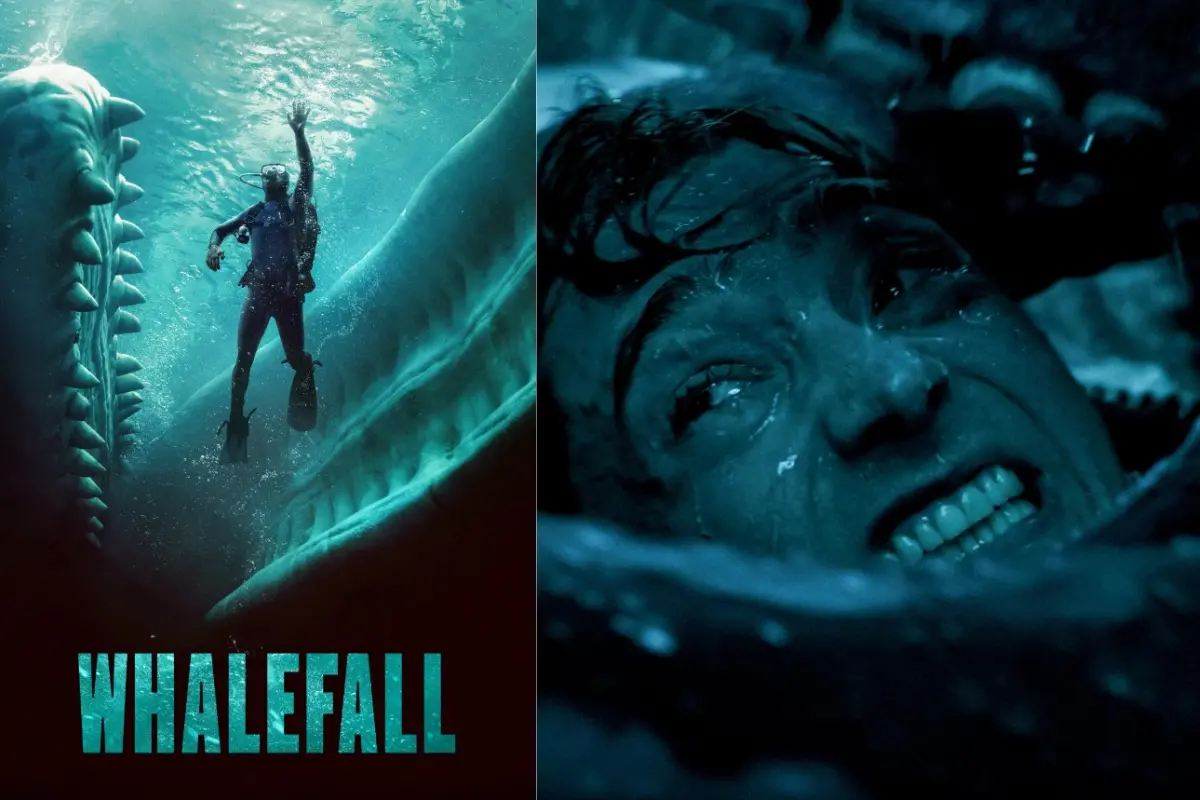
What would happen if a whale swallowed a human? The idea has inspired stories for centuries, from the biblical account of Jonah to modern survival fiction. Now, the frightening possibility is drawing renewed attention with 'Whalefall', a Hollywood thriller that follows a scuba diver desperately trying to escape after being swallowed by a giant marine mammal.
Starring Austin Abrams and Josh Brolin, the film was released in cinemas on October 16, 2026. Directed by Brian Duffield, it follows a diver who becomes trapped inside a sperm whale with a limited supply of oxygen and must find a way out before time runs out.
But could such an ordeal actually happen in real life? While incidents involving people being engulfed by whales have been documented, the prospect of surviving inside one is far more complicated. Here is what scientists and real-life accounts tell us about the possibility.
What is 'Whalefall' about?
'Whalefall' follows Jay Gardiner, played by Abrams, a scuba diver who ventures into the Pacific Ocean off the California coast to search for the remains of his late father, Mitt, played by Brolin.
During the dive, Jay becomes caught in an encounter involving a giant squid and a sperm whale. He is subsequently swallowed by the whale, leaving him trapped inside its body with only an hour's worth of oxygen remaining. His struggle to escape forms the central conflict of the survival thriller.
The cast also includes Elisabeth Shue, John Ortiz, Jane Levy and Emily Rudd.
The film is based on Daniel Kraus's 2023 novel of the same name. Although the story centres on an extraordinary survival scenario, it also explores grief, family expectations and the complicated relationship between a father and his son.
Kraus has explained that Mitt's overwhelming presence in Jay's life inspired the novel's central metaphor. He said, “Jay’s dad, Mitt, was kind of a local legend as a diver, and that’s part of the metaphor too, is that his dad was like a whale, in the sense that he was this huge presence and force that essentially swallowed up Jay. He wasn’t Jay; he was just Mitt Gardiner’s son and expected to be a man of the sea and the model of his father.”
In the story, Jay struggles with his father's terminal cancer diagnosis and their strained relationship. After Mitt dies, Jay returns to the ocean in an attempt to recover his remains and find a sense of closure.
Kraus said the premise took shape after he heard about a viral video showing a kayaker being engulfed by a whale during the Covid-19 pandemic.
“I was kind of hanging out with some friends outside, because this was during Covid, and they were talking about a viral video of a kayaker who ends up in the mouth,” he recalled. “That immediately made me think if a person really could be swallowed by a whale, like, if that’s actually biologically possible, and that got me excited.”
Can a whale really swallow a human?
The answer depends largely on the species of whale involved. Most whales cannot swallow a human because their throats are too narrow, despite their enormous size. Sperm whales, however, have a different anatomy from baleen whales, making the question more complicated.
According to whale scientist Dr Vanessa Pirotta of Macquarie University, a human could potentially pass through the throat of a sperm whale. Whether a person could survive the experience is another matter.
“The biology of the whale that we’re dealing with in this movie, you could potentially as a human go down the throat but whether you make it alive or not, I don’t think anyone knows that," she said and then added, “I have not yet done a sperm whale necropsy, but a human could easily fit inside their mouth and potentially be sucked into their throat."
Pirotta also emphasised that humans are not natural prey for whales. She said, “Humans are not part of a whale’s diet, I must point out. So, these animals are not targeting humans. A human would be dead and implode by the time they get down to that depth," she said.
Sperm whales primarily feed on squid, including giant squid, and are adapted to hunting in the deep ocean. A human being swallowed in the manner depicted in 'Whalefall' would therefore be an extraordinary and highly unlikely event, rather than a normal part of whale feeding behaviour.
Why most whales cannot swallow a person
Whales are broadly divided into two groups: baleen whales and toothed whales. Their feeding methods and anatomy help explain why being swallowed whole is not a realistic possibility for most species.
Baleen whales, including humpbacks, use specialised plates inside their mouths to filter food such as small fish and crustaceans from seawater. Although their mouths are enormous, their throats are relatively narrow.
According to the Smithsonian magazine, Nick Pyenson, curator of fossil marine mammals at the Smithsonian's National Museum of Natural History, has explained that the teeth of toothed whales are generally used to catch and hold prey rather than chew it.
Sperm whales are the largest toothed whales and are known for feeding on squid. Scientists believe they use suction to help capture prey, although observing their feeding behaviour in the deep ocean remains challenging.
Kraus consulted scientists while writing the novel to ensure that the whale's anatomy and behaviour were represented as accurately as possible. He acknowledged that most whale species could not swallow a person because of the limitations imposed by their throat structure.
He also explained how Jay's encounter with the sperm whale unfolds in the story.
“A whale would never swallow a human on purpose. So what happens is really the only thing that could happen, which is that Jay gets entangled with a giant squid,” says Kraus. “And the giant squid is what whales eat all day long. So he’s essentially pulled into the stomach with the squid.”
While this provides a biological explanation for the fictional sequence, the scenario remains highly improbable in reality.
Have people ever been swallowed by whales and survived?
There are documented cases of people being caught inside a whale's mouth before being released. However, there is no confirmed case of a person being swallowed into a whale's stomach and surviving.
One widely reported incident occurred in February 2025, when Chilean kayaker Adrián Simancas was briefly engulfed by a humpback whale in the Strait of Magellan. He was released unharmed.
Recalling the experience to the BBC, Simancas said, “I closed my eyes, and when I opened them again, I realized I was inside the whale’s mouth,” he told the BBC. “Finally, I got to the surface and realized that it hadn’t eaten me.”
A similar incident occurred in California in 2020, when two kayakers were caught in the mouth of a humpback whale before being released. The encounter reportedly helped inspire Kraus to write 'Whalefall'.
In June 2021, American lobster diver Michael Packard also reported being engulfed by a humpback whale off Cape Cod, Massachusetts. Packard described being surrounded by darkness before the whale surfaced and expelled him. He survived the encounter.
These incidents demonstrate that a whale can accidentally engulf a person while feeding. They do not, however, establish that a human can survive being swallowed into a whale's stomach.
Humpbacks are filter feeders, and such encounters generally involve people being caught in the mouth rather than passing down the throat. The circumstances are therefore very different from Jay's predicament in 'Whalefall'.
Is 'Whalefall' based on a true story?
No. 'Whalefall' is a fictional story adapted from Kraus's 2023 novel, rather than a direct retelling of a documented case of someone surviving inside a whale.
Real-life encounters between whales and humans helped inspire the book, but the central plot takes considerable creative liberties. The production consulted whale experts to make the film's portrayal of marine biology more convincing.
The story also uses the ocean and the whale as metaphors for grief, loss and the influence parents can have on their children. Jay's attempt to escape the whale mirrors his struggle to come to terms with his father's death and the impact their relationship had on his life.
The film's title carries a further meaning. In marine science, a whale fall refers to the carcass of a dead whale sinking to the ocean floor, where it becomes a source of nutrients and a habitat for deep-sea organisms. The remains can sustain an ecosystem for years.
For Kraus, the phenomenon reflects how a person's life can continue to influence others after death.
When a whale dies, it creates a “burst of life,” Kraus says. “And I really liked that idea about when people die. You know, it doesn’t have to be a whale. It can be a person. When a person dies, what they meant to people works in a sort of similar way to a whale fall, or we are the whale fall of all of our loved ones, in a way.”
Ultimately, while 'Whalefall' draws on real whale biology and documented encounters, its central survival scenario remains firmly in the realm of fiction. A person being caught in a whale's mouth is possible under rare circumstances, but being swallowed whole and escaping alive is an entirely different proposition.