Anirudh Ravichander, Kavya Maran’s wedding invite has 12 hand-painted details; designer shares making
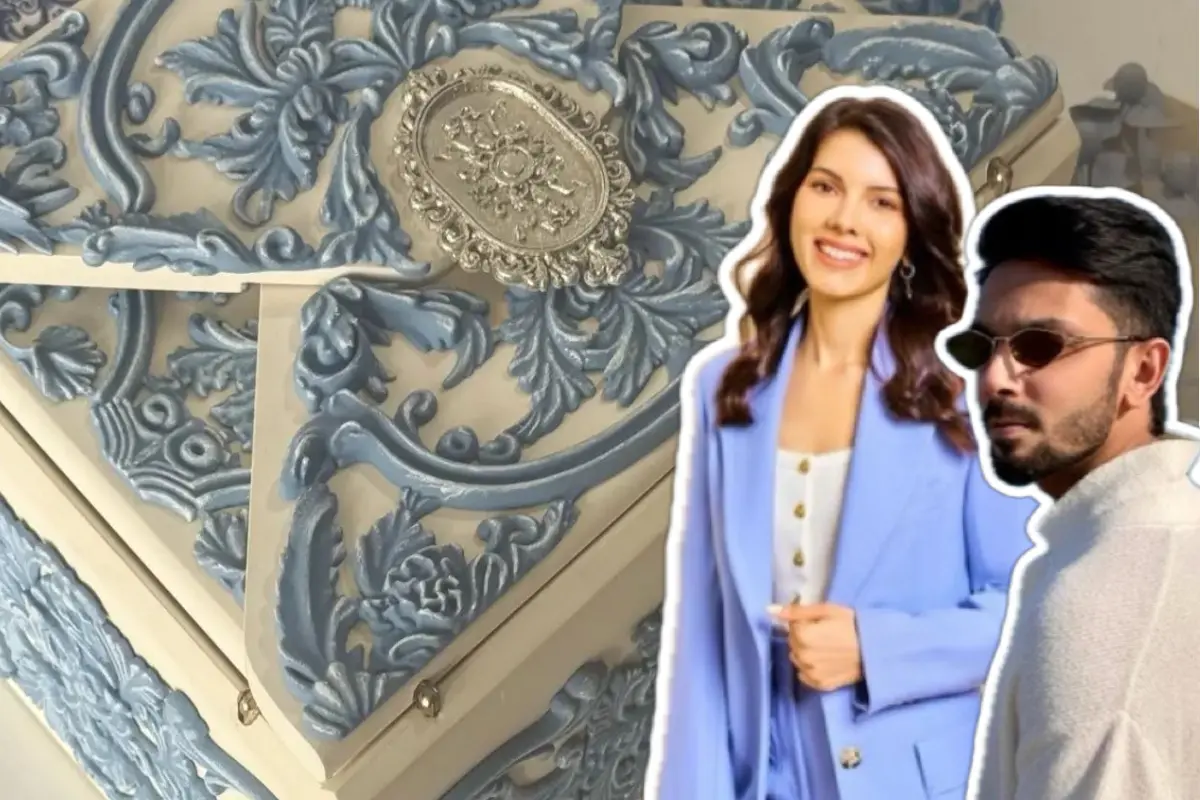
Some wedding invitations are opened, admired and eventually tucked away. Others are designed to stay. Anirudh Ravichander and Kavya Maran's wedding invitation firmly belongs to the latter category. With its powder-blue and ivory palette, sculptural detailing and elaborate vintage-inspired finish, the invitation looks less like a conventional wedding card and more like an heirloom object. But behind its ornate Baroque-inspired appearance is a surprisingly fascinating story of experimentation, craftsmanship and nearly four months of work.
As the couple prepares for their wedding celebrations in Greece, their invitation has become a talking point in its own right. And there is considerably more to it than meets the eye. Designer Ranjani Iyengar of Pink Whistle Man has now offered a glimpse into the making of the elaborate box, revealing the couple's brief, the manufacturing challenges and the painstaking details that went into every piece. In an interview with The Indian Express, Iyengar spoke about how the design evolved from an unexpected reference into a limited-edition keepsake.
It all began with a box the designer made for herself
The origins of the now-viral invitation are rather unexpected. The design actually began with a bright green-and-pink box featuring a three-dimensional Greek head, which Iyengar had created for herself long before the wedding project came along.
The couple happened to like the piece, particularly its sculptural element. That became the starting point for an entirely new design direction. Iyengar wanted the invitation to offer an experience beyond simply opening a box and reading a wedding card.
“I wanted that whole opening, unfolding and having something come up gradually,” she recalled.
The initial concepts were relatively two-dimensional, but Kavya wanted more depth and dimension. She encouraged the designer to experiment with three-dimensional details across different sections of the box. Several 3D renders were subsequently created to help the couple visualise how the finished invitation would look.
The result is an elaborate construction that reveals its details gradually, making the act of opening the invitation part of the experience itself.
Interestingly, the Baroque aesthetic that has become a popular description of the design was not something Iyengar had consciously set out to create. She admitted that she only learnt what the term meant after the invitation went viral.
The couple wanted a keepsake, not a personalised wedding souvenir
Despite the elaborate appearance, the brief from Anirudh and Kavya was relatively straightforward. They wanted something classic, timeless and elegant, without incorporating personal stories or references to their lives.
The intention was to create an object that guests could retain long after the wedding celebrations, rather than an invitation that would feel relevant only to the occasion.
ALSO READ: Anirudh Ravichander, Kavya Maran’s reported wedding gets a new update! What we know so far
That thinking also influenced the colour palette. Iyengar initially considered introducing red into the ivory-and-blue combination. However, the couple preferred a more restrained approach, choosing to work exclusively with the two existing shades.
The powder blue and ivory combination gives the invitation a softer visual identity, balancing its ornate details without making the overall design feel excessively busy.
The designer also recalled how involved both families were in the process. The couple's mothers were part of the discussions, but the number of people involved never became an obstacle. According to Iyengar, they were quick to make decisions and offered precise feedback, while remaining open to creative suggestions.
10–12 individual carvings, each hand-painted
The real complexity of the invitation lies in its construction. Made of wood, the box features approximately 10–12 individual carvings, each attached separately and hand-painted.
These are not simply printed motifs or decorative patterns. Every element has to be prepared, positioned and finished individually, contributing to the layered, sculptural quality of the final piece.
The team also employed a technique called tapping to give the base a slightly distressed appearance, adding to its vintage character.
The processing alone involves considerable time and effort. Iyengar estimates that the cumulative processing for an invitation takes approximately two to five hours, although the overall timeline is much longer when conceptualisation, design development, sourcing and manufacturing are factored in.
From the first ideas to arriving at a workable design and production process, the project took approximately three-and-a-half to four months. Manufacturing was still underway when Iyengar spoke about it, with several invitations already completed.
The hinges, materials and manufacturing headaches
Creating something this elaborate meant that the team had to solve several practical problems along the way. One of the challenges was finding the right hinges to ensure that the box opened smoothly and complemented its overall finish.
Some of the materials initially tested did not meet the desired aesthetic, with certain options appearing cheaper than intended. The team had to revisit the construction and experiment with alternatives before finding the right solution.
ALSO READ: Anirudh Ravichander to marry Kavya Maran? His uncle says, 'it's a sure thing'
Iyengar admitted that the manufacturing process was not always straightforward, with moments when she struggled to figure out how to move forward. She also acknowledged the collective effort behind the project, crediting the manufacturers, printers and other collaborators who helped translate the design into a physical object.
In her words, it took a village to bring the invitation to life.
Why this wedding invitation is a limited-edition creation
Measuring approximately 10 inches, the finished box is medium-heavy and comes with matching bags. There are also additional goodies inside, although the designer has kept those details under wraps. She has not disclosed the total number of invitations produced either.
Perhaps the most interesting detail is that the exact design may not be reproducible, even if there is demand for it.
The materials were sourced from different parts of India, with certain components specially manufactured for this project. Some of these materials may not be available again, making it difficult to recreate the invitation in precisely the same form.
Iyengar described it as a limited-edition creation, explaining that even she may not be able to produce identical boxes once the existing materials are exhausted.
ALSO READ: Anirudh Ravichander to marry Sunrisers Hyderabad co-owner Kavya Maran: Reports
And that, perhaps, is what makes the invitation particularly special. Beyond the elaborate carvings and vintage-inspired finish, it carries the character of something made through a very specific combination of materials, people, time and craftsmanship. For Anirudh and Kavya, it is a wedding invitation. For everyone else admiring it, it is a reminder of what happens when a simple piece of stationery is imagined as a keepsake.