Where Gods dance among people: The tale of Thrissur’s Kummatti | WATCH
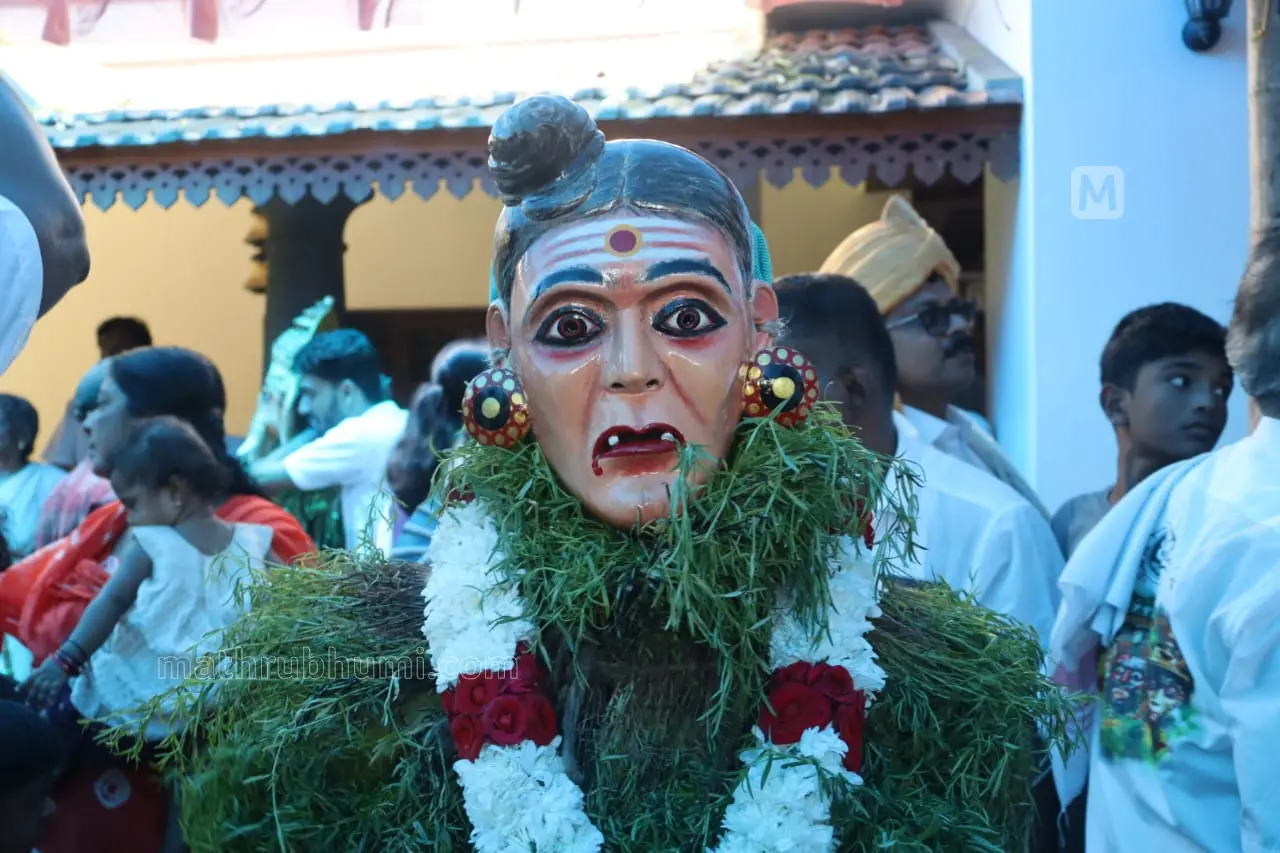
Onam celebrations in Kerala are typically associated with laying out the pookkalam, preparing the sadhya, the vallamkali (snake boat race), and the gathering of family members across the state. But the regional variations in celebrating Onam make it unique with a different ‘vibe’.Pulikkali (the tiger dance), a festival where performers paint tiger faces and stripes on their bodies and dance to rhythms, has gained attention worldwide as a unique celebration of Thrissur. Alongside this, there is another celebration, named Kummattikkali (Kummatti), deeply tied to myth and stories in Kerala’s 'cultural capital', Thrissur.
Kummatti and the feast of Bhadrakali
The word ‘Kummatti’, as per mythology, is often associated with the feast of the goddess Bhadrakali. But in Thrissur, the meaning is entirely different. Here, participants dress as characters from mythological tales, wearing hand-carved masks and dancing to the beat of various instruments.
The origin of this art form is uncertain, but the old-age tales are linked to two ancestral homes in Kizhakkumpattukara, Thrissur, named Thekkoott Kunnambath and Vadakkoott Kaarapurath families. The earliest form marked by performers visiting homes in the area during Onam, offering blessings, recalls Unnikrishnan Moothedath, president of the Kizhakkumpattukara Kummatti group.
The ensemble of mythological characters
Mythology forms the soul of the performance. The legend behind the art ties it to Lord Shiva in his Kiratha (hunter) form. According to the tale, Shiva, disguised as a wild man, and Parvati, as a Kirathi (huntress), danced with demons to entertain Lord Ganapati. Their joyous steps were so captivating that other gods soon joined the celebration.
“In performance, Shiva appears as the Kiratha figure, while Parvati is represented in the Thalla (a colloquial Malayalam term for mother). They are accompanied by portrayals of various mythological characters like Ganapati, Hanuman, Lord Krishna, and Shiva’s own attendants, the Bhoothaganas,” said Unnikrishnan Moothedath.
A trance beyond age and religion
What makes Kummatti truly stand out are its distinctive wooden masks, carefully hand-carved from trees such as jackfruit or kumizh (Gmelina arborea). Painted in vivid colours derived from natural sources, each mask brings to life gods or animals. Performers pair these with grass skirts woven from Parpatakam grass (Mollugo cerviana), giving their appearance a rustic, earthy charm.
The mask is, without doubt, the most striking element of Kummattikkali. In earlier days, faces were sketched onto kavungin pala (areca palm sheaths), but over time these fragile creations gave way to sturdier wooden masks. Many of these carved faces, some more than 80 years old, are still carefully preserved today. To complete the costume, leaves of ramacham, seemakonna, vaka, and dried banana sheaths are added.
Among the characters, the most common and important is the Kiratha face, representing Lord Shiva as the hunter. This is followed by the Thalla face, symbolising a nurturing mother Goddess Parvathi, and the ever-energetic Hanuman face. Each mask, whether of gods, demons, or animals, carries its own cultural weight and spiritual meaning.
The feeling of trance after placing the mask on one’s face is a unique thing to watch. There are no barriers of religion or age in wearing Kummatti attire, though it is most often men who take part in the veshams (costumes). This year, a third-standard student named Sreerag joined the celebration.“I’m thrilled to join the elders, dressed in my little Kummatti costume,” he says, his excitement seen vividly on his face.
The spirit runs high among the locals, too. As they cheer and dance with the mythological characters, the boundaries between the divine and the human seem to fade away.
Voices that invoke the gods
“Thekkan thekkan Thekkiniyappan thakkathil chila varangal nalki, vatsalyathaal Naduvileyappan uduppudayada udane nalki. Kailaseswariyayoru Devi maala, mothiram, valakal koduthu. Inganeyulloru Kummattikk mangalamaashu varenam melil”
The verse translates to a blessing: Lord Shiva bestows boons and garments, while Goddess Parvati, from her abode in Kailasa, offers a garland, a ring, and bangles. The lines are chanted as an invocation, expressing a wish that the Kummatti should go smoothly, without obstacles.
This is one of the oral verses sung at the beginning of Kummatti, calling upon the gods for blessings and protection so the performance can unfold without interruption.
Traditionally, Kummatti songs drew on mythological tales and were sung to the tune of the ‘Onavillu’, a simple reed instrument. Alongside divine stories, they often wove in local narratives and even contemporary themes, blending the present with the past. The songs fall into three categories: sacred verses rooted in mythology, songs that reflect culture, and those either composed afresh or preserved as oral traditions passed down through generations.
Over time, however, the role of music has evolved. What was once centred on songs with minimal accompaniment has now expanded into a fuller soundscape. Today’s Kummattikkali often features the chenda, nagaswaram, and singari melam, while still-life tableaux and kavadi performances add to the grandeur, transforming the art into a vibrant spectacle.
Kummattikkali at the crossroads
Despite its vibrancy, Kummattikkali faces practical challenges. The biggest is the scarcity of parpadaka grass. A single costume requires nearly half an acre of grass, which is now difficult to source. Some groups have resorted to using cloth or artificial substitutes, but many purists worry about the loss of authenticity.
Another concern is the fading tradition of Kummatti songs. Where once courtyards echoed with playful verses and household gatherings, today instruments often overshadow the singing.
The joy of generations
Beyond Kizhakkumpattukara, Kummatti is also performed in other parts of Thrissur, including Peruvanam and Urakam. Kummattikkali is still continuing because of the never-dying spirit and the dedication of families and cultural groups in nurturing it. It is a collection of shared memories, songs once sung in village courtyards, masks steeped in history, and generations uniting in joy.
As the festival grows with each passing year, the people of Thrissur hold fast to their resolve to preserve this vibrant tradition.