Beyond tiger sightings: Stories that make a safari memorable
As India’s tiger reserves gear up to reopen their gates for the new safari season on Thursday, thousands of visitors will enter the jungles hoping for that one unforgettable moment, a tiger emerging from the grass, crossing a road, or resting in the shade. But for those who have spent years in the jungle, a memorable safari is rarely defined by a tiger sighting alone.
Sometimes, it is a leopard mother watching her cubs play. Sometimes, it is a wolf appearing where it is rarely seen, a colony of baya weavers battling over nests, or an alarm call that makes an entire forest suddenly come alive. And sometimes, it is simply spending an hour watching something most tourists might otherwise drive past.
For wildlife filmmaker Farhan Khan, who has been going on safaris since he was in Class 4, one such experience came while he was filming in Pench Tiger Reserve. He came across a leopard with its cubs, a sight he considers particularly special given how difficult leopards can be to spot, especially mothers with cubs.
The mother was resting while the cubs played around her. Farhan filmed the family from a distance for some time before putting his camera away.
“It was a very long sighting that we had, and I enjoyed watching the chemistry among the cubs, and how the mother was also reacting to it,” he recalled.
For him, the experience also underlines what a safari can offer beyond the animal that most visitors arrive looking for. “Every time I’m inside the jungle, I also observe every wildlife possible, from birds to cheetal to tiger,” he says.
When the tiger isn't the story:
Ram Sharma, a naturalist with Aranyak Resort who has worked across Bandhavgarh, Kanha and Pench, has had several such experiences.
On one safari, he watched a male and female barking deer mating. Barking deer are commonly sighted, but what caught his attention was something he had not noticed before — the species' prominent canine teeth, a feature that he says distinguishes them from India's other deer species.
On another occasion, Ram and his guests discovered a hornbill nest. The female remained inside while the male repeatedly returned with food. They spent nearly an hour simply watching the pair.
Then there was a colony of baya weavers. The males were busy constructing nests while waiting for females to inspect their work. A female would approach a nest, inspect it, and either accept or reject it. If rejected, the male would begin constructing another. Ram also noticed males attempting to destroy a neighbouring male's nest when the latter was away. “We spent a good one and a half hours watching this drama unfold,” said Ram.
For Ram, these encounters demonstrate why visitors need to slow down. He wishes tourists would observe animals such as spotted deer and Barasingha with the same curiosity they reserve for tigers.
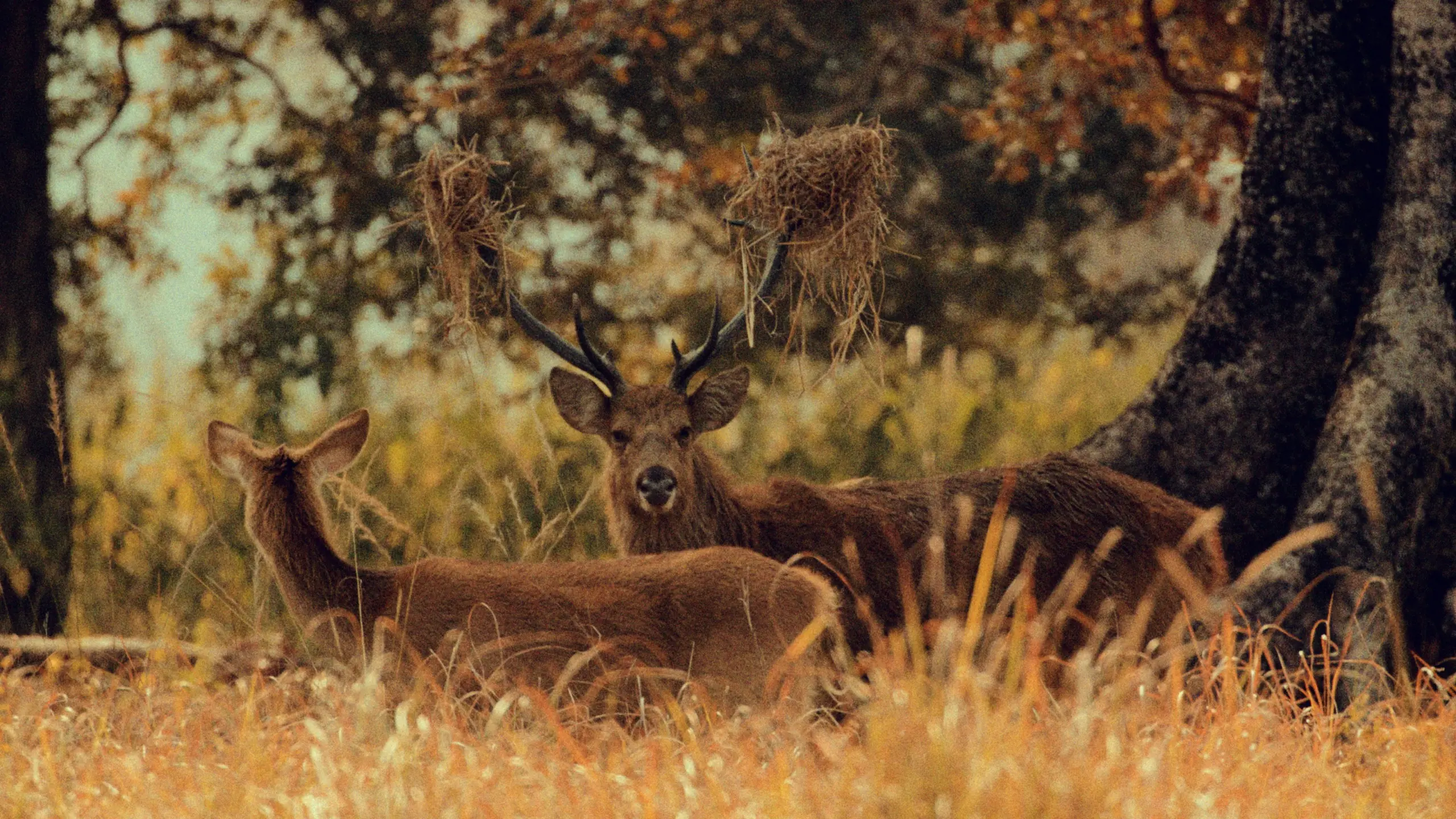
Talking about Barasingha, Ram mentioned how a male Barasingha decorates its antlers to attract females during the mating season. He also said how not many are aware that male spotted deer use scent glands to mark trees and bushes, a way they use to communicate to females that they are ready to mate.
“These things are so rare, but they often get overlooked in the race to sight just a tiger,” added Ram.
Learning to read the forest:
Wildlife filmmaker, conservationist and founder of Ameliya Safaris, Suyash Keshari, believes one of the most rewarding things a visitor can learn is how to understand the forest's alarm calls.
“A langur suddenly starts calling, a chital becomes completely alert, a sambar gives that unmistakable alarm call, and suddenly the entire forest changes,” he said, adding that the predator may not even be visible, yet the visitor is witnessing the forest communicating in real time.
Suyash remembers one particularly memorable boat safari in Satpura Tiger Reserve. There was no tiger, but the experience was filled with crocodiles basking on riverbanks, gaur coming down to drink, langurs and chital moving through the forest, and birds including ospreys, grey-headed fish eagles, river terns and painted storks.
“There was something incredibly peaceful about being on the water and experiencing the forest from a completely different perspective,” he further said.
That, he says, is what he loves about wildlife — “sometimes the most memorable safaris are the ones where you slow down enough to notice everything else that is happening around you.”
The animals tourists drive past:
According to Suyash, first-time visitors can become so focused on looking ahead for a tiger that “they miss what is happening around them — an Indian roller beside the vehicle, tiny birds in the bushes, a spider building its web, tracks on the road or langurs behaving differently”.
Naturalist Imran Khan, who works in Pench, has seen the same thing. He recalls taking guests on safaris for eight days without a tiger sighting. On one drive, they unexpectedly came across a wolf — an animal he says is rarely seen in the core area and is more commonly found towards the outer areas, buffer zones, and near human settlements.
He began explaining about the wolf, its behaviour, habitat, and other needs to the guests, which eventually grabbed their attention.
Ironically, when they eventually stopped chasing the tiger, they finally saw one.
“You have to look for the pug mark. If there is an alarm call, you have to tell them about it,” Khan says, adding that even tiger calls can offer clues about what is happening in the forest. A mother calling her cubs, for instance, may sound different depending on the circumstances.
Another safari offered him an even more unusual glimpse of animal behaviour. He and his guests came across a group of monkeys surrounding what appeared to be a dead infant. When a wild dog approached, the mother picked up the infant and the troop moved it into a tree.
“We were standing there for one to one-and-a-half hours,” he recalls. “It was quite interesting to see how the monkeys were behaving. At first they were snatching it, but when they saw the wild dog, they went on the tree. It’s very rare to see something like this.”
When a “rare” sighting isn't rare enough:
Namrata Bhandari, head naturalist at Taj Safaris' Baghvan in Pench, remembers a time when she was posted in Panna, around 2015, when tiger sightings were far less frequent.
That meant naturalists had to explore the reserve differently. She remembered her encounters with hyenas and honey badgers, along with the area's vultures, owls and other birds. Panna's boat safaris on the Ken River also offered a different perspective of the landscape.
She particularly remembered a honey badger sighting. For the naturalists, it was an extraordinary sighting. But the guests were more interested in finding a tiger.
“For us, we almost jumped out of the car. And they were like, can we just look for a tiger?” she recalled the episode.
Namrata believes the pressure (to sight a tiger) has increased with social media. She said that visitors sometimes arrive with photographs of particular tigers they want to see, even when those photographs may be years old.
“Everyone literally comes to the lodge, saying, "Humko toh yeh hi tiger dekhna (we want to see this tiger),” said Namrata. The result, she says, is that naturalists can find themselves trying to draw guests' attention towards rare birds, butterflies and other wildlife, only for the conversation to return to the tiger.
Seeing the forest beyond the tiger:
The fascination with tigers is understandable. They are charismatic, powerful and difficult to see in the wild. But the danger, as Suyash said, lies in allowing one sighting to determine whether an entire safari was successful. “A tiger reserve isn't a zoo with tigers as the main attraction. It is a living ecosystem,” he said.
“A tiger exists because there is prey, water, forest, grassland, rivers and hundreds of other species supporting that system. In that sense, what happens around a tiger can be as important as the tiger itself.”
Ram also recalled taking a foreign couple on 11 safaris in Bandhavgarh Tiger Reserve before they finally saw a tiger. “After the first two drives, the couple decided they did not want to spend their entire trip running after one.”
“Over the next several safaris, they saw a leopard with cubs, sloth bears with babies, rare birds, and even an Indian wolf, which is rare to see in Bandhavgarh. They also watched a male and female wolf preparing a den as the female was getting ready to give birth,” said Ram.
By the 11th safari, they finally saw a tiger. The sighting lasted nearly two hours, with the animal walking, spraying, and displaying different behaviours.
After ten drives spent observing the forest rather than simply searching for its most famous resident, they were perhaps better equipped to appreciate what they were seeing.
As Suyash said, “The tiger is just one character in a much larger story.” And perhaps that is what a first-time safari-goer needs to remember. A forest does not become silent because a tiger has not appeared. There are alarm calls, tracks, birds, predators, prey, insects, trees, and countless interactions unfolding around the vehicle.
The challenge is not always to find the tiger. Sometimes, it is to notice the forest before the tiger finds you.