Ten years after demonetisation: Did India's biggest currency gamble deliver?
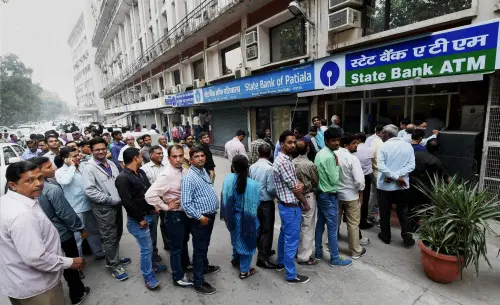
On the night of November 8, 2016, Prime Minister Narendra Modi announced that Rs 500 and Rs 1,000 currency notes would cease to be legal tender from midnight. The decision, which invalidated 86 per cent of the currency in circulation by value, sent millions of people scrambling to exchange or deposit their savings. Long queues formed outside banks and ATMs, businesses struggled to access cash, and daily-wage workers faced uncertainty over their earnings.
The government presented demonetisation as a decisive strike against black money, counterfeit currency and corruption. It was also projected as a way to curb terror financing and push India towards a less-cash economy. Over time, the emphasis shifted towards digital payments and formalisation of the economy.
Speaking with Mathrubhumi English, noted economists Jayati Ghosh, C P Chandrasekhar and Parakala Prabhakar revisit the decision and its consequences. Their assessments raise questions not only about the objectives that demonetisation achieved, but also about the economic disruption it caused, the limitations of the data used to assess its impact and the credibility of policymaking.
Black money: The first test
One of the principal arguments for demonetisation was that people holding unaccounted wealth in cash would be forced to surrender it or lose it. The return of almost the entire stock of invalidated currency became one of the clearest indicators of the limits of that expectation.
The RBI’s 2017-18 annual report recorded that Rs 15.31 lakh crore of the Rs 15.42 lakh crore in specified banknotes in circulation before demonetisation had returned to the banking system. Around 99.3 per cent of the withdrawn currency was accounted for.
How much of the invalidated currency came back
Item | Value |
| Specified banknotes (Rs 500 and Rs 1,000) in circulation before demonetisation | Rs 15.42 lakh crore |
| Returned to the banking system | Rs 15.31 lakh crore |
| Not returned (difference) | about Rs 0.11 lakh crore |
| Share returned | about 99.3% |
Source: RBI Annual Report 2017-18.
Chandrasekhar said the outcome contradicted the expectation that a substantial amount of black money would remain outside the banking system.
“At the end of it all, almost all of the money came back. This whole idea that most of the money wouldn’t come out and people would go around burning it or throwing it away so as not to be exposed to the state; that didn’t happen,” he said.
The return of the notes did not, by itself, establish that every rupee deposited was legitimate or that no tax investigations followed. But it significantly weakened the expectation that a large volume of undisclosed cash would be extinguished through the exercise.
Ghosh argued that the policy was based on a flawed understanding of where black money was held. She said unaccounted wealth was not confined to cash but was also routed through formal financial channels, including offshore tax havens, trusts and companies with opaque ownership structures.
“What is black money? It is money that is evading or avoiding tax. Now, most of that, 90 per cent or 95 per cent of that, happens through formal financial channels,” she said.
Ghosh said the government should have focused on identifying the beneficial owners of trusts and companies and cracking down on shadow companies and complex corporate arrangements.
“The very first thing we should do is abolish the possibility of having trusts or companies that don’t list the beneficial owners,” she said.
She argued that the focus on small cash holdings was misplaced when much larger structures could be used to conceal wealth. Comparing the approach to targeting minor offenders while allowing larger networks to operate, she said, “You’re claiming you’re killing a mosquito whereas actually what you’re doing is you’re allowing these huge big parasites to come and destroy everything, and you’re getting after a few flies here and there.”
Prabhakar made a similar argument, saying black money was generally held in assets rather than kept entirely in currency.
“Black money is not held in cash, as any person who knows Economics 101 would tell you. Black money is held in terms of gold, land, buildings and assets and things like that,” he said.
“Nobody, unless the bribe or the black money is generated a day or two before, holds it in cash. So demonetising currency does not affect the black money holding at all,” he added.
Chandrasekhar said tackling undisclosed wealth required sustained investigation, monitoring and penalties rather than a sudden withdrawal of currency.
“The only way you can tackle black money is to actually have a very strong investigation mechanism and very strong penalties,” he said.
He also questioned the consistency of the government’s approach to political funding, referring to the introduction of electoral bonds.
“Why would you actually say that I’m going to have electoral bonds in which I’m not going to question where the money comes from?” he asked.
The informal economy and its hidden cost
While the debate over black money centred on the currency that returned to banks, the economists said the disruption to cash-dependent businesses and workers was a more enduring consequence.
Ghosh described the decision as an economic disaster, pointing to the multiplier effect of lost incomes in the informal sector. When workers and small enterprises lose their earnings, she said, the impact extends beyond them to the businesses that depend on their spending.
“There is an impact on informal economic activity which is going to have very bad negative multiplier effects. When these incomes of informal workers, informal enterprises, etc., collapse, then the causes of demand collapse, and then it takes a very long time for the economy to recover... Eighty-five per cent of our workers are in informal enterprises. And most of them, more than half of them, are self-employed,” she said.
Small businesses that depended on cash were unable to function normally, while workers who relied on daily wages faced an immediate loss of income.
Many women, Ghosh said, saved small amounts from household expenses and kept the money aside for their children’s education or other basic needs. In households where men controlled spending, these savings could provide women with a measure of independence.
“They would pay for their children’s education or for some basic household things. They would keep cash which would be hidden from the head of the household,” she said. The invalidation of those savings forced some women to disclose money they had kept aside, sometimes leading to conflict and violence, she added.
“So, you know, there’s a very strong gender dimension,” Ghosh opined.
She argued that the damage continued after the initial cash shortage, with many enterprises failing to recover. The introduction of the Goods and Services Tax (GST) in July 2017, she said, added to the pressure on businesses already struggling after demonetisation.
“Many never got back. The rural economy remained depressed for a long time,” she said. “Again, with barely three months’ notice, GST was something that hit informal enterprises very badly.”
Chandrasekhar said the impact was particularly severe in cash-dependent activities. He argued that conventional national economic statistics were not designed to capture informal-sector activity adequately, making it difficult to assess the full extent of the disruption.
“What exactly it did do was essentially damage a whole area of the economy. There was substantial damage, particularly in the informal sector in Kerala, for example, in fisheries and so on. It damaged informal economic activity,” he opined.
He added the effects of demonetisation and the subsequent impact of GST were not adequately reflected in assessments of economic growth.
“National economic statistics are not designed to capture informal-sector activity,” he said.
Chandrasekhar also questioned claims that India had recorded high growth and a sharp reduction in poverty over the period, arguing that the evidence used to support such assessments did not adequately account for the informal economy. He cited the government’s rejection of a consumer expenditure survey conducted by its own National Sample Survey Organisation as an example of how evidence that could challenge official assessments had been handled.
“All of the assessments about how growth has been high in the last 10 years, India is the fastest-growing economy in the world, poverty has just collapsed and so on: all of that is completely challenged. The evidence to try and make those analyses doesn’t exist,” he said.
Prabhakar took the argument further, linking the disruption of small businesses to the way economic growth was estimated. He said small corner shops and family-owned businesses had lost ground to organised retailers and e-commerce platforms.
“See, the small corner shops and family-owned shops, they’ve collapsed. The market has shifted to formal organised shops like Reliance,” he said.
Prabhakar argued that when business moved from the informal to the organised sector, growth recorded by the latter could be used as a proxy for the former, creating a misleading picture of overall economic activity.
“What instead they’re doing is they are proxying the formal organised sector data onto informal unorganised sector data,” he said.
He explained that if small businesses were losing customers while organised retailers were gaining them, the growth of the organised sector could not automatically be treated as evidence that the informal sector was also expanding.
“When something is destroyed and the market shifts to some place, when there is a growth there, if you proxy that growth figure onto the destroyed sector also, then you get high GDP numbers very misleadingly,” he said.
Prabhakar described demonetisation as having dealt “a death blow to the informal sector”. He argued that the loss of small businesses and employment weakened incomes, production and demand.
“When growth and job opportunities are adversely affected, your productivity comes down, your production comes down. When your production comes down, your productivity comes down, people don’t have earnings. Then your economy gets weaker,” he said.
Digital payments and the return of cash
The move towards digital transactions became an increasingly prominent justification for demonetisation. But the growth of digital payments needs to be considered separately from the question of whether the note ban caused it.
UPI was launched by the National Payments Corporation of India in April 2016, several months before demonetisation. Its subsequent expansion has been substantial. The timing, however, does not establish that demonetisation was responsible for that growth.
UPI growth, volume and value by financial year
| Financial year | Transactions (crore) | Value (Rs lakh crore) | Value per transaction (approx.) |
| 2016-17 | 1.78 | 0.07 | Rs 3,900 |
| 2022-23 | 8,371.44 | 139.15 | Rs 1,660 |
| 2023-24 | 13,112.95 | 199.95 | Rs 1,525 |
| 2024-25 | 18,586.60 | 260.56 | Rs 1,400 |
| 2025-26 | 24,162 | 314.23 | Rs 1,300 |
Source: Ministry of Finance / NPCI figures, including a Lok Sabha reply
Ghosh argued that the shift towards digital payments was already underway and would have continued even without the withdrawal of high-denomination notes.
“Demonetisation has not changed the trend. The trend was already occurring for more groups, especially with UPI,” she said.
She also questioned the suggestion that demonetisation had permanently reduced India’s dependence on cash. Currency in circulation, she said, had not declined.
The RBI’s data offer a measure of that continued demand. Currency in circulation stood at Rs 41.66 lakh crore at the end of March 2026, up 11.9 per cent during the financial year. The figure does not, on its own, establish that demonetisation had no effect on cash usage, but it shows that the economy continues to rely heavily on physical currency.
Cash still large, e-rupee small (RBI Annual Report 2025-26)
| Indicator | End-March 2025 | End-March 2026 |
| Banknotes in circulation | Rs 36.86 lakh crore | Rs 41.23 lakh crore (about +11.8%) |
| Currency-to-GDP ratio | 11.7% | 12.1% |
| Rs 500 notes, value | Rs 31.72 lakh crore | Rs 35.27 lakh crore (85.5% of banknote value) |
₹ (retail CBDC) in circulation | Rs 1,016.5 crore | Rs 771.7 crore (about −24%) |
Source: RBI Annual Report 2025-26
Prabhakar questioned the use of transaction counts as evidence of the success of digital payments. He said a rise in the number of transactions did not necessarily mean a comparable increase in the total value of money being exchanged.
He cited RBI data to argue that 86 per cent of person-to-person UPI transactions were below Rs 500, with a large proportion of business-to-person payments also involving small amounts. The figure, he said, needed to be considered while assessing claims based on the growth in transaction numbers.
“The government is only showing the velocity of transactions, not the total volume of transactions,” he said.
He explained that the same amount of money could change hands several times, generating multiple transactions without increasing the total amount of money in circulation. His distinction is between the number of payments and the value of money involved. It does not mean that low-value digital payments have no economic benefit; rather, he argued that transaction counts alone do not provide a complete picture of the shift away from cash.
The political and institutional questions
The shifting explanations for demonetisation remain another point of criticism among the economists. Prabhakar said the government had not clearly spelt out a single objective for the exercise, with the emphasis moving from black money to digital transactions and counterfeit currency.
“We do not exactly know what the intended target was, because it kept on shifting… First it said that this is a strike against black money. Then it said it is to increase the digital currency. Then some kind of a narrative was brought in that a lot of fake notes were being circulated, which were printed in Pakistan. It went on and on and on. The government did not spell out what exactly the purpose behind demonetisation was,” he added.
Chandrasekhar said the exercise had failed to achieve the objectives cited by the government, including curbing counterfeiting and corruption. Counterfeiting, he noted, had not come to an end, as the RBI had also acknowledged.
Counterfeit Rs 500 notes detected in the banking system
| Year | Fake Rs 500 notes detected (pieces) |
| 2024-25 | 1,17,722 |
| 2025-26 | 1,41,907 (about +20.5%) |
Source: RBI Annual Report 2025-26
Ghosh said she could find no economic justification for demonetisation and argued that it had also served a political purpose. She alleged that the decision disadvantaged opposition parties ahead of the Uttar Pradesh Assembly election by disrupting their access to cash.
“From the economic point of view, there is absolutely no rationale. There is no economic justification I can find for it at all,” she said.
“However, now that we have the benefit of hindsight, we see that there was a political motive and that political goal was achieved, which is that they wanted to wipe out opposition parties before the UP elections. And they succeeded,” she added.
Ghosh further alleged that large withdrawals had been made from BJP accounts shortly before demonetisation, leaving other parties at a disadvantage. The allegation is her assessment of the political context and is not an independently established finding.
Chandrasekhar, meanwhile, reflected on how the scale of the announcement may have shaped public perceptions of the decision. He said people could assume that a government undertaking such a dramatic measure must have had a sound reason for doing so.
“The feeling was that we are in a world in which politics is constituted by promoting the irrational,” he said.
He argued that the scale of the decision itself could divert attention from the damage it caused and from more effective ways of addressing corruption.
“Instead of actually criticising the damage, it’s actually a kind of politics which tries to use irrationality as a way of diverting attention from what is the actual problem and what’s the best way to deal with those problems,” he said.
The legal verdict and the Rs 2,000 note
The political and economic debate also played out in the courts. In January 2023, the Supreme Court upheld the 2016 demonetisation decision by a 4:1 majority. Justice B V Nagarathna dissented, holding that the exercise should have been carried out through legislation rather than by notification.
The judgment settled the legal challenge to the process, but it was not an economic assessment of whether demonetisation achieved its objectives or whether its costs were justified. The distinction is important: the legality of a decision and its economic effectiveness are separate questions.
Another development came in May 2023, when the RBI announced the withdrawal of Rs 2,000 banknotes from circulation. The notes, introduced after the 2016 exercise to meet currency requirements, continued to remain legal tender. The RBI said the denomination had served its purpose and was not commonly used for transactions.
What could have been done differently?
The economists said tackling black money required measures directed at tax evasion, opaque ownership structures and corruption rather than a sudden withdrawal of currency.
Ghosh called for greater transparency in the ownership of trusts and companies, along with action against shadow companies and complex business arrangements that could conceal the people benefiting from them.
Chandrasekhar emphasised investigation, consistent monitoring and strong penalties, including scrutiny of political funding.
Prabhakar said the focus should have been on cracking down on corrupt practices and improving tax compliance. He also questioned the wisdom of a policy that, in his view, weakened public confidence in the currency.
Ghosh said that even if the objective had been to gradually phase out cash, the government could have announced a planned transition instead of invalidating notes overnight.
“You don’t do it all at once, by surprise, when nobody knows. Even the RBI governor doesn’t know. The printing machines are not doing replacement. You don’t do it that way. You do it gradually. You say, ‘Over the next six months, these notes will be phased out. You can go and change your notes for new notes in the bank,’” she added.
Prabhakar, meanwhile, questioned why the government no longer highlighted demonetisation as an achievement.
“If the government really believed that there were achievements, every year they would have got out on the rooftop and announced them… They don’t talk about it because, in fact, they avoid the topic because they know very well in their bones that it is an utter flop,” he added.