Sowcar Janaki: A face of cinema, a keeper of memories
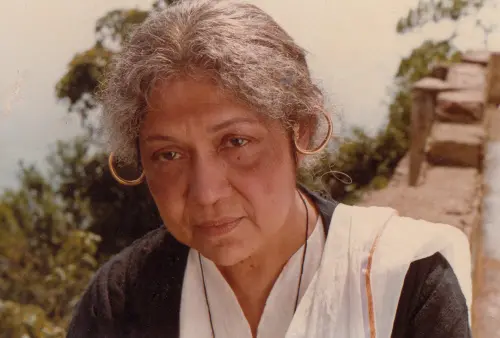
Some departures feel larger than the life they mark. The passing of Sowcar Janaki feels like one of them—a farewell not only to a remarkable actress, but to a world of cinema, women’s stardom and memory that is slowly disappearing.
There are certain faces in cinema that seem to belong not only to the films in which they appeared, but to an entire era. Sowcar Janaki was one of them.
Her passing feels like the quiet closing of a door into another time—a time when Tamil cinema’s women stars carried a distinctive elegance, emotional intensity and cultural presence. And for those who hold Jayalalithaa close in memory, Sowcar Janaki’s departure carries another, more intimate ache: the loss of one of the last living links to the world from which Jayalalithaa emerged.
Sowcar Janaki’s own journey through Indian cinema reads almost like a passage through its changing seasons. She entered the screen world with the Telugu film Shavukaru in 1950, the film that gave her the name by which generations would come to know her. What began there grew into an extraordinary career spanning more than seven decades and nearly 400 films across Telugu, Tamil, Kannada and Malayalam cinema.
She moved with remarkable ease from the leading roles of her early years to the deeply textured character performances of later generations. The stage and radio were also part of her artistic journey. Recognition followed across the decades, including the Kalaimamani and, in 2022, the Padma Shri.
Yet honours and numbers can only describe the scale of her career. They cannot quite capture the presence of Sowcar Janaki.
Sowcar Janaki had a cinematic language entirely her own. Her charm never depended on spectacle. It lived in the smallest movement of her eyes, the curve of a gesture, the pause before a line, the quiet authority with which she occupied a frame. She could make restraint powerful and silence eloquent.
Across generations, Sowcar Janaki moved between vulnerability and strength, tenderness and authority, without ever losing the individuality of her presence.
But for me, her passing touches something deeper.
I have always been an ardent admirer of Jayalalithaa—not simply as a political figure or a celebrated actress, but as a woman and an artist. Her intelligence, charisma, beauty, extraordinary screen presence and feminine power have long fascinated me. Yet what draws me most strongly to her artistic legacy is something more elusive: her romantic sensibility, her ability to embody glamour, longing, emotion and vulnerability without surrendering strength.
Perhaps because of this, I have always felt a particular emotional closeness to those who were deeply connected to Jayalalithaa’s life and artistic journey.
Sowcar Janaki was one of them.
In recent years, I had begun to look at Sowcar Janaki almost as a living fragment of Jayalalithaa’s memory—a precious link to a world that has otherwise largely vanished. Sowcar Janaki had known Jayalalithaa before the political phenomenon, before the mythology, before the immense public persona. Sowcar Janaki had known the woman before the legend.
Sowcar Janaki knew the young Jaya.
Sowcar Janaki recalled knowing her as Sandhya’s beautiful and brilliant daughter. When Sandhya went to work, young Jayalalithaa would sometimes be left at Sowcar Janaki’s home. Sowcar Janaki’s eldest daughter was about a year older than Jaya, and the two attended the same school.
In those memories, there is a glimpse of another Jayalalithaa: not the Chief Minister, not the political icon, not the figure who would eventually dominate Tamil Nadu’s public life, but the young girl who was still becoming herself.
Their paths later converged professionally. The two acted together in Oli Vilakku, the Tamil remake of Phool Aur Patthar, with Sowcar Janaki taking the role associated with Meena Kumari and Jayalalithaa playing Shashikala’s part.
But theirs was never merely a professional association.
Sowcar Janaki remembered a lunch at Jayalalithaa’s home where nearly 50 dishes had been prepared. Knowing Sowcar Janaki was a good cook, Jayalalithaa insisted that she taste the food and tell her what she liked. At an artistes’ gathering, they exchanged saris. Sowcar Janaki wrote to Jayalalithaa whenever she admired her work and recalled, with particular tenderness, that Jayalalithaa preserved those letters.
There had been differences between them during their years in cinema. Yet those differences did not erase the affection and respect that remained.
It is these small recollections that make their relationship feel so human.
History remembers Jayalalithaa as an actress, political leader and cultural icon. Sowcar Janaki’s memories remind us of the person beneath those monumental identities—a young woman who formed friendships, welcomed colleagues into her home, cared about food, treasured letters and carried relationships with her through the changing chapters of her life.
Sowcar Janaki was one of the people who knew that Jayalalithaa.
And when such a person disappears, we lose something that no archive can entirely preserve.
We lose a living memory.
There is another, less tangible thread that connects these two women for me: their romanticism.
Both possessed what I can only describe as an almost incurable romantic spirit—not romance merely as love or sentiment, but as a way of experiencing the world. A receptiveness to beauty, emotion, femininity, longing and the theatre of human life.
They belonged to a generation of actresses who demonstrated that femininity could be powerful without becoming hard, and that elegance could coexist with extraordinary strength.
For Malayali audiences, Sowcar Janaki occupies yet another cherished place in memory. Many will remember Sowcar Janaki with particular affection as Mammootty’s mother in the Malayalam classic Soorya Manasam. That performance brought Sowcar Janaki into the emotional landscape of Malayalam cinema and made her beloved far beyond Tamil Nadu.
It was another reminder that the artistry of Sowcar Janaki was never confined by language.
Sowcar Janaki crossed linguistic boundaries with the same ease with which she crossed generations. Her artistry travelled. Her characters travelled. Her emotional presence travelled.
And perhaps that is why her passing feels larger than the loss of one actress.
Something of a certain kind of cinema seems to be disappearing with Sowcar Janaki—the elegance of an earlier generation, the patience to allow performance to breathe, the power of a woman’s presence without the need to announce it, the emotional richness and unapologetic romanticism of a time when screen icons could become part of the cultural imagination for generations.
For those who admired Jayalalithaa, Sowcar Janaki’s departure carries an added poignancy. Sowcar Janaki was among the few remaining living bridges to a world that now survives mostly through films, photographs, letters and memories.
A world in which Jayalalithaa was still simply Jaya.
A world in which cinema’s great women were not only stars, but witnesses to one another’s lives.
And perhaps that is why Sowcar Janaki’s passing feels like the disappearance of more than one life.
It feels like another light going out in the corridor of memory.
An era does not always end with a dramatic farewell.
Sometimes, it fades quietly—one familiar face at a time.
With Sowcar Janaki, another such face has disappeared.
And with her goes a little more of the world that gave us memories of the extraordinary women of Tamil cinema—and of a golden age of Indian screen artistry that can never quite return.